


Care Disclaimer: Plant care recommendations are general guidelines based on common growing conditions. Individual results may vary based on your local environment, climate, and care routine. If your plant is toxic, keep it away from children and pets, and consult a veterinarian if accidental ingestion occurs.
1.Orchid Masdevallia — Overview
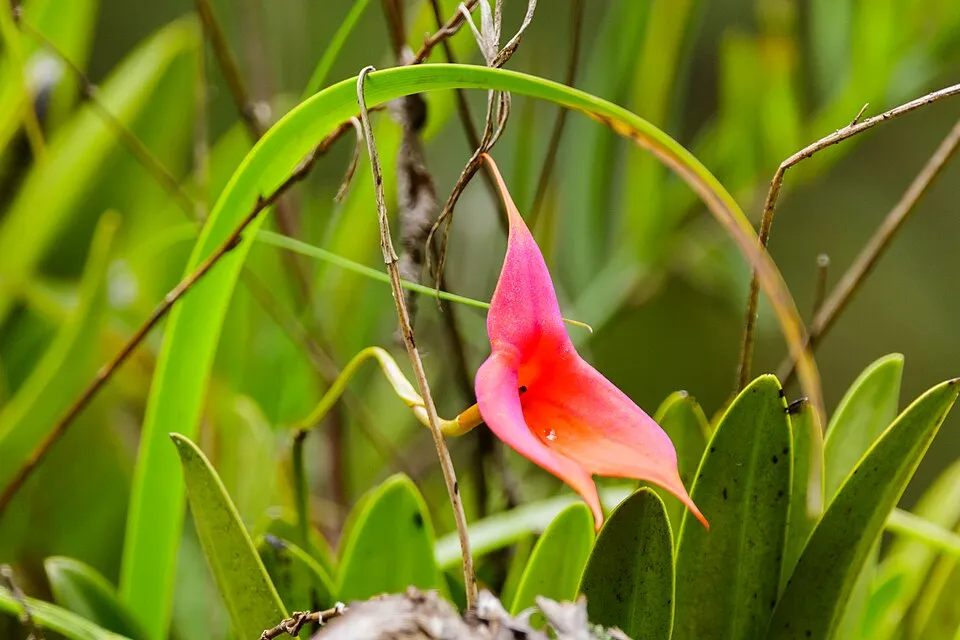
Masdevallia veitchiana, commonly known as the Orchid Masdevallia or King of the Masdevallias, is a truly magnificent epiphytic orchid species within the extensive Orchidaceae family. This captivating plant is indigenous solely to the high-altitude cloud forests of Peru, thriving in the cool, perpetually moist conditions of the Andes Mountains at elevations ranging from approximately 1,500 to 3,000 meters above sea level.
This specific environment, characterized by consistent fog and high humidity, is crucial for its distinct morphology and ecological niche.
Unlike many orchids, Masdevallia veitchiana does not possess pseudobulbs for water storage, instead relying on its robust, fleshy, dark green, lanceolate leaves that can reach up to 20 centimeters in length and exhibit a characteristic glossy finish. These leaves are adept at efficient light capture in its shaded understory habitat.
Its fibrous root system is perfectly adapted for clinging to tree bark or rocks, absorbing atmospheric moisture and nutrients from accumulated detritus. The plant typically attains a modest height of 30 to 45 centimeters.
The most striking feature is its vibrant inflorescence, producing solitary, long-lasting flowers that emerge from the leaf axils on slender, upright stems. These spectacular blooms can measure up to 10 centimeters across, renowned for their brilliant coloration.
They predominantly display a vivid orange-red to fiery scarlet base color, often intricately adorned with velvety dark reddish-brown to purple hairs or markings, particularly towards the elongated sepal tails. The sepals are fused at the base, forming a tubular structure that gracefully flares out, culminating in these distinctive, often recurved tails, which are thought to play a role in pollinator attraction and contribute significantly to its unique aesthetic appeal.
Trusted Scientific References
1. Authoritative external sources for Masdevallia veitchiana
1.1 Wikipedia — Masdevallia veitchiana
1.2 Kew POWO (Plants of the World Online)
1.3 PubMed — peer-reviewed research
1.4 NCBI Taxonomy Browser
1.5 GBIF — Global Biodiversity
1.1.Orchid Masdevallia — Key Features
- ✓ <strong>Epiphytic Growth Habit</strong> — Thrives on trees or rocks in its native habitat, not rooted in soil.
- ✓ <strong>Endemic to Peruvian Andes</strong> — Found exclusively in the high-altitude cloud forests of Peru.
- ✓ <strong>Striking Inflorescence</strong> — Produces solitary, long-lasting flowers with brilliant orange-red to scarlet coloration.
- ✓ <strong>Distinctive Sepal Tails</strong> — Characterized by elongated, often recurved sepal tails on its blooms.
- ✓ <strong>Absence of Pseudobulbs</strong> — Unique among many orchids, it stores water in its fleshy leaves.
- ✓ <strong>Requires Cool, Moist Conditions</strong> — Prefers consistent humidity and cool temperatures for optimal growth.
- ✓ <strong>Modest Plant Size</strong> — Typically grows to a height of 30 to 45 centimeters.
- ✓ <strong>Lanceolate, Glossy Leaves</strong> — Features dark green, slender leaves up to 20 cm long.
- ✓ <strong>High Ornamental Value</strong> — Highly sought after by orchid collectors and horticulturists for its beauty.
- ✓ <strong>Undocumented Medicinal Use</strong> — Primarily valued for its botanical and aesthetic qualities, with no established therapeutic applications.
1.2.Orchid Masdevallia — Quick Summary
- ✓ Masdevallia veitchiana is an exquisite epiphytic orchid, endemic to the high-altitude cloud forests of Peru.
- ✓ Renowned for its vibrant orange-red to scarlet flowers with intricate markings and distinctive elongated sepal tails.
- ✓ Lacks pseudobulbs, relying on fleshy leaves for moisture storage, requiring consistent humidity and moisture.
- ✓ Primarily cultivated as an ornamental species, highly prized for its unique beauty in specialized collections.
- ✓ Medicinal uses are largely undocumented; its phytochemistry and therapeutic applications require extensive research.
- ✓ Thrives in cool, moist, high-humidity conditions, mimicking its native Andean cloud forest habitat.
2.Orchid Masdevallia — Scientific Identity
3.Orchid Masdevallia — Quick Facts
4.Orchid Masdevallia — Appearance & Identification
5.Orchid Masdevallia — Native Habitat
6.Orchid Masdevallia — Water Requirements
- ✓ Light Requirements — Provide moderate to bright indirect light; about 1-3 hours of direct morning or late afternoon sun is ideal, or 10,750-21,500 lumens in a greenhouse setting.
- ✓ Temperature Control — Maintain a consistent cool to intermediate temperature range of 12.7-22.2°C (55-72°F), with tolerance up to 29.4°C (85°F) if nights are cooler.
- ✓ Watering Regimen — Due to the absence of pseudobulbs, Masdevallia veitchiana requires constant moisture; the potting mix should remain perpetually moist, never allowing it to dry out completely.
- ✓ Humidity Management — High humidity levels of 60-90% are crucial, mimicking its cloud forest habitat; ensure good air circulation to prevent fungal issues.
- ✓ Fertilization Schedule — Fertilize regularly during active growth, which can be year-round for these equatorial plants, using a 1/2 to 1/4 strength balanced fertilizer (e.g., 10-10-10).
- ✓ Potting Medium — Best grown mounted on cork or tree fern with sphagnum moss, or in plastic pots using a fine, free-draining mix of tree fern fiber, sphagnum, or fine orchid bark.
- ✓ Repotting Timing — Repot when new root growth commences, typically in spring, but can be done any time of year for perpetually growing plants, avoiding periods of active spiking.
- ✓ Water Quality — Use rainwater or distilled water, as Masdevallia species are sensitive to salts and dissolved solids, which can cause black tips on leaves.
Reviewed by the Flora Medical Global Botanical Review Panel
Multi-disciplinary editorial group · Botany · Ethnobotany · Herbal-medicine literature
Who reviewed this: This page was checked by the Flora Medical Global Botanical Review Panel — an in-house editorial group of botany graduates, ethnobotany researchers, and horticulture practitioners who collectively maintain our 7,000+ plant encyclopedia. Meet the team.
Our 4-step verification process
1. Taxonomic verification
Scientific names and synonyms cross-checked against Kew POWO, World Flora Online, and The Plant List.
2. Phytochemical & medicinal cross-reference
Active compounds, traditional uses, and reported activities are cross-referenced with PubMed, USDA Dr. Duke's database, and peer-reviewed ethnobotanical literature.
3. Conservation & distribution check
Distribution, ecology, and conservation status confirmed against GBIF occurrence records and the IUCN Red List.
4. Editorial & safety review
Every entry passes an editorial pass for clarity, originality, and safety notices (toxicity, contraindications, dosage caveats) before publication.
Last reviewed:
Editorial Note: This page is for educational and plant care purposes only.
Written by: Flora Medical Global Editorial Team
Reviewed by: Flora Medical Global Botanical Review Panel
Last Updated: June 15, 2026







Orchid Masdevallia — Comments & Community Reviews
Rate this plant