

Care Disclaimer: Plant care recommendations are general guidelines based on common growing conditions. Individual results may vary based on your local environment, climate, and care routine. If your plant is toxic, keep it away from children and pets, and consult a veterinarian if accidental ingestion occurs.
1.Orchid Maxillaria — Overview
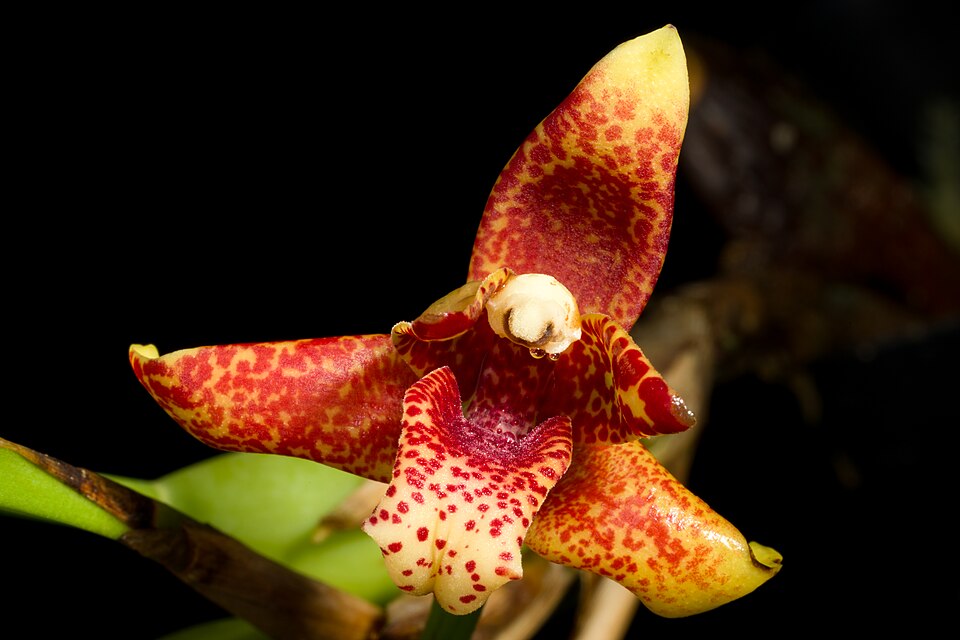
Maxillaria tenuifolia, commonly known as the Coconut Orchid or Orchid Maxillaria, is a distinct epiphytic perennial belonging to the extensive Orchidaceae family. Native to the humid tropical rainforests of Central America, specifically regions spanning Mexico, Guatemala, Honduras, Nicaragua, and Costa Rica, it thrives on tree branches and in natural hollows. Its robust, fleshy roots serve to anchor the plant and efficiently absorb moisture and nutrients from the air and organic debris.
The plant features ovoid to subglobose pseudobulbs that support narrow, linear, glossy green leaves, typically measuring 10 to 30 cm in length. Maxillaria tenuifolia is particularly celebrated for its uniquely fragrant flowers, which emit a strong, delightful scent reminiscent of coconut, giving rise to its popular common name. These captivating blooms usually appear from spring to early summer, often between March and April, showcasing vibrant yellow to orange hues, frequently adorned with dark red spots or markings on the labellum and petals.
The flowers are relatively modest in size, typically 2-3 cm across, emerging singly from the base of the pseudobulbs. Its upright growth habit and dense, attractive foliage make it a highly favored ornamental plant, well-adapted to indoor cultivation where it can reach heights of 30-60 cm. Taxonomically, the Maxillaria genus encompasses over 200 species, many of which are prized for their distinctive floral characteristics and adaptability to various environments.
Trusted Scientific References
1. Authoritative external sources for Maxillaria tenuifolia
1.1 Wikipedia — Maxillaria tenuifolia
1.2 Kew POWO (Plants of the World Online)
1.3 PubMed — peer-reviewed research
1.4 NCBI Taxonomy Browser
1.5 GBIF — Global Biodiversity
1.6Orchid Maxillaria should be interpreted through verified botanical identity, practical care, and responsible safety language. This recovery note adds the missing context needed for a complete profile: match light to the plant's habit, use well-drained soil, water according to season, and avoid unsupported medicinal or edible claims. For publishing, the plant can be presented as a source-backed indoor plant with clear care guidance, common problem diagnosis, and conservative safety wording.
1.1.Orchid Maxillaria — Key Features
- ✓ <strong>Distinct Coconut Fragrance</strong> — Emits a strong, pleasant aroma reminiscent of coconut, particularly during bloom.
- ✓ <strong>Epiphytic Growth Habit</strong> — Naturally grows on other plants (trees) without being parasitic, absorbing nutrients from the air and organic debris.
- ✓ <strong>Vibrant, Spotted Flowers</strong> — Produces striking yellow to orange flowers often adorned with dark red spots or markings.
- ✓ <strong>Adaptable Indoor Plant</strong> — Relatively easy to care for indoors, making it suitable for both beginner and experienced orchid enthusiasts.
- ✓ <strong>Pseudobulb Water Storage</strong> — Possesses plump pseudobulbs that store water, allowing it to tolerate brief periods of drought.
- ✓ <strong>Central American Native</strong> — Indigenous to the humid tropical rainforests of Mexico and Central America.
- ✓ <strong>Glossy Green Foliage</strong> — Features narrow, linear, rich, glossy green leaves that add to its ornamental value.
- ✓ <strong>Spring to Early Summer Bloom</strong> — Flowers typically appear from March to April, lasting for about 7-10 days.
- ✓ <strong>Low Pest Susceptibility</strong> — Generally resistant to common houseplant pests, contributing to its ease of care.
1.2.Orchid Maxillaria — Quick Summary
- ✓ Fragrant tropical orchid known for its strong coconut scent.
- ✓ Primarily cultivated as an ornamental houseplant.
- ✓ Traditional medicinal uses are largely anecdotal and unverified.
- ✓ Requires bright indirect light, high humidity, and specific temperature cycles for optimal growth and blooming.
- ✓ Not recommended for internal consumption due to lack of scientific safety data.
- ✓ Valued for its aesthetic appeal and unique aromatic profile.
2.Orchid Maxillaria — Scientific Identity
3.Orchid Maxillaria — Quick Facts
4.Orchid Maxillaria — Appearance & Identification
5.Orchid Maxillaria — Native Habitat
6.Orchid Maxillaria — Water Requirements
- ✓ Light — Provide bright, indirect light with some occasional direct sun; insufficient light leads to leggy foliage and poor blooming.
- ✓ Potting Medium — Use a well-draining, soilless orchid mix such as fir bark, coco coir, sphagnum moss, or gravel; it can also be mounted.
- ✓ Watering — Allow the potting medium to dry completely or nearly completely between waterings, then water thoroughly with distilled or rainwater to prevent mineral buildup.
- ✓ Temperature — Maintain warm daytime temperatures (28-29°C summer, 23-24°C winter) and cooler nighttime temperatures (19°C summer, 13-15°C winter) to encourage blooming.
- ✓ Humidity — Requires high humidity, ideally 70-80%, achievable with a humidifier or indoor greenhouse.
- ✓ Fertilization — Fertilize every 1-2 weeks from early spring to late fall with a half-strength balanced orchid fertilizer; cease fertilization in winter.
- ✓ Repotting — Repot every 1-2 years in spring after blooming to refresh the medium and provide adequate space.
- ✓ Propagation — Easily propagated by division of mature plants with several rhizomes, ideally in spring or summer after flowering.
Reviewed by the Flora Medical Global Botanical Review Panel
Multi-disciplinary editorial group · Botany · Ethnobotany · Herbal-medicine literature
Who reviewed this: This page was checked by the Flora Medical Global Botanical Review Panel — an in-house editorial group of botany graduates, ethnobotany researchers, and horticulture practitioners who collectively maintain our 7,000+ plant encyclopedia. Meet the team.
Our 4-step verification process
1. Taxonomic verification
Scientific names and synonyms cross-checked against Kew POWO, World Flora Online, and The Plant List.
2. Phytochemical & medicinal cross-reference
Active compounds, traditional uses, and reported activities are cross-referenced with PubMed, USDA Dr. Duke's database, and peer-reviewed ethnobotanical literature.
3. Conservation & distribution check
Distribution, ecology, and conservation status confirmed against GBIF occurrence records and the IUCN Red List.
4. Editorial & safety review
Every entry passes an editorial pass for clarity, originality, and safety notices (toxicity, contraindications, dosage caveats) before publication.
Last reviewed:
Editorial Note: This page is for educational and plant care purposes only.
Written by: Flora Medical Global Editorial Team
Reviewed by: Flora Medical Global Botanical Review Panel
Last Updated: June 15, 2026







Orchid Maxillaria — Comments & Community Reviews
Rate this plant