
Care Disclaimer: Plant care recommendations are general guidelines based on common growing conditions. Individual results may vary based on your local environment, climate, and care routine. If your plant is toxic, keep it away from children and pets, and consult a veterinarian if accidental ingestion occurs.
1.Orchid Miltonia — Overview
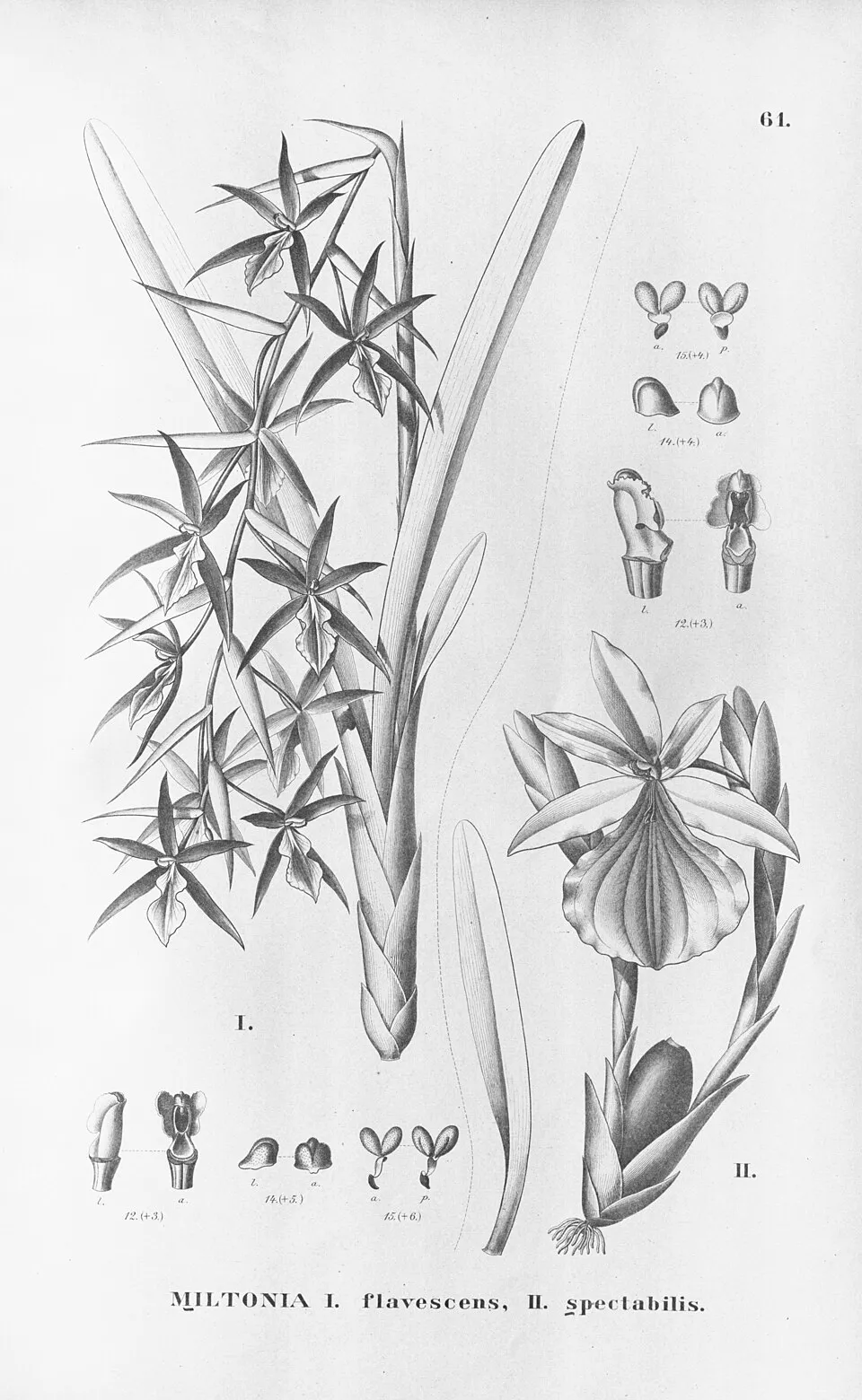
Miltonia spectabilis, affectionately known as the Miltonia Orchid or Pansy Orchid, is an exquisite member of the expansive Orchidaceae family, celebrated for its striking blossoms. This epiphytic species typically reaches a modest height of 30 to 60 centimeters, showcasing thick, strap-like leaves that can extend up to 30 centimeters in length, emerging from a sympodial growth habit. The plant is characterized by its smooth, water-storing pseudobulbs and thin, feathery roots, perfectly adapted to its natural epiphytic existence.
Its most captivating feature is undoubtedly its elegant flowers, which can measure up to 10 centimeters across. These delicate blooms present a stunning palette, predominantly in shades of white and lavender, often adorned with distinctive purple markings that enhance their allure. Each flower possesses a unique structure, featuring a prominent, often wavy, round labellum and a contrasting throat.
Native to the humid montane forests of Brazil, Miltonia spectabilis thrives at elevations ranging from 800 to 2,700 meters, where it naturally enjoys filtered sunlight. Taxonomically, it falls within the subfamily Epidendroideae, and its remarkable aesthetic appeal makes it a highly sought-after plant for both novice and experienced plant enthusiasts, adding a touch of tropical elegance to any indoor setting.
Trusted Scientific References
1. Authoritative external sources for Miltonia spectabilis
1.1 Wikipedia — Miltonia spectabilis
1.2 Kew POWO (Plants of the World Online)
1.3 PubMed — peer-reviewed research
1.4 NCBI Taxonomy Browser
1.5 GBIF — Global Biodiversity
1.6Orchid Miltonia should be interpreted through verified botanical identity, practical care, and responsible safety language. This recovery note adds the missing context needed for a complete profile: match light to the plant's habit, use well-drained soil, water according to season, and avoid unsupported medicinal or edible claims. For publishing, the plant can be presented as a source-backed indoor plant with clear care guidance, common problem diagnosis, and conservative safety wording.
1.1.Orchid Miltonia — Key Features
- ✓ <strong>Captivating white and</strong> — Captivating white and lavender flowers with distinctive purple markings.
- ✓ <strong>Elegant blooms reaching</strong> — Elegant blooms reaching up to 10 centimeters across with a prominent, wavy labellum.
- ✓ <strong>Thick, strap</strong> — like leaves growing up to 30 centimeters in length.
- ✓ <strong>Epiphytic growth habit</strong> — Epiphytic growth habit with thin, feathery roots adapted for aerial attachment.
- ✓ <strong>Presence of smooth</strong> — Presence of smooth pseudobulbs for efficient water and nutrient storage.
- ✓ <strong>Native distribution in</strong> — Native distribution in the humid montane forests of Brazil.
- ✓ <strong>Requires filtered sunlight</strong> — Requires filtered sunlight and consistently high humidity (70%+) for thriving.
- ✓ <strong>Considered relatively easier</strong> — Considered relatively easier to care for compared to some other orchid species.
- ✓ <strong>Often associated with</strong> — Often associated with symbols of luxury, beauty, and refined taste.
- ✓ <strong>Known for its</strong> — Known for its ability to create a serene and aesthetically pleasing indoor ambiance.
1.2.Orchid Miltonia — Quick Summary
- ✓ Miltonia spectabilis is a captivating Brazilian orchid known for its elegant, colorful flowers.
- ✓ Primarily valued for its ornamental beauty and indirect psychological and environmental wellness benefits.
- ✓ Thrives in warm, humid, shaded conditions, requiring specific care for optimal health.
- ✓ Generally considered non-toxic to humans and pets, making it safe for most indoor settings.
- ✓ Contributes to stress reduction, mood enhancement, and improved indoor aesthetics.
- ✓ Care involves precise light, water, humidity, and potting medium management.
2.Orchid Miltonia — Scientific Identity
3.Orchid Miltonia — Quick Facts
4.Orchid Miltonia — Appearance & Identification
5.Orchid Miltonia — Native Habitat
6.Orchid Miltonia — Water Requirements
- ✓ Light — Provide relatively shaded conditions, avoiding direct sunlight which can easily scorch the thin leaves; Miltonia spectabilis requires approximately 21,500 lumens (2,000 foot-candles) for optimal growth.
- ✓ Temperature — Thrives in warmer environments, tolerating temperatures over 32°C (90°F) provided high humidity levels (70-75% or higher) are maintained; the minimum acceptable temperature is 16°C (60°F).
- ✓ Watering — Requires abundant water, ensuring the potting medium drains perfectly; allow the plant to approach dryness between waterings and flush the medium every 4-5 waterings to prevent salt accumulation.
- ✓ Humidity — Maintain high humidity, at least 70%, to support the plant’s significant water needs and prevent leaf pleating; however, avoid excessive humidity without adequate air circulation.
- ✓ Fertilization — Apply a half-strength, balanced fertilizer every two weeks during active growth, reducing the frequency in winter or during overcast periods; a 10-30-20 blossom-booster is beneficial in early spring.
- ✓ Potting — Repotting is best done after flowering as new growth emerges; Miltonia spectabilis prefers shallow pans or mounting on cork or tree fern, using a fine-rooted mix like seedling bark with charcoal and perlite, or tree fern and chopped sphagnum.
- ✓ Air Circulation — Essential to prevent fungal diseases, especially in high-humidity environments; ensure good airflow around the plant to promote healthy growth.
Reviewed by the Flora Medical Global Botanical Review Panel
Multi-disciplinary editorial group · Botany · Ethnobotany · Herbal-medicine literature
Who reviewed this: This page was checked by the Flora Medical Global Botanical Review Panel — an in-house editorial group of botany graduates, ethnobotany researchers, and horticulture practitioners who collectively maintain our 7,000+ plant encyclopedia. Meet the team.
Our 4-step verification process
1. Taxonomic verification
Scientific names and synonyms cross-checked against Kew POWO, World Flora Online, and The Plant List.
2. Phytochemical & medicinal cross-reference
Active compounds, traditional uses, and reported activities are cross-referenced with PubMed, USDA Dr. Duke's database, and peer-reviewed ethnobotanical literature.
3. Conservation & distribution check
Distribution, ecology, and conservation status confirmed against GBIF occurrence records and the IUCN Red List.
4. Editorial & safety review
Every entry passes an editorial pass for clarity, originality, and safety notices (toxicity, contraindications, dosage caveats) before publication.
Last reviewed:
Editorial Note: This page is for educational and plant care purposes only.
Written by: Flora Medical Global Editorial Team
Reviewed by: Flora Medical Global Botanical Review Panel
Last Updated: June 15, 2026







Orchid Miltonia — Comments & Community Reviews
Rate this plant