

Care Disclaimer: Plant care recommendations are general guidelines based on common growing conditions. Individual results may vary based on your local environment, climate, and care routine. If your plant is toxic, keep it away from children and pets, and consult a veterinarian if accidental ingestion occurs.
1.Ornithogalum Caudatum — Overview
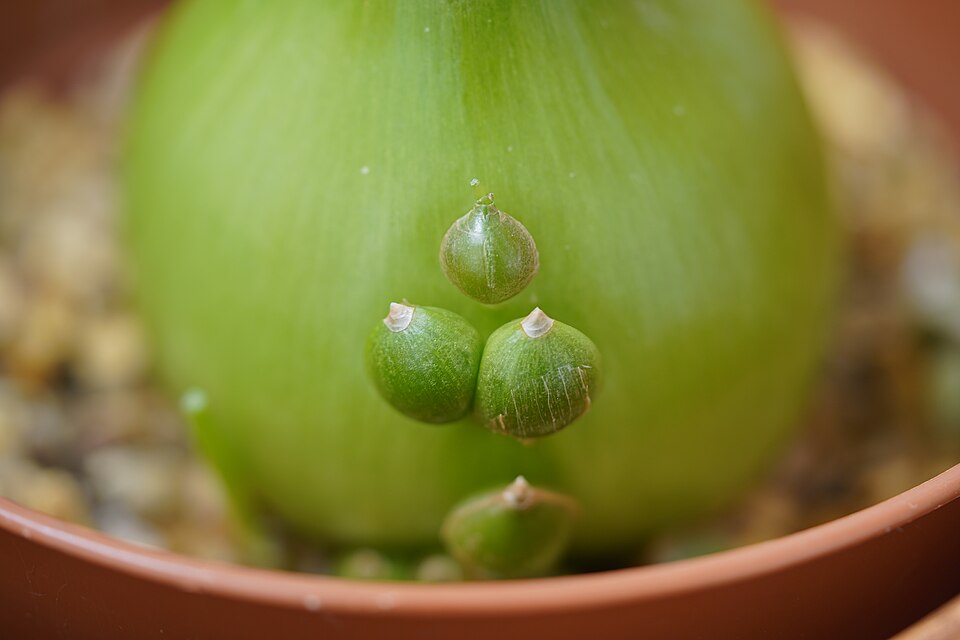
Ornithogalum caudatum, commonly known as the Pregnant Onion or Sea Onion, is a distinctive bulbous perennial belonging to the Asparagaceae family, native to the arid and semi-arid regions of South Africa. This unique plant is characterized by its prominent, often green-tinged bulb, which can reach up to 10 cm (4 inches) in diameter. A remarkable feature is its prolific production of miniature bulblets directly on the surface of the mother bulb, giving it the appearance of being 'pregnant'.
From the bulb emerge long, strap-like leaves, typically 30 to 40 cm (12 to 16 inches) in length and 1 to 2 cm (0.4 to 0.8 inches) wide, displaying a glossy, deep green hue with subtly wavy margins. During its flowering season, usually in spring or summer, Ornithogalum caudatum sends up a tall, slender flower stalk, or peduncle, that can extend 45 to 60 cm (18 to 24 inches) high. This stalk is adorned with numerous small, star-shaped white flowers, each possessing six tepals that are often marked by a delicate green stripe down their midrib.
The plant thrives in well-drained soils and is well-adapted to Mediterranean climates, making it a popular ornamental succulent in indoor collections globally due to its unusual morphology and ease of care.
Trusted Scientific References
1. Authoritative external sources for Ornithogalum caudatum
1.1 Wikipedia — Ornithogalum caudatum
1.2 Kew POWO (Plants of the World Online)
1.3 PubMed — peer-reviewed research
1.4 NCBI Taxonomy Browser
1.5 GBIF — Global Biodiversity
1.6Ornithogalum Caudatum should be interpreted through verified botanical identity, practical care, and responsible safety language. This recovery note adds the missing context needed for a complete profile: match light to the plant's habit, use well-drained soil, water according to season, and avoid unsupported medicinal or edible claims. For publishing, the plant can be presented as a source-backed indoor plant with clear care guidance, common problem diagnosis, and conservative safety wording.
1.1.Ornithogalum Caudatum — Key Features
- ✓ <strong>Distinctive large bulb</strong> — Distinctive large bulb producing numerous small bulblets, resembling a 'pregnant' belly.
- ✓ <strong>Long, strap</strong> — like, glossy green leaves with wavy margins.
- ✓ <strong>Tall flower stalk bearing many small, star</strong> — shaped white flowers, often with green midribs.
- ✓ <strong>Native to South Africa, adapted to dry, well</strong> — drained conditions.
- ✓ <strong>Traditionally utilized topically</strong> — Traditionally utilized topically for its purported wound healing and anti-inflammatory properties.
- ✓ <strong>Contains potent cardiac</strong> — Contains potent cardiac glycosides (bufadienolides) making all parts highly toxic if ingested.
- ✓ <strong>Popular as an</strong> — Popular as an ornamental houseplant due to its unique appearance and ease of propagation.
- ✓ <strong>Belongs to the</strong> — Belongs to the Asparagaceae family, which includes other bulbous ornamentals.
- ✓ <strong>Requires bright, direct</strong> — Requires bright, direct sunlight and excellent drainage for optimal growth.
- ✓ <strong>Known for its</strong> — Known for its resilience and ability to thrive with minimal care, provided toxicity warnings are heeded.
1.2.Ornithogalum Caudatum — Quick Summary
- ✓ Ornithogalum caudatum, or Pregnant Onion, is a unique South African bulbous perennial.
- ✓ Known for its 'pregnant' bulb with numerous bulblets and star-shaped white flowers.
- ✓ Traditionally used topically for wound healing, inflammation, and skin irritations.
- ✓ Contains highly toxic cardiac glycosides, especially bufadienolides, making it dangerous if ingested.
- ✓ STRICTLY for external use only; internal consumption is severely contraindicated and potentially fatal.
- ✓ Requires bright light and well-drained soil for cultivation as an ornamental plant.
2.Ornithogalum Caudatum — Scientific Identity
3.Ornithogalum Caudatum — Quick Facts
4.Ornithogalum Caudatum — Appearance & Identification
5.Ornithogalum Caudatum — Native Habitat
6.Ornithogalum Caudatum — Water Requirements
- ✓ Soil Requirements — Prefers highly well-drained soil; a mix of potting soil, perlite, and sand or grit works best to prevent waterlogging and root rot.
- ✓ Light Exposure — Thrives in abundant, bright, and direct sunlight; place it within one foot of a south-facing window or in a sunny outdoor spot.
- ✓ Watering Schedule — Water thoroughly when the soil is completely dry to the touch, typically every 7-9 days, allowing for complete drainage to avoid overwatering.
- ✓ Temperature and Humidity — Best suited for average room temperatures (18-24°C / 65-75°F) and moderate humidity; protect from frost and extreme cold.
- ✓ Fertilization and Repotting — Repot annually or when the bulb doubles in size, using fresh potting mix, which generally provides sufficient nutrients without additional fertilizer.
- ✓ Propagation — Easily propagated by carefully detaching the numerous small bulblets that form around the base of the main bulb and planting them in well-drained soil.
- ✓ Hardiness Zones — Can be grown outdoors as a perennial in USDA Hardiness Zones 9a-11b, provided it has excellent drainage and protection during colder periods.
Reviewed by the Flora Medical Global Botanical Review Panel
Multi-disciplinary editorial group · Botany · Ethnobotany · Herbal-medicine literature
Who reviewed this: This page was checked by the Flora Medical Global Botanical Review Panel — an in-house editorial group of botany graduates, ethnobotany researchers, and horticulture practitioners who collectively maintain our 7,000+ plant encyclopedia. Meet the team.
Our 4-step verification process
1. Taxonomic verification
Scientific names and synonyms cross-checked against Kew POWO, World Flora Online, and The Plant List.
2. Phytochemical & medicinal cross-reference
Active compounds, traditional uses, and reported activities are cross-referenced with PubMed, USDA Dr. Duke's database, and peer-reviewed ethnobotanical literature.
3. Conservation & distribution check
Distribution, ecology, and conservation status confirmed against GBIF occurrence records and the IUCN Red List.
4. Editorial & safety review
Every entry passes an editorial pass for clarity, originality, and safety notices (toxicity, contraindications, dosage caveats) before publication.
Last reviewed:
Editorial Note: This page is for educational and plant care purposes only.
Written by: Flora Medical Global Editorial Team
Reviewed by: Flora Medical Global Botanical Review Panel
Last Updated: June 15, 2026







Ornithogalum Caudatum — Comments & Community Reviews
Rate this plant