

Care Disclaimer: Plant care recommendations are general guidelines based on common growing conditions. Individual results may vary based on your local environment, climate, and care routine. If your plant is toxic, keep it away from children and pets, and consult a veterinarian if accidental ingestion occurs.
1.Oxalis Iron Cross — Overview
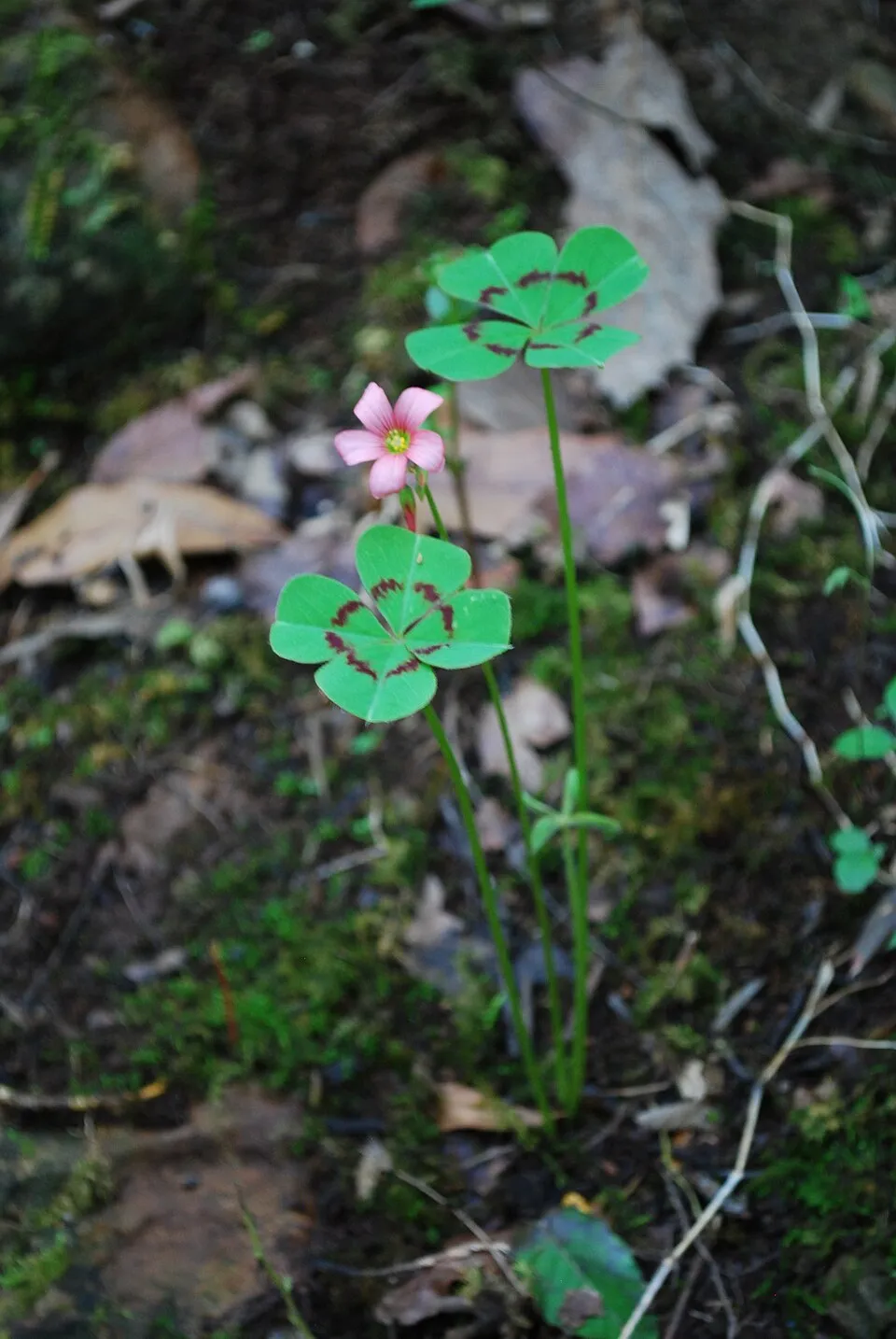
Oxalis tetraphylla, commonly known as Oxalis Iron Cross, is a captivating perennial herbaceous plant belonging to the diverse Oxalidaceae family. This species is highly valued for its distinctive ornamental foliage and delicate floral displays. It typically grows to a modest height of 12 to 18 inches (30 to 45 cm) with a similar spread, forming an attractive clump ideal for both indoor cultivation and shaded garden spots. The most striking morphological feature of Oxalis Iron Cross is its compound leaves, palmately divided into four leaflets.
These leaflets are symmetrically arranged, creating a cruciform or 'iron cross' pattern, which is the origin of its popular moniker and 'good luck plant' symbolism. Each leaflet presents a vibrant deep green color, beautifully contrasted by a prominent, often triangular or heart-shaped, purplish-brown blotch at its center, which intensifies under optimal light conditions. The leaves exhibit fascinating nyctinastic movements, folding downwards at night or in response to touch or intense light, a physiological adaptation to conserve moisture and protect against harsh conditions. The root system consists of small, bulb-like rhizomes or bulblets, which enable efficient vegetative propagation and perennation, allowing the plant to survive adverse conditions by going dormant.
During the warmer months, typically from spring through summer, slender, erect flower stalks emerge, bearing clusters of charming, five-petaled flowers. These blossoms range in color from soft pink to white, often with darker venation or centers, measuring approximately 1 inch (2.5 cm) in diameter. The delicate stems are typically light green, complementing the rich hues of the foliage. Oxalis tetraphylla is native to the warm temperate and subtropical regions of Mexico and parts of South America, where it naturally thrives in understory environments, preferring well-drained, sandy to loamy soils and partial to full indirect sunlight.
Trusted Scientific References
1. Authoritative external sources for Oxalis tetraphylla
1.1 Wikipedia — Oxalis tetraphylla
1.2 Kew POWO (Plants of the World Online)
1.3 PubMed — peer-reviewed research
1.4 NCBI Taxonomy Browser
1.5 GBIF — Global Biodiversity
1.1.Oxalis Iron Cross — Key Features
- ✓ <strong>Unique 'Iron Cross'</strong> — Unique 'Iron Cross' leaf pattern with four leaflets.
- ✓ <strong>Striking deep green foliage with central purplish</strong> — brown markings.
- ✓ <strong>Nyctinastic leaves that</strong> — Nyctinastic leaves that fold at night or in response to touch.
- ✓ <strong>Produces charming pink to white, five</strong> — petaled flowers.
- ✓ <strong>Grows from small, bulb</strong> — like rhizomes, allowing for easy propagation.
- ✓ <strong>Native to Mexico</strong> — Native to Mexico and parts of South America, preferring partial shade.
- ✓ <strong>Considered a 'Good</strong> — Considered a 'Good Luck Plant' and is a popular ornamental.
- ✓ <strong>Relatively low maintenance</strong> — Relatively low maintenance and adaptable to various soil types.
- ✓ <strong>Edible parts (leaves,</strong> — Edible parts (leaves, bulbs) are very sour due to oxalic acid, requiring extreme caution.
- ✓ <strong>Excellent for container</strong> — Excellent for container gardening, rock gardens, and as a border plant.
1.2.Oxalis Iron Cross — Quick Summary
- ✓ Distinctive 'Iron Cross' foliage with purplish-brown blotches.
- ✓ Known as the 'Good Luck Plant' due to its four-leaf clover appearance.
- ✓ Perennial bulbous plant, easy to grow in pots or gardens.
- ✓ Exhibits nyctinastic leaf movements, folding at night.
- ✓ Contains oxalic acid, making it cautiously edible in very small amounts.
- ✓ Primarily cultivated as an ornamental plant for its unique aesthetic.
2.Oxalis Iron Cross — Scientific Identity
3.Oxalis Iron Cross — Quick Facts
4.Oxalis Iron Cross — Appearance & Identification
5.Oxalis Iron Cross — Native Habitat
6.Oxalis Iron Cross — Water Requirements
- ✓ Planting Bulbs — Plant the small, bulb-like rhizomes about 5 cm (2 inches) deep and 12 cm (5 inches) apart in spring for optimal growth.
- ✓ Soil Requirements — Thrives in fertile, humus-rich, and well-draining soil; it can tolerate various soil types and pH levels as long as drainage is adequate.
- ✓ Light Exposure — Prefers bright indirect light indoors; outdoors, it tolerates a mix of full sun and partial shade, which is unusual for many Oxalis species.
- ✓ Watering Schedule — Keep soil consistently moist but never waterlogged during the growing season; reduce watering significantly once leaves begin to die back for dormancy.
- ✓ Temperature Needs — Performs best in cooler temperatures, ideally between 12-22°C (54-72°F); protect from frost as it is not fully hardy in colder zones.
- ✓ Fertilization — Apply a slow-release granular fertilizer in spring or a liquid houseplant fertilizer monthly during the active growing season to support vigorous growth.
- ✓ Dormancy Management — Allow the plant to go dormant by stopping water when leaves yellow; store bulbs in a cool, dark, dry place for 2-3 months before re-emerging in spring.
- ✓ Propagation — Easily propagated by dividing the bulbs or bulblets during dormancy or when repotting, allowing for an increase in plant collection.
Reviewed by the Flora Medical Global Botanical Review Panel
Multi-disciplinary editorial group · Botany · Ethnobotany · Herbal-medicine literature
Who reviewed this: This page was checked by the Flora Medical Global Botanical Review Panel — an in-house editorial group of botany graduates, ethnobotany researchers, and horticulture practitioners who collectively maintain our 7,000+ plant encyclopedia. Meet the team.
Our 4-step verification process
1. Taxonomic verification
Scientific names and synonyms cross-checked against Kew POWO, World Flora Online, and The Plant List.
2. Phytochemical & medicinal cross-reference
Active compounds, traditional uses, and reported activities are cross-referenced with PubMed, USDA Dr. Duke's database, and peer-reviewed ethnobotanical literature.
3. Conservation & distribution check
Distribution, ecology, and conservation status confirmed against GBIF occurrence records and the IUCN Red List.
4. Editorial & safety review
Every entry passes an editorial pass for clarity, originality, and safety notices (toxicity, contraindications, dosage caveats) before publication.
Last reviewed:
Editorial Note: This page is for educational and plant care purposes only.
Written by: Flora Medical Global Editorial Team
Reviewed by: Flora Medical Global Botanical Review Panel
Last Updated: June 15, 2026







Oxalis Iron Cross — Comments & Community Reviews
Rate this plant