
Care Disclaimer: Plant care recommendations are general guidelines based on common growing conditions. Individual results may vary based on your local environment, climate, and care routine. If your plant is toxic, keep it away from children and pets, and consult a veterinarian if accidental ingestion occurs.
1.Peperomia Verticillata — Overview
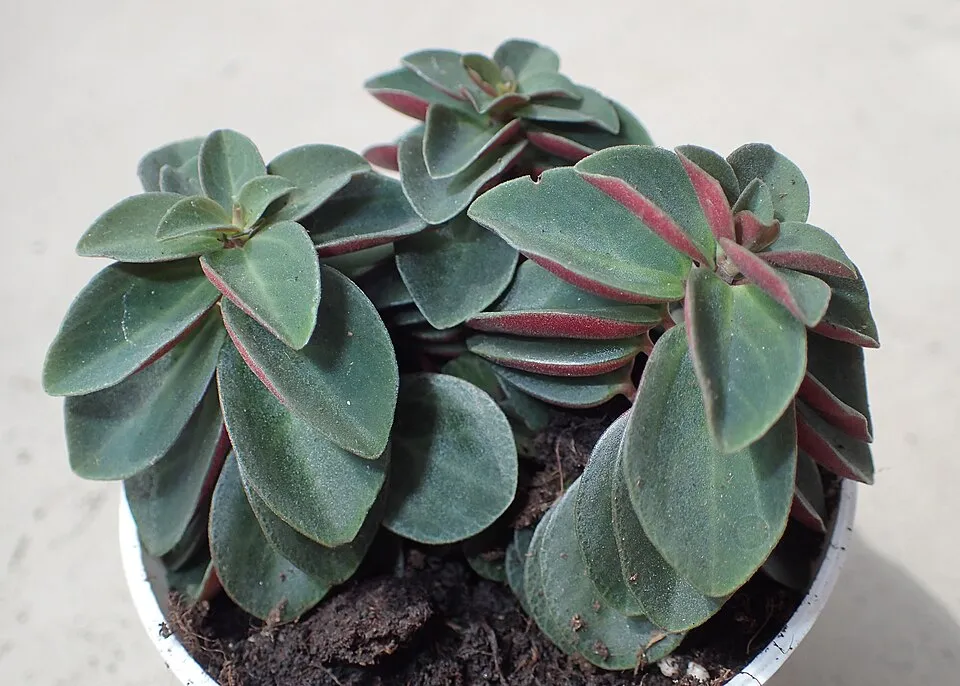
Peperomia verticillata, affectionately known as the Belly Button Peperomia, Whorled Peperomia, or Red Log Peperomia, is a captivating dwarf perennial within the diverse Piperaceae family, a lineage that also includes the economically vital black pepper. Native to the humid tropical and subtropical zones of Central and South America, this species thrives as an understory plant, often found growing terrestrially or epiphytically on decaying organic matter like logs and rocks.
This natural preference dictates its need for consistently moist, well-draining substrates and indirect, filtered light, replicating its canopy-shaded origins.
Morphologically, Peperomia verticillata typically forms a compact, bushy mound, reaching modest heights of 15 to 30 centimeters (6 to 12 inches). Its most striking features are its succulent-like stems and foliage. The stems are fleshy, often exhibiting attractive reddish or purplish tinges, and develop a smooth, slightly ridged texture with age, contributing to both structural support and efficient moisture retention.
The leaves are arranged in distinctive whorls, usually of three to five at each node, which gives rise to its 'Whorled Peperomia' common name. Individual leaves are small, measuring approximately 2.5 to 5 cm (1 to 2 inches) in length, and are orbicular to broadly ovate with a unique, deeply cupped or 'belly button' depression in the center, hence another of its common monikers. The leaf surface is typically glossy, presenting in shades from vibrant dark green to a more subdued olive, often showcasing subtle maroon undersides or a marbled variegation, especially under optimal light conditions.
Venation is typically palmate but can be inconspicuous. The root system is fibrous and shallow, perfectly adapted to absorbing moisture and nutrients from superficial organic matter. While primarily celebrated for its ornamental foliage, Peperomia verticillata produces slender, spike-like inflorescences that emerge vertically from the leaf axils, bearing numerous minute, apetalous flowers.
Trusted Scientific References
1. Authoritative external sources for Peperomia verticillata
1.1 Wikipedia — Peperomia verticillata
1.2 Kew POWO (Plants of the World Online)
1.3 PubMed — peer-reviewed research
1.4 NCBI Taxonomy Browser
1.5 GBIF — Global Biodiversity
1.1.Peperomia Verticillata — Key Features
- ✓ <strong>Distinctive whorled leaf</strong> — Distinctive whorled leaf arrangement.
- ✓ <strong>Deeply cupped or</strong> — Deeply cupped or 'belly button' depression in the center of each leaf.
- ✓ <strong>Succulent</strong> — like, fleshy leaves for water storage.
- ✓ <strong>Fleshy stems, often</strong> — Fleshy stems, often with reddish or purplish tinges.
- ✓ <strong>Compact, bushy growth habit, typically reaching 15</strong> — 30 cm in height.
- ✓ <strong>Native to the</strong> — Native to the humid tropical and subtropical regions of Central and South America.
- ✓ <strong>Low</strong> — maintenance and adaptable as an indoor ornamental plant.
- ✓ <strong>Prefers bright, indirect light and well</strong> — draining, aerated potting mix.
- ✓ <strong>Fibrous and shallow</strong> — Fibrous and shallow root system, adapted to superficial organic matter.
- ✓ <strong>Produces slender, spike</strong> — like inflorescences with minute, apetalous flowers.
1.2.Peperomia Verticillata — Quick Summary
- ✓ Peperomia verticillata is a popular, low-maintenance ornamental plant.
- ✓ Characterized by whorled, succulent-like leaves with a unique 'belly button' depression.
- ✓ Native to tropical Central and South America, preferring bright, indirect light and well-draining soil.
- ✓ While specific medicinal research on P. verticillata is limited, the Peperomia genus is known for anti-inflammatory, antioxidant, and antimicrobial properties.
- ✓ Generally considered non-toxic as a houseplant, but internal use for medicinal purposes lacks scientific validation and is not recommended.
- ✓ Cultivation is straightforward, making it suitable for beginner plant enthusiasts.
2.Peperomia Verticillata — Scientific Identity
3.Peperomia Verticillata — Quick Facts
4.Peperomia Verticillata — Appearance & Identification
5.Peperomia Verticillata — Native Habitat
6.Peperomia Verticillata — Water Requirements
- ✓ Light — Provide bright, indirect light; direct sunlight can scorch leaves, while insufficient light dulls foliage and reduces color. Rotate regularly for even growth.
- ✓ Water — Water when the top soil is almost completely dry, as its succulent-like leaves store water. Reduce frequency in colder, less active seasons.
- ✓ Humidity — Appreciates average to high humidity but is not strictly essential. A pebble tray or humidifier can be used to boost ambient moisture.
- ✓ Potting Mix — Use a very well-draining, well-aerated mix, such as a standard houseplant potting mix amended with perlite (up to a 1:1 ratio).
- ✓ Repotting — Infrequent repotting is ideal as Peperomia verticillata has shallow roots and prefers to be somewhat rootbound. Repot only when roots emerge from drainage holes, going up just one to two pot sizes.
- ✓ Fertilizer — Fertilize sparingly; a general houseplant fertilizer once a month during the active growing season (spring and summer) is sufficient. Avoid over-fertilization.
- ✓ Temperature — Prefers warm temperatures, ideally between 15-26°C (59-79°F). Protect from cold drafts and temperatures below 10°C (50°F) to prevent leaf drop.
- ✓ Pruning — Pinch off growing tips occasionally during the growing season to encourage a bushier, more compact growth habit. Regularly remove any dead or yellowing leaves.
Reviewed by the Flora Medical Global Botanical Review Panel
Multi-disciplinary editorial group · Botany · Ethnobotany · Herbal-medicine literature
Who reviewed this: This page was checked by the Flora Medical Global Botanical Review Panel — an in-house editorial group of botany graduates, ethnobotany researchers, and horticulture practitioners who collectively maintain our 7,000+ plant encyclopedia. Meet the team.
Our 4-step verification process
1. Taxonomic verification
Scientific names and synonyms cross-checked against Kew POWO, World Flora Online, and The Plant List.
2. Phytochemical & medicinal cross-reference
Active compounds, traditional uses, and reported activities are cross-referenced with PubMed, USDA Dr. Duke's database, and peer-reviewed ethnobotanical literature.
3. Conservation & distribution check
Distribution, ecology, and conservation status confirmed against GBIF occurrence records and the IUCN Red List.
4. Editorial & safety review
Every entry passes an editorial pass for clarity, originality, and safety notices (toxicity, contraindications, dosage caveats) before publication.
Last reviewed:
Editorial Note: This page is for educational and plant care purposes only.
Written by: Flora Medical Global Editorial Team
Reviewed by: Flora Medical Global Botanical Review Panel
Last Updated: June 15, 2026







Peperomia Verticillata — Comments & Community Reviews
Rate this plant