
Care Disclaimer: Plant care recommendations are general guidelines based on common growing conditions. Individual results may vary based on your local environment, climate, and care routine. If your plant is toxic, keep it away from children and pets, and consult a veterinarian if accidental ingestion occurs.
1.Phalaenopsis Amabilis — Overview
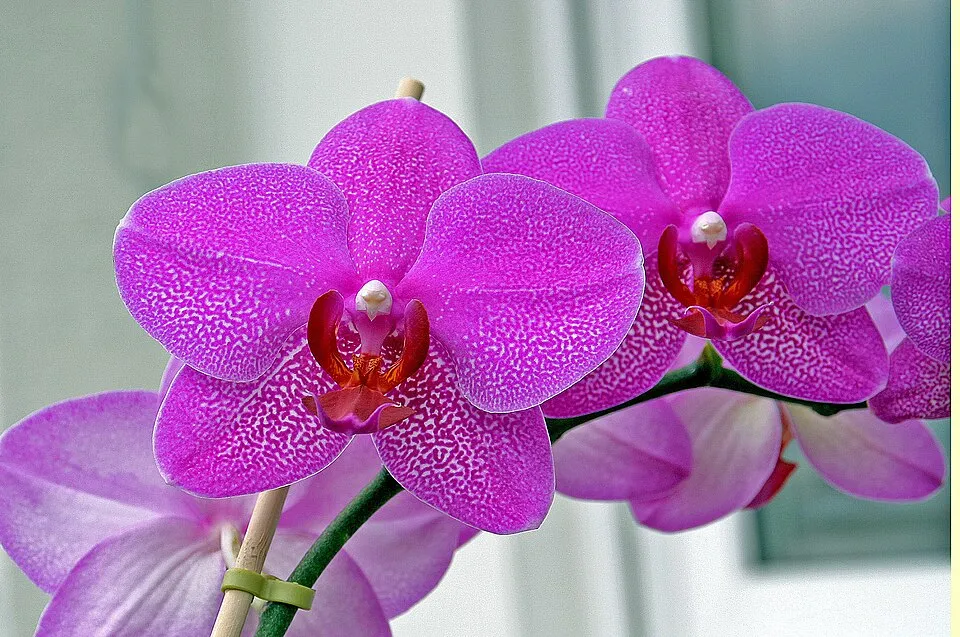
Phalaenopsis amabilis, commonly known as the Moon Orchid or Moth Orchid, is a stunning epiphytic orchid species celebrated for its elegant and long-lasting flowers. Native to the warm, humid tropical rainforests of northern Australia, Indonesia, and surrounding islands, it thrives by attaching itself to trees, absorbing moisture and nutrients from the air and rain rather than soil. Morphologically, the plant features broadly oval, fleshy, and glossy green leaves that can reach up to 20 inches (50 cm) in length, providing a lush, evergreen appeal.
From its compact base emerges a tall, arching flower stalk, often growing up to 40 inches (100 cm) high, which can bear 20-30 individual blooms. These exquisite flowers, typically up to 4 inches (10 cm) across, are pure white, resembling moths in flight, hence one of its common names. They are often adorned with a distinctive white and yellow lip, sometimes marked with a red throat, adding to their intricate beauty.
As a foundational species within the Orchidaceae family, Phalaenopsis amabilis holds significant horticultural importance, being a primary parent for countless modern Phalaenopsis hybrids. Its graceful appearance and adaptability have made it one of the most popular and widely cultivated ornamental orchids globally, and it proudly serves as the national flower of Indonesia.
Trusted Scientific References
1. Authoritative external sources for Phalaenopsis amabilis
1.1 Wikipedia — Phalaenopsis amabilis
1.2 Kew POWO (Plants of the World Online)
1.3 PubMed — peer-reviewed research
1.4 NCBI Taxonomy Browser
1.5 GBIF — Global Biodiversity
1.6Phalaenopsis Amabilis should be interpreted through verified botanical identity, practical care, and responsible safety language. This recovery note adds the missing context needed for a complete profile: match light to the plant's habit, use well-drained soil, water according to season, and avoid unsupported medicinal or edible claims. For publishing, the plant can be presented as a source-backed indoor plant with clear care guidance, common problem diagnosis, and conservative safety wording.
1.1.Phalaenopsis Amabilis — Key Features
- ✓ <strong>Common Names</strong> — Moon Orchid, Moth Orchid.
- ✓ <strong>Botanical Name</strong> — Phalaenopsis amabilis.
- ✓ <strong>Family</strong> — Orchidaceae.
- ✓ <strong>Growth Habit</strong> — Epiphytic, growing on other plants for physical support.
- ✓ <strong>Flower Characteristics</strong> — Large, fragrant, pure white blooms resembling moths, often with distinctive yellow and red markings on the lip.
- ✓ <strong>Foliage</strong> — Broad, fleshy, elliptical, and glossy green leaves, providing year-round appeal.
- ✓ <strong>Native Range</strong> — Indigenous to northern Australia, Indonesia, and surrounding islands.
- ✓ <strong>Cultural Significance</strong> — Holds the esteemed status as the national flower of Indonesia.
- ✓ <strong>Indoor Air Quality</strong> — Known for its ability to help purify indoor air by removing certain volatile organic compounds.
- ✓ <strong>Non</strong> — Toxic Status — Universally recognized as non-toxic to both humans and household pets.
1.2.Phalaenopsis Amabilis — Quick Summary
- ✓ Elegant epiphytic orchid known for its stunning, long-lasting white 'moth-like' flowers.
- ✓ Native to tropical regions of Southeast Asia and Australia, thriving in warm, humid conditions.
- ✓ Primarily valued as an ornamental houseplant and for its air-purifying qualities.
- ✓ Non-toxic to humans and pets, making it a safe choice for indoor environments.
- ✓ Requires bright, indirect light, specialized orchid potting mix, and consistent moisture.
- ✓ Lacks traditional or scientifically documented direct medicinal uses, unlike some other orchid species.
2.Phalaenopsis Amabilis — Scientific Identity
3.Phalaenopsis Amabilis — Quick Facts
4.Phalaenopsis Amabilis — Appearance & Identification
5.Phalaenopsis Amabilis — Native Habitat
6.Phalaenopsis Amabilis — Water Requirements
- Cultivating Phalaenopsis amabilis successfully requires attention to its specific epiphytic needs:
- ✓ Light Requirements — Provide bright, indirect light; avoid direct sunlight which can scorch leaves. East or west-facing windows are often ideal.
- ✓ Potting Medium — Use a specialized, well-draining orchid potting mix, typically composed of bark chips, sphagnum moss, perlite, and charcoal, to ensure adequate air circulation around the roots.
- ✓ Watering Schedule — Water thoroughly when the top inch of the potting medium feels dry, usually once a week; ensure all excess water drains out and avoid letting the plant sit in standing water or water accumulating in the leaf crown.
- ✓ Temperature & Humidity — Thrives in warm conditions, with ideal daytime temperatures between 75-85°F (24-29°C) and nighttime temperatures between 61-66°F (16-19°C); maintain high humidity levels (50-80%) using a humidity tray or humidifier.
- ✓ Air Circulation — Essential for root health and preventing fungal diseases; ensure good air movement around the plant but protect it from strong drafts.
- ✓ Fertilization — Apply a balanced, water-soluble orchid-specific fertilizer (e.g., 20-20-20) every other week during the growing season, reducing to monthly during dormancy or winter.
- ✓ Pruning & Repotting — After flowers fade, you can cut the spike just above a node for potential reblooming or remove entirely if it browns; repot every 1-2 years or when the medium breaks down, ideally after blooming.
- ✓ Propagation — Most commonly propagated from keikis (small plantlets) that develop on the flower spikes, which can be carefully removed and potted once they develop roots.
Reviewed by the Flora Medical Global Botanical Review Panel
Multi-disciplinary editorial group · Botany · Ethnobotany · Herbal-medicine literature
Who reviewed this: This page was checked by the Flora Medical Global Botanical Review Panel — an in-house editorial group of botany graduates, ethnobotany researchers, and horticulture practitioners who collectively maintain our 7,000+ plant encyclopedia. Meet the team.
Our 4-step verification process
1. Taxonomic verification
Scientific names and synonyms cross-checked against Kew POWO, World Flora Online, and The Plant List.
2. Phytochemical & medicinal cross-reference
Active compounds, traditional uses, and reported activities are cross-referenced with PubMed, USDA Dr. Duke's database, and peer-reviewed ethnobotanical literature.
3. Conservation & distribution check
Distribution, ecology, and conservation status confirmed against GBIF occurrence records and the IUCN Red List.
4. Editorial & safety review
Every entry passes an editorial pass for clarity, originality, and safety notices (toxicity, contraindications, dosage caveats) before publication.
Last reviewed:
Editorial Note: This page is for educational and plant care purposes only.
Written by: Flora Medical Global Editorial Team
Reviewed by: Flora Medical Global Botanical Review Panel
Last Updated: June 15, 2026







Phalaenopsis Amabilis — Comments & Community Reviews
Rate this plant