


Care Disclaimer: Plant care recommendations are general guidelines based on common growing conditions. Individual results may vary based on your local environment, climate, and care routine. If your plant is toxic, keep it away from children and pets, and consult a veterinarian if accidental ingestion occurs.
1.Phalaenopsis Schilleriana — Overview
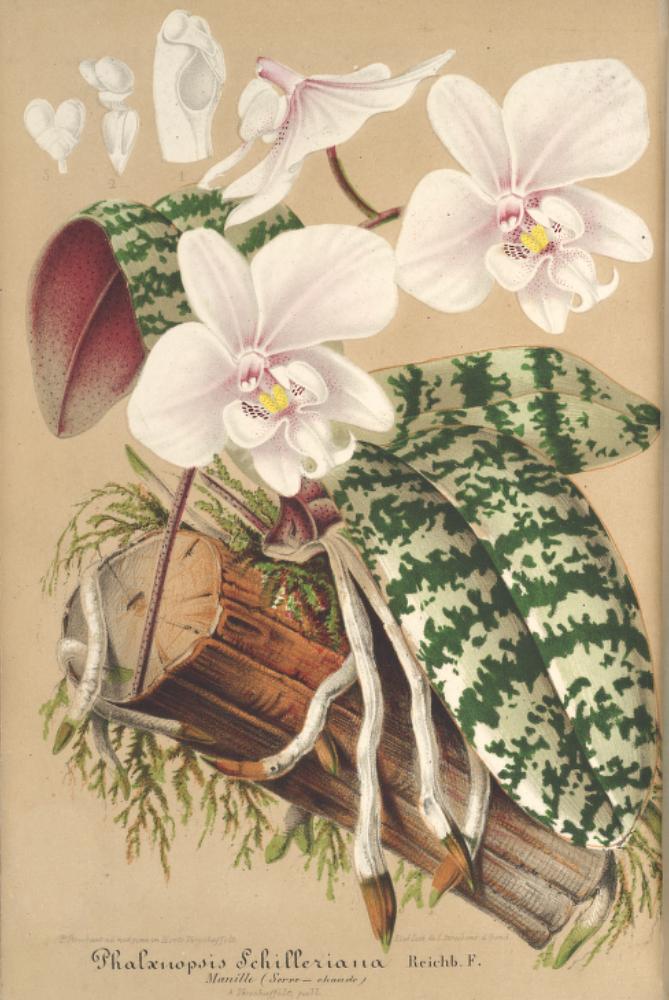
Phalaenopsis schilleriana, often celebrated as the Pink Moth Orchid or Schiller's Phalaenopsis, is a distinguished epiphytic orchid species belonging to the Orchidaceae family. It is indigenous to the tropical rainforests of the Philippines, particularly thriving on islands such as Luzon, Mindoro, and Panay.
This species flourishes in warm, humid conditions, typically anchoring itself to tree bark beneath the filtered light of the forest canopy, showcasing its adaptation to dappled, low-light environments. As a monopodial orchid, it grows from a singular, short, stout stem, largely concealed by overlapping leaf bases, reaching a vegetative height of 30 to 60 cm, with its impressive inflorescences extending considerably further.
The orchid possesses a robust root system characterized by thick, silvery-green aerial roots. These roots are encased in a spongy outer layer known as the velamen, which efficiently absorbs atmospheric moisture and dissolved nutrients. A hallmark of Phalaenopsis schilleriana is its strikingly ornamental foliage.
The leaves are large, leathery, and display an ovate to oblong-elliptic shape, typically measuring 20 to 30 cm in length and 8 to 12 cm in width. Their upper surface exhibits a captivating silver-green mottling or marbling pattern, often complemented by a reddish or purplish underside, providing both camouflage and significant aesthetic appeal. The inflorescences are arching or pendulous, frequently branched, and can attain remarkable lengths of 60 to 90 cm or more on mature specimens, capable of bearing dozens to over a hundred exquisite flowers.
Each bloom, typically 5 to 8 cm across, presents delicate soft pink to rose-pink petals and sepals, often adorned with darker pink spots or streaks, creating a mesmerizing display. The labellum, or lip, is distinctly three-lobed, often featuring contrasting markings or a yellowish callus, enhancing the flower's intricate beauty.
Trusted Scientific References
1. Authoritative external sources for Phalaenopsis schilleriana
1.1 Wikipedia — Phalaenopsis schilleriana
1.2 Kew POWO (Plants of the World Online)
1.3 PubMed — peer-reviewed research
1.4 NCBI Taxonomy Browser
1.5 GBIF — Global Biodiversity
1.1.Phalaenopsis Schilleriana — Key Features
- ✓ <strong>Native to the</strong> — Native to the tropical forests of the Philippines, exhibiting an epiphytic growth habit.
- ✓ <strong>Distinctive silver</strong> — green mottled leaves with an attractive reddish or purplish underside.
- ✓ <strong>Produces abundant, delicate soft pink to rose</strong> — pink flowers, typically 5 to 8 cm in diameter.
- ✓ <strong>Features long, arching</strong> — Features long, arching or pendulous inflorescences capable of bearing dozens to over a hundred blooms.
- ✓ <strong>Possesses a robust</strong> — Possesses a robust aerial root system covered with velamen for efficient atmospheric moisture absorption.
- ✓ <strong>Exhibits monopodial growth,</strong> — Exhibits monopodial growth, developing from a single, short, central stem.
- ✓ <strong>Thrives in warm,</strong> — Thrives in warm, humid conditions with bright, indirect light, mimicking its native forest understory habitat.
- ✓ <strong>Flowers typically emerge</strong> — Flowers typically emerge in late winter to early spring, with initiation triggered by cooler night temperatures in the fall.
- ✓ <strong>Some varieties are</strong> — Some varieties are noted for a subtle, sometimes powdery rose-like, fragrance.
- ✓ <strong>Highly popular as</strong> — Highly popular as an ornamental houseplant for its exceptional beauty and unique characteristics.
1.2.Phalaenopsis Schilleriana — Quick Summary
- ✓ Exquisite epiphytic orchid native to the Philippines, highly valued for its ornamental beauty.
- ✓ Features striking silver-green mottled leaves and cascades of delicate soft pink flowers.
- ✓ Requires warm temperatures, high humidity, indirect light, and specific wet/dry cycles for optimal growth.
- ✓ Primarily appreciated for its aesthetic appeal and horticultural interest, with no known traditional medicinal uses.
- ✓ Generally considered non-toxic to humans and pets, making it a safe and popular houseplant.
- ✓ Cultivation offers psychological benefits through engagement in horticultural therapy and appreciation of natural beauty.
2.Phalaenopsis Schilleriana — Scientific Identity
3.Phalaenopsis Schilleriana — Quick Facts
4.Phalaenopsis Schilleriana — Appearance & Identification
5.Phalaenopsis Schilleriana — Native Habitat
6.Phalaenopsis Schilleriana — Water Requirements
- ✓ Light — Provide bright, indirect light, such as an east-facing window or a shaded south or west window. Phalaenopsis schilleriana can tolerate slightly brighter conditions if adequate air circulation is provided.
- ✓ Temperature — Maintain warm conditions with daytime temperatures around 29°C (85°F) and minimum night temperatures of 21°C (70°F). Cooler night temperatures in fall (around 15-17°C or 60°F) are crucial for initiating flower spikes.
- ✓ Watering — Water regularly in the morning, allowing the potting medium to almost dry out completely between waterings (typically within 3-5 days). Avoid prolonged wetness to prevent root rot, as the roots do not like to stay wet for more than 3 days.
- ✓ Humidity — High humidity is essential, ideally 50% during the day and up to 70% at night. Achieve this by placing the plant on a gravel tray partially filled with water or using a humidifier.
- ✓ Potting Medium & Repotting — Use an open, airy potting mix, such as bark chips, or a minimal amount of sphagnum moss (<20%) to ensure distinct wet/dry cycles. Repot every couple of years or when the plant doubles in size.
- ✓ Fertilizing — Feed regularly during the active growing season with a balanced orchid fertilizer. Reduce the frequency of fertilization to about twice a month during the cooler winter months.
- ✓ Pests — Common pests include spider mites, mealybugs, and soft brown scale. Early infestations can be treated by gently scrubbing affected areas with a soft toothbrush dipped in rubbing alcohol.
- ✓ Flowering — Phalaenopsis schilleriana is a winter-spiking orchid that requires a period of cooler night temperatures (around 16°C) in the fall to trigger spike initiation, typically blooming in late winter or early spring.
Reviewed by the Flora Medical Global Botanical Review Panel
Multi-disciplinary editorial group · Botany · Ethnobotany · Herbal-medicine literature
Who reviewed this: This page was checked by the Flora Medical Global Botanical Review Panel — an in-house editorial group of botany graduates, ethnobotany researchers, and horticulture practitioners who collectively maintain our 7,000+ plant encyclopedia. Meet the team.
Our 4-step verification process
1. Taxonomic verification
Scientific names and synonyms cross-checked against Kew POWO, World Flora Online, and The Plant List.
2. Phytochemical & medicinal cross-reference
Active compounds, traditional uses, and reported activities are cross-referenced with PubMed, USDA Dr. Duke's database, and peer-reviewed ethnobotanical literature.
3. Conservation & distribution check
Distribution, ecology, and conservation status confirmed against GBIF occurrence records and the IUCN Red List.
4. Editorial & safety review
Every entry passes an editorial pass for clarity, originality, and safety notices (toxicity, contraindications, dosage caveats) before publication.
Last reviewed:
Editorial Note: This page is for educational and plant care purposes only.
Written by: Flora Medical Global Editorial Team
Reviewed by: Flora Medical Global Botanical Review Panel
Last Updated: June 15, 2026







Phalaenopsis Schilleriana — Comments & Community Reviews
Rate this plant