

Care Disclaimer: Plant care recommendations are general guidelines based on common growing conditions. Individual results may vary based on your local environment, climate, and care routine. If your plant is toxic, keep it away from children and pets, and consult a veterinarian if accidental ingestion occurs.
1.Pleiospilos Nelii — Overview
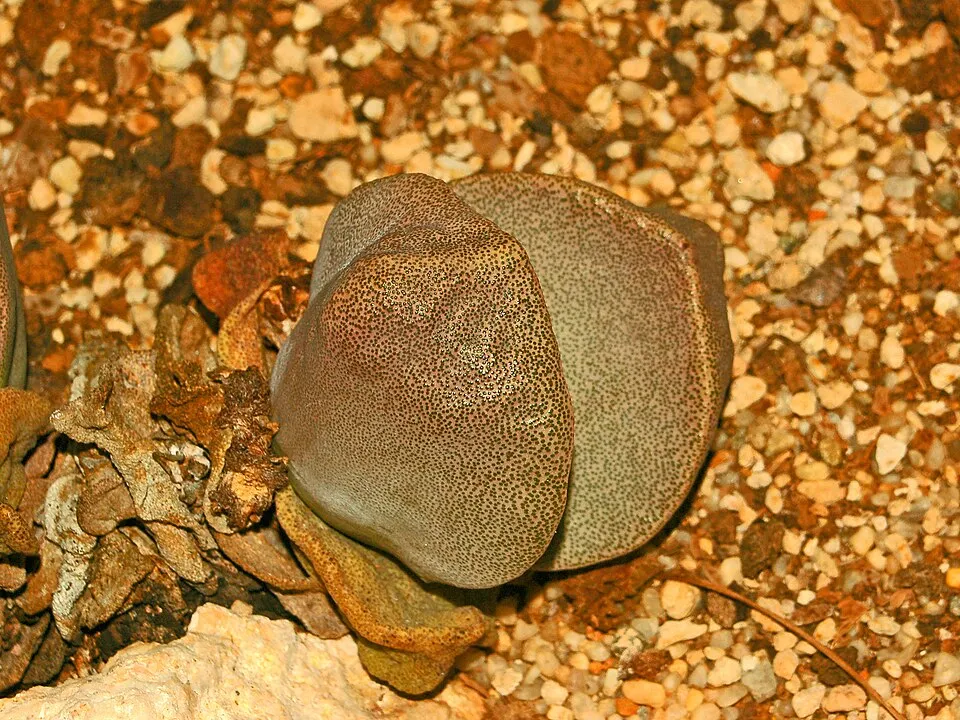
Pleiospilos nelii, widely known as the split rock plant or living stone, is an extraordinary succulent species native to the arid landscapes of South Africa. This captivating perennial typically forms compact clumps, rarely exceeding 10 to 15 centimeters in height, and is highly esteemed for its remarkable lithophytic mimicry, allowing it to blend almost imperceptibly with its stony surroundings. Its distinctive morphology is characterized by two to four thick, fleshy, obconical leaves, which exhibit characteristic grey-green to brownish-grey hues and are often adorned with numerous small, dark dots or fissures, further enhancing their resemblance to granite or quartzite pebbles. These robust leaves are arranged in opposing pairs, creating a pronounced 'split' appearance from which its common name is derived.
Each leaf can measure between 2 to 5 centimeters in width and up to 6 centimeters in length, providing substantial capacity for water storage—a crucial adaptation for survival in its drought-prone natural habitat. The plant's stem is exceptionally short, frequently subterranean or entirely obscured by the dense foliage, contributing to its compact, rock-like profile. During late summer or early fall, Pleiospilos nelii produces solitary, showy, daisy-like flowers that emerge dramatically from the fissure between the leaf pairs. These vibrant blossoms typically display radiant hues of yellow, orange, or occasionally white, and can span up to 5 centimeters in diameter, offering a striking visual contrast to the plant's otherwise camouflaged appearance.
The leaf texture is smooth, though often punctuated by the aforementioned dark dots or 'warts' that contribute to its geological disguise. A robust taproot system anchors the plant firmly and efficiently absorbs moisture from deep within the substrate. Taxonomically, Pleiospilos nelii belongs to the Aizoaceae family, a diverse group of dicotyledonous flowering plants predominantly found in southern Africa, renowned for their succulent members often collectively referred to as 'mesembs'.
Trusted Scientific References
1. Authoritative external sources for Pleiospilos nelii
1.1 Wikipedia — Pleiospilos nelii
1.2 Kew POWO (Plants of the World Online)
1.3 PubMed — peer-reviewed research
1.4 NCBI Taxonomy Browser
1.5 GBIF — Global Biodiversity
1.1.Pleiospilos Nelii — Key Features
- ✓ <strong>Native to the</strong> — Native to the arid regions of South Africa.
- ✓ <strong>Exhibits striking lithophytic</strong> — Exhibits striking lithophytic mimicry, resembling pebbles.
- ✓ <strong>Characterized by 2</strong> — 4 thick, fleshy, grey-green to brownish-grey leaves.
- ✓ <strong>Produces solitary, vibrant</strong> — Produces solitary, vibrant yellow, orange, or white daisy-like flowers.
- ✓ <strong>Possesses an exceptionally</strong> — Possesses an exceptionally short, often subterranean stem.
- ✓ <strong>Highly adapted to</strong> — Highly adapted to drought, requiring minimal, infrequent watering.
- ✓ <strong>Thrives in bright,</strong> — Thrives in bright, indirect sunlight conditions.
- ✓ <strong>Generally considered non</strong> — toxic to humans and household pets.
- ✓ <strong>A popular choice</strong> — A popular choice for unique indoor ornamental plant collections.
- ✓ <strong>Belongs to the</strong> — Belongs to the Aizoaceae family, known as 'mesembs'.
1.2.Pleiospilos Nelii — Quick Summary
- ✓ Pleiospilos nelii, or Split Rock Plant, is a unique South African succulent.
- ✓ Renowned for its remarkable mimicry, blending with stony surroundings.
- ✓ Primarily an ornamental plant, offering aesthetic and biophilic benefits.
- ✓ Requires bright, indirect light and extremely well-draining soil.
- ✓ Highly drought-tolerant, needing minimal, infrequent watering.
- ✓ Considered non-toxic, making it safe for homes with pets and children.
2.Pleiospilos Nelii — Scientific Identity
3.Pleiospilos Nelii — Quick Facts
4.Pleiospilos Nelii — Appearance & Identification
5.Pleiospilos Nelii — Native Habitat
6.Pleiospilos Nelii — Water Requirements
- Cultivating Pleiospilos nelii requires attention to its desert adaptations:
- ✓ Soil Selection — Use a highly porous, well-draining succulent or cactus mix, often supplemented with perlite, pumice, or coarse sand to prevent waterlogging.
- ✓ Container Choice — Opt for pots with ample drainage holes to ensure excess water can escape freely, crucial for preventing root rot.
- ✓ Planting Seeds — Sprinkle seeds on the soil surface without covering, as they require light to germinate; mist consistently until rooted, then reduce frequency.
- ✓ Watering Regimen — Water sparingly; allow the soil to dry out completely between waterings, typically biweekly or less for mature plants, especially during dormancy.
- ✓ Light Requirements — Provide bright, indirect sunlight; a south-facing window with some protection from harsh midday sun is ideal.
- ✓ Temperature & Humidity — Maintain consistent temperatures, ideally between 18-25°C (65-77°F), and keep humidity low, mimicking its natural arid habitat.
- ✓ Fertilization — Fertilize minimally with a diluted succulent-specific fertilizer at the beginning of the growing season (spring and fall, coinciding with dormancy breaks).
- ✓ Repotting — Repot every two years or when the plant outgrows its container, always using fresh, well-draining soil.
Reviewed by the Flora Medical Global Botanical Review Panel
Multi-disciplinary editorial group · Botany · Ethnobotany · Herbal-medicine literature
Who reviewed this: This page was checked by the Flora Medical Global Botanical Review Panel — an in-house editorial group of botany graduates, ethnobotany researchers, and horticulture practitioners who collectively maintain our 7,000+ plant encyclopedia. Meet the team.
Our 4-step verification process
1. Taxonomic verification
Scientific names and synonyms cross-checked against Kew POWO, World Flora Online, and The Plant List.
2. Phytochemical & medicinal cross-reference
Active compounds, traditional uses, and reported activities are cross-referenced with PubMed, USDA Dr. Duke's database, and peer-reviewed ethnobotanical literature.
3. Conservation & distribution check
Distribution, ecology, and conservation status confirmed against GBIF occurrence records and the IUCN Red List.
4. Editorial & safety review
Every entry passes an editorial pass for clarity, originality, and safety notices (toxicity, contraindications, dosage caveats) before publication.
Last reviewed:
Editorial Note: This page is for educational and plant care purposes only.
Written by: Flora Medical Global Editorial Team
Reviewed by: Flora Medical Global Botanical Review Panel
Last Updated: June 15, 2026







Pleiospilos Nelii — Comments & Community Reviews
Rate this plant