
Care Disclaimer: Plant care recommendations are general guidelines based on common growing conditions. Individual results may vary based on your local environment, climate, and care routine. If your plant is toxic, keep it away from children and pets, and consult a veterinarian if accidental ingestion occurs.
1.Pothos Jade — Overview
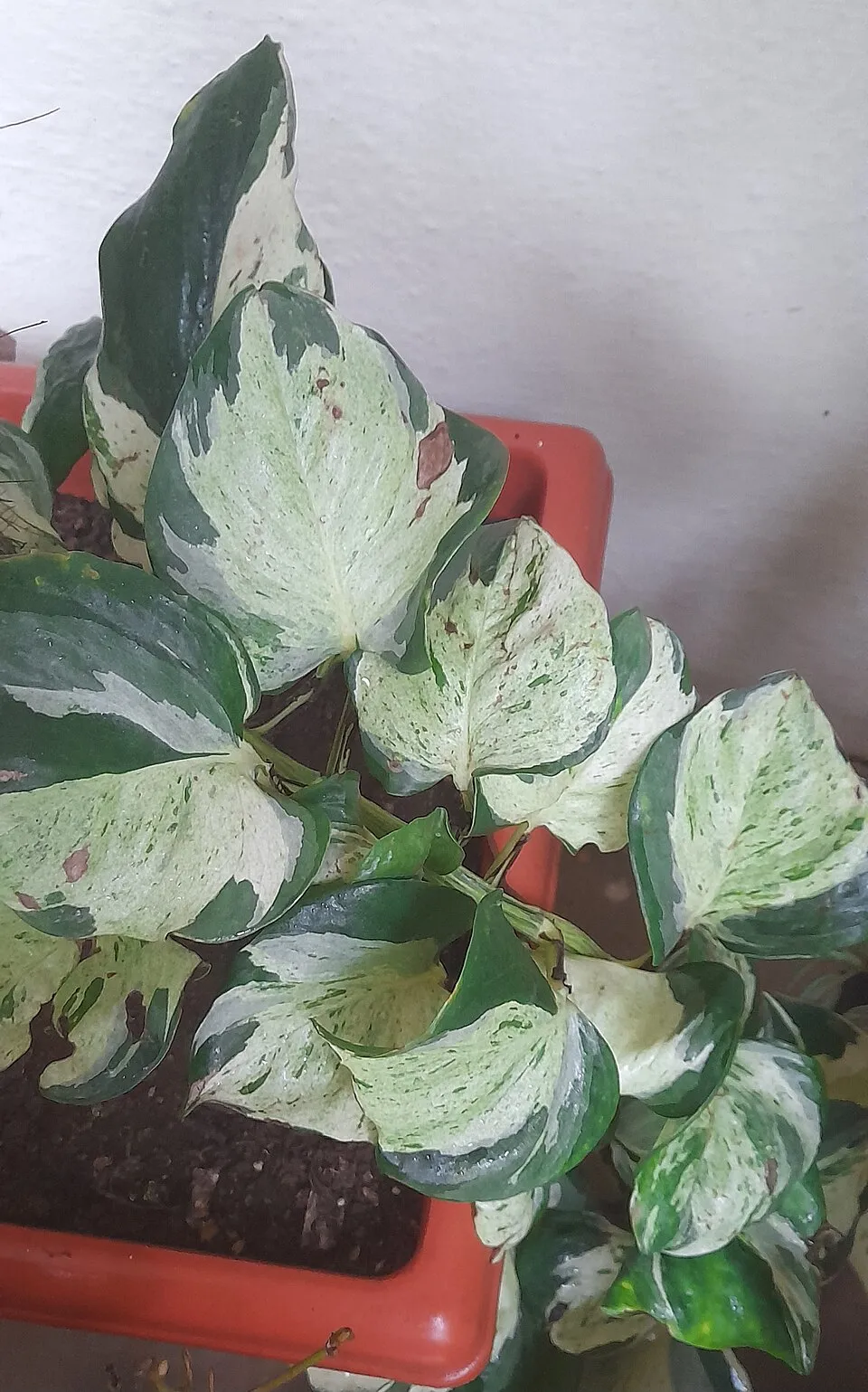
Pothos Jade, a specific cultivar of Epipremnum aureum, is a highly acclaimed ornamental plant belonging to the Araceae family. This cultivar is particularly distinguished by its uniformly deep green, glossy, heart-shaped leaves, which typically measure between 10 to 20 cm (4-8 inches) in length and notably lack the variegation seen in other varieties of Epipremnum aureum. This absence of lighter patterns lends the 'Jade' Pothos its characteristic rich and consistent emerald hue, making it a favored choice for indoor cultivation. In its native tropical rainforest habitats, primarily the Solomon Islands and other parts of Southeast Asia and the Pacific, it thrives as a vining epiphyte.
Its long, flexible stems can gracefully trail from elevated positions or ascend support structures, often reaching lengths of 3 meters (10 feet) or more under optimal conditions. Mature stems can become quite robust, sometimes exceeding 6 mm (0.25 inches) in diameter, anchoring numerous aerial roots that facilitate climbing and absorption of moisture and nutrients. While primarily cultivated for its striking foliage, like its parent species, Pothos Jade can rarely produce the characteristic Araceae inflorescence—a small, white spathe enclosing a spadix—though this phenomenon is exceptionally uncommon in indoor settings. Taxonomically, Epipremnum aureum has undergone several reclassifications, originally described as Pothos aureus and later Rhaphidophora aurea, before its current designation.
It is distinct from Epipremnum pinnatum, despite past confusion, based on specific leaf morphology and growth patterns. The genus name 'Epipremnum' signifies 'on trees,' referencing its epiphytic nature, while 'aureum' refers to the golden-yellow variegation typical of the species, though absent in the 'Jade' cultivar. Its ease of care, resilience, and adaptability to various indoor conditions, coupled with significant air-purifying capabilities, contribute to its global appeal.
Trusted Scientific References
1. Authoritative external sources for Epipremnum aureum Jade
1.1 Wikipedia — Epipremnum aureum Jade
1.2 Kew POWO (Plants of the World Online)
1.3 PubMed — peer-reviewed research
1.4 NCBI Taxonomy Browser
1.5 GBIF — Global Biodiversity
1.1.Pothos Jade — Key Features
- ✓ <strong>Unblemished, deep green, heart</strong> — shaped leaves without variegation.
- ✓ <strong>Robust vining and</strong> — Robust vining and trailing growth habit, ideal for hanging baskets or climbing.
- ✓ <strong>Exceptional capabilities in</strong> — Exceptional capabilities in purifying indoor air from harmful volatile organic compounds.
- ✓ <strong>High tolerance to</strong> — High tolerance to a wide range of light conditions, from low to bright indirect.
- ✓ <strong>Contains insoluble calcium</strong> — Contains insoluble calcium oxalate raphides, rendering all parts of the plant toxic.
- ✓ <strong>Simple and efficient</strong> — Simple and efficient propagation method through stem cuttings in water or soil.
- ✓ <strong>Highly adaptable and</strong> — Highly adaptable and resilient, thriving in typical indoor environments with minimal care.
- ✓ <strong>Capable of rapid</strong> — Capable of rapid growth, with stems potentially reaching several meters in length.
- ✓ <strong>Low maintenance requirements,</strong> — Low maintenance requirements, making it suitable for beginner plant enthusiasts.
- ✓ <strong>A tropical epiphyte</strong> — A tropical epiphyte originating from the rainforests of Southeast Asia and the Pacific.
1.2.Pothos Jade — Quick Summary
- ✓ Popular ornamental houseplant known for its deep green foliage.
- ✓ Highly effective natural air purifier, removing common indoor pollutants.
- ✓ Contains toxic calcium oxalate crystals, making it unsafe for ingestion by humans and pets.
- ✓ Exhibits antioxidant, antimicrobial, and potential anticancer properties in research settings.
- ✓ Extremely easy to cultivate and propagate, adapting well to various indoor conditions.
- ✓ Native to tropical regions of Southeast Asia and the Pacific.
2.Pothos Jade — Scientific Identity
3.Pothos Jade — Quick Facts
4.Pothos Jade — Appearance & Identification
5.Pothos Jade — Native Habitat
6.Pothos Jade — Water Requirements
- ✓ Light — Thrives in bright, indirect light but is highly tolerant of low-light conditions, though growth may be slower.
- ✓ Watering — Water moderately, allowing the top inch or two of soil to dry out between waterings to prevent root rot.
- ✓ Soil — Prefers well-draining, nutrient-rich potting mix, ideally with good aeration.
- ✓ Humidity — Benefits from higher humidity levels, typical of its native tropical environment, but adapts to average household humidity.
- ✓ Temperature — Best grown in warm indoor temperatures, ideally between 18-30°C (65-85°F), avoiding cold drafts.
- ✓ Propagation — Easily propagated from stem cuttings placed in water or moist soil, rooting readily within a few weeks.
- ✓ Support — As a vining plant, it can be grown in hanging baskets to trail or provided with a moss pole or trellis to climb.
Reviewed by the Flora Medical Global Botanical Review Panel
Multi-disciplinary editorial group · Botany · Ethnobotany · Herbal-medicine literature
Who reviewed this: This page was checked by the Flora Medical Global Botanical Review Panel — an in-house editorial group of botany graduates, ethnobotany researchers, and horticulture practitioners who collectively maintain our 7,000+ plant encyclopedia. Meet the team.
Our 4-step verification process
1. Taxonomic verification
Scientific names and synonyms cross-checked against Kew POWO, World Flora Online, and The Plant List.
2. Phytochemical & medicinal cross-reference
Active compounds, traditional uses, and reported activities are cross-referenced with PubMed, USDA Dr. Duke's database, and peer-reviewed ethnobotanical literature.
3. Conservation & distribution check
Distribution, ecology, and conservation status confirmed against GBIF occurrence records and the IUCN Red List.
4. Editorial & safety review
Every entry passes an editorial pass for clarity, originality, and safety notices (toxicity, contraindications, dosage caveats) before publication.
Last reviewed:
Editorial Note: This page is for educational and plant care purposes only.
Written by: Flora Medical Global Editorial Team
Reviewed by: Flora Medical Global Botanical Review Panel
Last Updated: June 15, 2026







Pothos Jade — Comments & Community Reviews
Rate this plant