
Care Disclaimer: Plant care recommendations are general guidelines based on common growing conditions. Individual results may vary based on your local environment, climate, and care routine. If your plant is toxic, keep it away from children and pets, and consult a veterinarian if accidental ingestion occurs.
1.Prince of Orange Philodendron — Overview
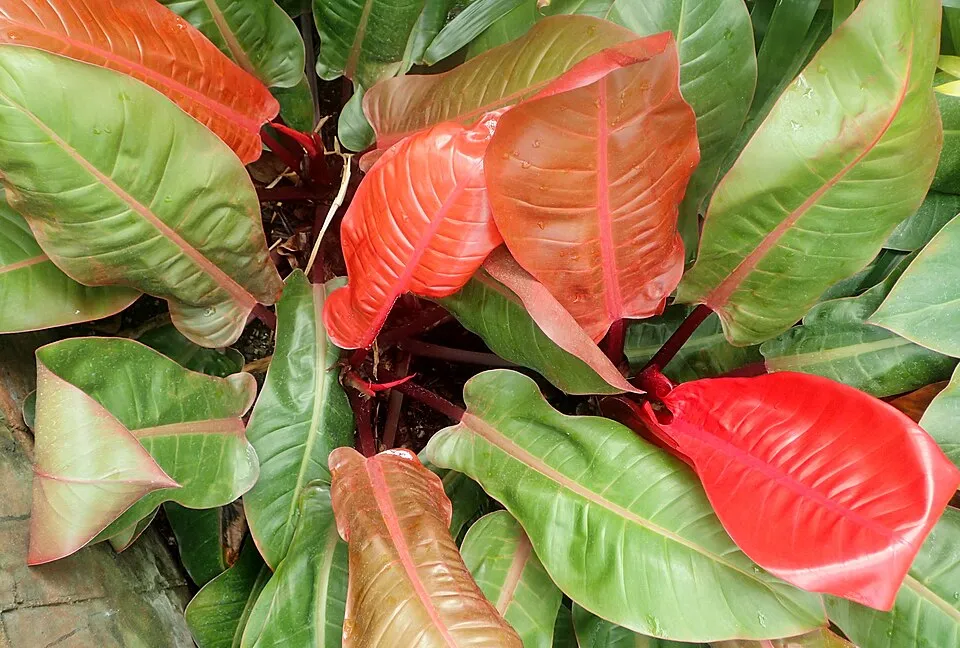
The Prince of Orange Philodendron (Philodendron prince of orange) is a captivating hybrid cultivar within the Araceae family, primarily recognized for its striking ornamental foliage rather than wild distribution, as it is a horticultural creation. This compact, self-heading philodendron typically reaches an average height of 12 to 24 inches (30 to 61 cm) with a similar spread, forming a bushy, upright silhouette unlike many vining Philodendron species. Its most distinctive feature is the dynamic coloration of its leaves; new foliage emerges in a brilliant, fiery copper-orange hue, gradually transitioning to vibrant yellow, and finally maturing into a lush, glossy green.
These large, heart-shaped to oblong-ovate leaves can measure 6 to 10 inches (15 to 25 cm) in length, often complemented by reddish-orange petioles that provide a beautiful contrast. While the genus Philodendron is native to the tropical rainforests of South America, this specific hybrid was developed for indoor cultivation, thriving in conditions that mimic its ancestral tropical environment, such as bright indirect light and high humidity. It is prized for its ease of care and ability to add a dramatic splash of natural beauty and color to indoor gardens, offices, and residential spaces, making it a highly sought-after houseplant globally.
Trusted Scientific References
1. Authoritative external sources for Philodendron prince of orange
1.1 Wikipedia — Philodendron prince of orange
1.2 Kew POWO (Plants of the World Online)
1.3 PubMed — peer-reviewed research
1.4 NCBI Taxonomy Browser
1.5 GBIF — Global Biodiversity
1.6Prince of Orange Philodendron should be interpreted through verified botanical identity, practical care, and responsible safety language. This recovery note adds the missing context needed for a complete profile: match light to the plant's habit, use well-drained soil, water according to season, and avoid unsupported medicinal or edible claims. For publishing, the plant can be presented as a source-backed indoor plant with clear care guidance, common problem diagnosis, and conservative safety wording.
1.1.Prince of Orange Philodendron — Key Features
- ✓ <strong>Eye</strong> — catching Foliage — New leaves emerge a vibrant copper-orange, maturing to yellow and then lush green, providing a dynamic visual spectacle.
- ✓ <strong>Upright Growth Habit</strong> — Forms a compact, bushy plant, differentiating it from many vining philodendrons and making it suitable for various indoor placements.
- ✓ <strong>Glossy, Oblong</strong> — Ovate Leaves — Features smooth, lustrous leaves with prominent venation, contributing to its dramatic visual appeal.
- ✓ <strong>Contrasting Petioles</strong> — Leaf stalks often display a reddish-orange hue, offering an additional layer of color contrast.
- ✓ <strong>Adaptable Indoor Plant</strong> — Suitable for various indoor lighting conditions, preferring bright indirect light for optimal color development.
- ✓ <strong>Air Purifying Qualities</strong> — Contributes to improving indoor air quality by absorbing certain volatile organic compounds and producing oxygen.
- ✓ <strong>Moderate Water Needs</strong> — Prefers consistently moist soil but dislikes waterlogging, requiring well-draining potting mix.
- ✓ <strong>High Humidity Lover</strong> — Benefits significantly from increased ambient humidity, mimicking its tropical rainforest ancestry.
- ✓ <strong>Easy to Propagate</strong> — Can be successfully grown from stem cuttings, allowing for easy reproduction and sharing.
- ✓ <strong>Low Maintenance</strong> — Generally considered an easy-care houseplant once its basic light, water, and humidity requirements are met.
1.2.Prince of Orange Philodendron — Quick Summary
- ✓ Philodendron 'Prince of Orange' is a popular ornamental hybrid known for its unique, color-changing foliage.
- ✓ New leaves emerge a vibrant copper-orange, gradually maturing to yellow and then green, offering a dynamic visual display.
- ✓ This self-heading philodendron exhibits an upright, bushy growth habit, making it ideal for compact spaces.
- ✓ It thrives in bright, indirect light and requires consistently moist, well-draining soil with high ambient humidity.
- ✓ While primarily non-toxic to touch, its sap contains calcium oxalate crystals that can cause skin irritation and gastrointestinal upset if ingested.
- ✓ It is well-suited for indoor cultivation, prized for its aesthetic appeal and minor air-purifying qualities.
2.Prince of Orange Philodendron — Scientific Identity
3.Prince of Orange Philodendron — Quick Facts
4.Prince of Orange Philodendron — Appearance & Identification
5.Prince of Orange Philodendron — Native Habitat
6.Prince of Orange Philodendron — Water Requirements
- ✓ Light — Provide bright, indirect light; avoid direct sun to prevent leaf scorch, but ensure adequate light for vibrant coloration.
- ✓ Watering — Water thoroughly when the top inch of soil feels dry, allowing excess water to drain to prevent root rot, and reduce frequency in winter.
- ✓ Humidity — Maintain medium to high humidity (50-70%) by misting, using a pebble tray, or a humidifier, mimicking its tropical origins.
- ✓ Temperature — Keep temperatures consistently between 15-30°C (60-85°F), protecting from cold drafts or extreme fluctuations.
- ✓ Soil & Potting — Use a well-draining, aerated potting mix rich in organic matter, such as a blend of peat moss, perlite, and pine bark, in a pot with drainage holes.
- ✓ Fertilization — Feed monthly during the active growing season (spring and summer) with a balanced liquid fertilizer (e.g., 10-10-10) diluted to half strength.
- ✓ Pruning — Regularly remove any yellowing, damaged, or dead leaves to encourage new growth and maintain the plant's bushy, appealing form.
- ✓ Propagation — Easily propagate new plants from stem cuttings containing at least one node and a leaf, rooting them in water or moist soil.
Reviewed by the Flora Medical Global Botanical Review Panel
Multi-disciplinary editorial group · Botany · Ethnobotany · Herbal-medicine literature
Who reviewed this: This page was checked by the Flora Medical Global Botanical Review Panel — an in-house editorial group of botany graduates, ethnobotany researchers, and horticulture practitioners who collectively maintain our 7,000+ plant encyclopedia. Meet the team.
Our 4-step verification process
1. Taxonomic verification
Scientific names and synonyms cross-checked against Kew POWO, World Flora Online, and The Plant List.
2. Phytochemical & medicinal cross-reference
Active compounds, traditional uses, and reported activities are cross-referenced with PubMed, USDA Dr. Duke's database, and peer-reviewed ethnobotanical literature.
3. Conservation & distribution check
Distribution, ecology, and conservation status confirmed against GBIF occurrence records and the IUCN Red List.
4. Editorial & safety review
Every entry passes an editorial pass for clarity, originality, and safety notices (toxicity, contraindications, dosage caveats) before publication.
Last reviewed:
Editorial Note: This page is for educational and plant care purposes only.
Written by: Flora Medical Global Editorial Team
Reviewed by: Flora Medical Global Botanical Review Panel
Last Updated: June 15, 2026







Prince of Orange Philodendron — Comments & Community Reviews
Rate this plant