
Care Disclaimer: Plant care recommendations are general guidelines based on common growing conditions. Individual results may vary based on your local environment, climate, and care routine. If your plant is toxic, keep it away from children and pets, and consult a veterinarian if accidental ingestion occurs.
1.Pseudolithos — Overview
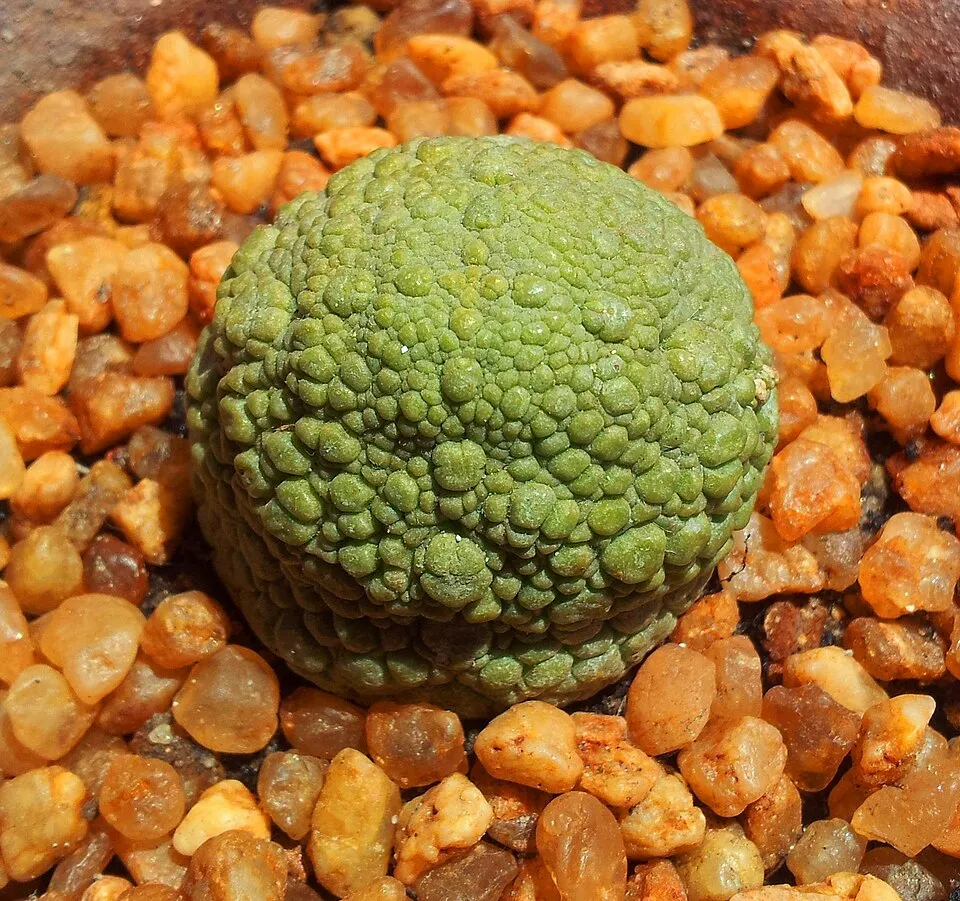
Pseudolithos migiurtinus, a captivating perennial succulent, is an intriguing member of the Apocynaceae family, renowned for its unique morphology. Native to the arid and semi-desert regions of northeastern Somalia, specifically the former Majeerteen Sultanate (Migiurtinia), this plant is expertly adapted to extreme drought conditions. It typically presents as a dwarf, leafless stem succulent, forming semi-spherical to spherical bodies that can reach up to 8 cm in height, occasionally developing knobbly textures with age.
The stems are characterized by roundish tessellations and vary in color from a pale green to a distinctive bluish hue, often possessing a waxy surface that significantly reduces water loss. During its flowering period, Pseudolithos migiurtinus produces small, star-shaped flowers, typically measuring up to 2 cm in diameter. The corolla tube is often white to pale green, while the corolla lobes display striking reddish-brown, dark red, or maroon coloration, sometimes tipped with short, tufted, hair-like appendages.
These flowers emit a pungent scent, a characteristic adaptation designed to attract specific pollinators, primarily carrion insects like flies and beetles. Following successful pollination, the plant develops twin follicles, which can grow up to 8 cm in length. This species thrives in rocky, well-drained media, making it a fascinating specimen for collectors and researchers interested in extreme xerophytes and their specialized adaptations.
Trusted Scientific References
1. Authoritative external sources for Pseudolithos migiurtinus
1.1 Wikipedia — Pseudolithos migiurtinus
1.2 Kew POWO (Plants of the World Online)
1.3 PubMed — peer-reviewed research
1.4 NCBI Taxonomy Browser
1.5 GBIF — Global Biodiversity
1.6Pseudolithos should be interpreted through verified botanical identity, practical care, and responsible safety language. This recovery note adds the missing context needed for a complete profile: match light to the plant's habit, use well-drained soil, water according to season, and avoid unsupported medicinal or edible claims. For publishing, the plant can be presented as a source-backed indoor plant with clear care guidance, common problem diagnosis, and conservative safety wording.
1.1.Pseudolithos — Key Features
- ✓ <strong>Botanical Name</strong> — *Pseudolithos migiurtinus* (Chiov.) P.R.O. Bally
- ✓ <strong>Family</strong> — Apocynaceae
- ✓ <strong>Native Origin</strong> — Northeastern Somalia
- ✓ <strong>Growth Form</strong> — Semi-spherical to spherical leafless stem succulent, up to 8 cm tall.
- ✓ <strong>Flower Characteristics</strong> — Small, star-shaped, reddish-brown to maroon flowers with a distinctive pungent scent.
- ✓ <strong>Drought Tolerance</strong> — Extremely high, showcasing specialized adaptations for survival in arid desert environments.
- ✓ <strong>Medicinal Potential</strong> — Traditional uses in related species for antimalarial and analgesic effects; specific research on *P. migiurtinus* is limited and unverified.
- ✓ <strong>Chemical Profile</strong> — Contains potential alkaloids and glycosides, typical of the Apocynaceae family, awaiting specific identification for this species.
- ✓ <strong>Horticultural Value</strong> — Highly prized ornamental for succulent enthusiasts due to its unusual and striking form.
- ✓ <strong>Safety Concern</strong> — Sap may cause skin irritation; all plant parts are considered toxic if ingested, posing a risk to children and pets.
1.2.Pseudolithos — Quick Summary
- ✓ Unique leafless succulent native to Somalia, adapted to arid conditions.
- ✓ Characterized by its distinctive knobbly, spherical stem and small, star-shaped, pungent flowers.
- ✓ Traditionally used in folk medicine for antimalarial and analgesic purposes in related species, though specific *P. migiurtinus* evidence is limited.
- ✓ Contains potential alkaloids and glycosides, common in the Apocynaceae family, warranting further phytochemical investigation.
- ✓ Requires full sun, minimal water, and extremely well-draining soil for successful cultivation.
- ✓ Sap may cause skin irritation upon contact; the plant is considered toxic if ingested, requiring careful handling and placement.
2.Pseudolithos — Scientific Identity
3.Pseudolithos — Quick Facts
4.Pseudolithos — Appearance & Identification
5.Pseudolithos — Native Habitat
6.Pseudolithos — Water Requirements
- ✓ Light Requirements — *Pseudolithos migiurtinus* thrives in full sun exposure, requiring bright light conditions to maintain its compact form and vibrant coloration; however, in extremely intense climates, some afternoon shade can prevent scorching.
- ✓ Soil Mix — Utilize a very coarse, well-draining soil mix, ideally formulated for cacti and succulents, comprising inorganic components like pumice, perlite, or grit (up to 70-80%) to ensure excellent aeration and prevent root rot.
- ✓ Watering Regimen — Water sparingly, allowing the soil to dry out completely between waterings; this species is highly drought-tolerant and extremely prone to rotting from overwatering, especially in humid or cool conditions.
- ✓ Ventilation — Ensure excellent air circulation around the plant, particularly when grown indoors or in sheltered areas, as good ventilation helps prevent fungal issues and promotes healthy growth.
- ✓ Temperature and Humidity — Prefers warm, arid conditions, mimicking its native desert habitat; protect from frost and prolonged cold, as it is not tolerant of low temperatures and high humidity.
- ✓ Fertilization — Feed sparingly during the active growing season (spring to early summer) with a balanced, slow-release succulent fertilizer or a diluted liquid feed, reducing frequency in cooler months.
- ✓ Propagation Method — Primarily propagated from seeds, which can be challenging due to specific germination requirements; cuttings are generally not a viable or common method for this species.
- ✓ Pest Management — Monitor diligently for common succulent pests such as mealybugs and spider mites, treating promptly with appropriate organic or systemic insecticides if infestations occur to prevent damage.
Reviewed by the Flora Medical Global Botanical Review Panel
Multi-disciplinary editorial group · Botany · Ethnobotany · Herbal-medicine literature
Who reviewed this: This page was checked by the Flora Medical Global Botanical Review Panel — an in-house editorial group of botany graduates, ethnobotany researchers, and horticulture practitioners who collectively maintain our 7,000+ plant encyclopedia. Meet the team.
Our 4-step verification process
1. Taxonomic verification
Scientific names and synonyms cross-checked against Kew POWO, World Flora Online, and The Plant List.
2. Phytochemical & medicinal cross-reference
Active compounds, traditional uses, and reported activities are cross-referenced with PubMed, USDA Dr. Duke's database, and peer-reviewed ethnobotanical literature.
3. Conservation & distribution check
Distribution, ecology, and conservation status confirmed against GBIF occurrence records and the IUCN Red List.
4. Editorial & safety review
Every entry passes an editorial pass for clarity, originality, and safety notices (toxicity, contraindications, dosage caveats) before publication.
Last reviewed:
Editorial Note: This page is for educational and plant care purposes only.
Written by: Flora Medical Global Editorial Team
Reviewed by: Flora Medical Global Botanical Review Panel
Last Updated: June 15, 2026







Pseudolithos — Comments & Community Reviews
Rate this plant