
Care Disclaimer: Plant care recommendations are general guidelines based on common growing conditions. Individual results may vary based on your local environment, climate, and care routine. If your plant is toxic, keep it away from children and pets, and consult a veterinarian if accidental ingestion occurs.
1.Raphidophora Korthalsii — Overview
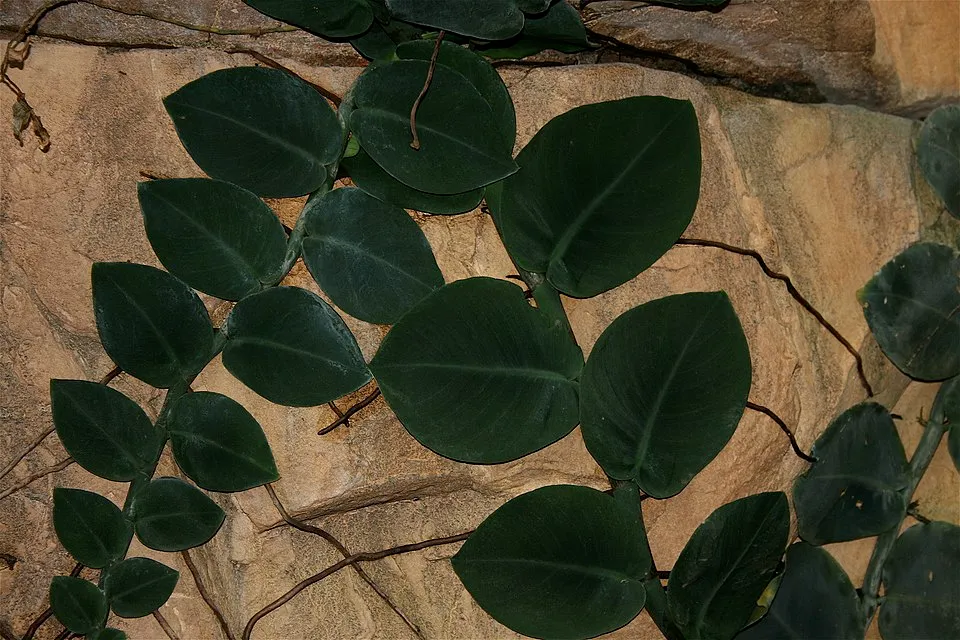
Rhaphidophora korthalsii, commonly known as Dragon Tail or Shingle Plant, is a striking perennial climbing vine indigenous to the humid tropical rainforests of Southeast Asia, with a native distribution spanning Malaysia, Indonesia, and Singapore. Belonging to the Araceae family, this plant is characterized by its distinctive foliage.
The leaves are typically heart-shaped to ovate, with a glossy, dark green surface and a somewhat leathery texture that aids in moisture retention within its naturally moist environment. These leaves can achieve impressive sizes, often reaching up to 30 centimeters in length, and are known for their habit of 'shingling' or pressing flat against tree trunks as the plant climbs, an adaptation to maximize light capture in dense forest understories.
As a hemiepiphyte, Rhaphidophora korthalsii utilizes robust aerial roots to anchor itself firmly to host trees or other structures, allowing it to ascend considerable heights. While its inflorescences, consisting of a characteristic spadix enveloped by a spathe, are less frequently observed in cultivated settings, they are typical of the Araceae family.
In horticultural contexts, particularly as an indoor ornamental, the plant is prized for its unique foliage and its adaptability to varied indoor conditions, making it a popular choice for tropical plant enthusiasts.
Trusted Scientific References
1. Authoritative external sources for Rhaphidophora korthalsii
1.1 Wikipedia — Rhaphidophora korthalsii
1.2 Kew POWO (Plants of the World Online)
1.3 PubMed — peer-reviewed research
1.4 NCBI Taxonomy Browser
1.5 GBIF — Global Biodiversity
1.6Raphidophora Korthalsii should be interpreted through verified botanical identity, practical care, and responsible safety language. This recovery note adds the missing context needed for a complete profile: match light to the plant's habit, use well-drained soil, water according to season, and avoid unsupported medicinal or edible claims. For publishing, the plant can be presented as a source-backed indoor plant with clear care guidance, common problem diagnosis, and conservative safety wording.
1.1.Raphidophora Korthalsii — Key Features
- ✓ <strong>Botanical Name</strong> — Rhaphidophora korthalsii, a member of the Araceae family.
- ✓ <strong>Common Names</strong> — Dragon Tail, Shingle Plant, due to its unique leaf growth habit.
- ✓ <strong>Native Habitat</strong> — Tropical rainforests of Southeast Asia, including Malaysia and Indonesia.
- ✓ <strong>Morphological Traits</strong> — Large, glossy, heart-shaped leaves that 'shingle' on surfaces.
- ✓ <strong>Medicinal Uses</strong> — Traditional Chinese Medicine for cancer and skin conditions.
- ✓ <strong>Immunomodulatory</strong> — Research shows enhanced Natural Killer cell cytotoxicity.
- ✓ <strong>Active Compounds</strong> — Rich in phenolics, flavonoids, and indole derivatives like DHI.
- ✓ <strong>Horticultural Value</strong> — Popular as an ornamental houseplant for its unique foliage.
- ✓ <strong>Aerial Roots</strong> — Produces strong aerial roots for climbing and support.
- ✓ <strong>Hemiepiphytic Nature</strong> — Begins life rooted in soil, then climbs and can become epiphytic.
1.2.Raphidophora Korthalsii — Quick Summary
- ✓ Rhaphidophora korthalsii is a Southeast Asian climbing vine from the Araceae family.
- ✓ Traditionally used in TCM for cancer and skin diseases, known as Dragon Tail.
- ✓ Scientific research confirms immunomodulatory effects, boosting NK cell activity.
- ✓ Contains active compounds like 5,6-dihydroxyindole (DHI) with cytotoxic potential.
- ✓ Requires careful preparation due to calcium oxalate crystals; avoid raw ingestion.
- ✓ Popular ornamental plant, also valued for potential air purification.
2.Raphidophora Korthalsii — Scientific Identity
3.Raphidophora Korthalsii — Quick Facts
4.Raphidophora Korthalsii — Appearance & Identification
5.Raphidophora Korthalsii — Native Habitat
6.Raphidophora Korthalsii — Water Requirements
- ✓ Soil Preference — Rhaphidophora korthalsii thrives in well-draining, rich potting soil, ideally an aroid mix with good aeration.
- ✓ Watering Schedule — Water thoroughly when the top inch or two of soil feels dry to the touch, allowing excess water to drain to prevent root rot.
- ✓ Humidity Requirements — This tropical vine prefers high humidity, ideally above 60%, benefiting from regular misting or placement near a humidifier.
- ✓ Light Conditions — Prefers bright, indirect light; direct sunlight can scorch its leaves. It tolerates lower light but growth may be slower.
- ✓ Fertilization — During its active growing season (spring and summer), fertilize every 2-4 weeks with a balanced liquid fertilizer diluted to half strength.
- ✓ Pruning Techniques — Regular pruning helps encourage bushier growth and can be used to manage its climbing habit, especially for indoor cultivation.
- ✓ Support Structure — Provide a moss pole or trellis for its aerial roots to cling to, mimicking its natural climbing behavior and promoting larger leaf development.
- ✓ Temperature Range — Maintain temperatures between 18-29°C (65-85°F); avoid cold drafts and temperatures below 15°C (60°F).
Reviewed by the Flora Medical Global Botanical Review Panel
Multi-disciplinary editorial group · Botany · Ethnobotany · Herbal-medicine literature
Who reviewed this: This page was checked by the Flora Medical Global Botanical Review Panel — an in-house editorial group of botany graduates, ethnobotany researchers, and horticulture practitioners who collectively maintain our 7,000+ plant encyclopedia. Meet the team.
Our 4-step verification process
1. Taxonomic verification
Scientific names and synonyms cross-checked against Kew POWO, World Flora Online, and The Plant List.
2. Phytochemical & medicinal cross-reference
Active compounds, traditional uses, and reported activities are cross-referenced with PubMed, USDA Dr. Duke's database, and peer-reviewed ethnobotanical literature.
3. Conservation & distribution check
Distribution, ecology, and conservation status confirmed against GBIF occurrence records and the IUCN Red List.
4. Editorial & safety review
Every entry passes an editorial pass for clarity, originality, and safety notices (toxicity, contraindications, dosage caveats) before publication.
Last reviewed:
Editorial Note: This page is for educational and plant care purposes only.
Written by: Flora Medical Global Editorial Team
Reviewed by: Flora Medical Global Botanical Review Panel
Last Updated: June 15, 2026







Raphidophora Korthalsii — Comments & Community Reviews
Rate this plant