
Care Disclaimer: Plant care recommendations are general guidelines based on common growing conditions. Individual results may vary based on your local environment, climate, and care routine. If your plant is toxic, keep it away from children and pets, and consult a veterinarian if accidental ingestion occurs.
1.Rhipsalis Ewaldiana — Overview
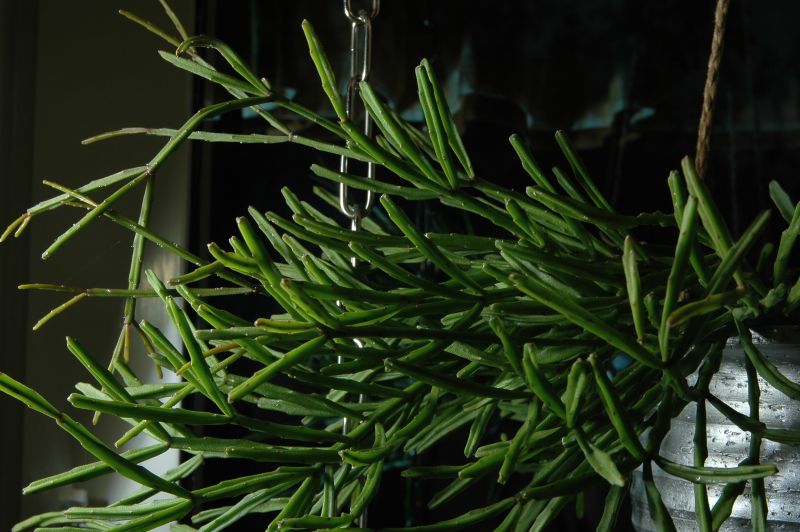
Rhipsalis ewaldiana, commonly known as Ewald's Rhipsalis or Mistletoe Cactus, is a captivating epiphytic member of the Cactaceae family, indigenous to the tropical and subtropical forests of southeastern Brazil, particularly within the Atlantic Forest biome. This species is predominantly found clinging to tree trunks and branches, utilizing them for support rather than as a parasitic host, thriving in the dappled light and high humidity characteristic of its native environment. Morphologically, Rhipsalis ewaldiana is distinguished by its cascading, segmented stems, which present as slender, cylindrical to slightly flattened, bright green chains. These succulent stems can attain lengths of up to 2 meters, developing an elegant, pendulous habit that makes the plant highly sought after in ornamental horticulture, especially for hanging baskets. The individual stem segments are typically smooth, glabrous, and can branch profusely, creating a dense, intricate curtain of foliage.
Unlike many desert cacti, Rhipsalis ewaldiana lacks prominent spines, possessing instead minute areoles from which its small, often inconspicuous flowers emerge. The blooms are typically solitary or in small clusters, appearing along the stem tips or nodes. They are relatively small, usually white or cream-colored, delicate, and star-shaped, often blooming during the cooler, drier months. Following successful pollination, these flowers give way to small, spherical, berry-like fruits. These fruits are typically vibrant red or purple when mature, adding a decorative contrast to the green stems, and are considered edible, though often bland in flavor.
The root system is fibrous and adapted for clinging to rough bark, absorbing moisture and nutrients from the humid air and accumulated organic debris. Taxonomically, Rhipsalis ewaldiana belongs to the genus Rhipsalis, which encompasses approximately 35-60 species, all native to the Americas, with the highest diversity in Brazil. The genus name 'Rhipsalis' derives from the ancient Greek word for 'wickerwork,' referring to the plant's flexible, interwoven branches. This species is valued primarily for its aesthetic appeal and ease of cultivation as an indoor or greenhouse plant.
Trusted Scientific References
1. Authoritative external sources for Rhipsalis ewaldiana
1.1 Wikipedia — Rhipsalis ewaldiana
1.2 Kew POWO (Plants of the World Online)
1.3 PubMed — peer-reviewed research
1.4 NCBI Taxonomy Browser
1.5 GBIF — Global Biodiversity
1.1.Rhipsalis Ewaldiana — Key Features
- ✓ <strong>Epiphytic Growth Habit</strong> — Naturally grows on trees for support, not as a parasite, in its native tropical habitat.
- ✓ <strong>Cascading Stems</strong> — Long, pendulous, segmented stems make it highly decorative for hanging displays.
- ✓ <strong>Succulent Nature</strong> — Stems are succulent, allowing water storage and adaptation to humid but sometimes dry conditions.
- ✓ <strong>Spineless Cactus</strong> — Unlike many cacti, Rhipsalis ewaldiana lacks prominent spines, making it easy to handle.
- ✓ <strong>Small, Delicate Flowers</strong> — Produces inconspicuous white or cream-colored, star-shaped flowers along its stems.
- ✓ <strong>Edible Berry</strong> — like Fruits — Develops small, vibrant red or purple fruits that are edible, though mild in taste.
- ✓ <strong>Native to Atlantic Forest</strong> — Indigenous to the tropical and subtropical forests of southeastern Brazil.
- ✓ <strong>Low Maintenance Ornamental</strong> — Popular as a houseplant due to its unique appearance and relatively easy care requirements.
- ✓ <strong>High Humidity Preference</strong> — Thrives in environments with consistent high humidity, reflecting its rainforest origins.
- ✓ <strong>Dappled Light Adaptation</strong> — Prefers indirect or filtered light, sensitive to intense direct sunlight.
1.2.Rhipsalis Ewaldiana — Quick Summary
- ✓ Rhipsalis ewaldiana is an epiphytic cactus from Brazil, known for its cascading green stems.
- ✓ Primarily valued as an ornamental houseplant, thriving in humid, indirect light conditions.
- ✓ Produces small, edible, berry-like fruits that are typically bland in flavor.
- ✓ Specific medicinal uses for R. ewaldiana are not widely documented in modern research.
- ✓ Contains general plant compounds like flavonoids and mucilage, offering potential antioxidant and hydrating benefits.
- ✓ Requires well-draining soil, warm temperatures, and is not frost tolerant.
2.Rhipsalis Ewaldiana — Scientific Identity
3.Rhipsalis Ewaldiana — Quick Facts
4.Rhipsalis Ewaldiana — Appearance & Identification
5.Rhipsalis Ewaldiana — Native Habitat
6.Rhipsalis Ewaldiana — Water Requirements
- ✓ Light — Prefers bright, indirect light; avoid direct, harsh sun which can scorch stems. Dappled shade is ideal.
- ✓ Watering — Water thoroughly when the top inch of soil feels dry, then allow to drain completely. Reduce watering in cooler, dormant months.
- ✓ Humidity — Thrives in high humidity, mimicking its native rainforest environment. Regular misting or a humidity tray is beneficial.
- ✓ Soil — Requires a well-draining, airy potting mix, typically an orchid or succulent mix with added perlite or bark.
- ✓ Temperature — Best grown in warm temperatures, between 18-29°C (65-85°F). Not frost tolerant, protect from cold drafts.
- ✓ Fertilization — Feed monthly during the growing season (spring and summer) with a balanced liquid fertilizer diluted to half strength.
- ✓ Propagation — Easily propagated from stem cuttings. Allow cuttings to callus for a few days before planting in moist, well-draining soil.
- ✓ Support — As an epiphytic plant with cascading stems, it is best grown in hanging baskets or on elevated surfaces to allow its foliage to trail.
Reviewed by the Flora Medical Global Botanical Review Panel
Multi-disciplinary editorial group · Botany · Ethnobotany · Herbal-medicine literature
Who reviewed this: This page was checked by the Flora Medical Global Botanical Review Panel — an in-house editorial group of botany graduates, ethnobotany researchers, and horticulture practitioners who collectively maintain our 7,000+ plant encyclopedia. Meet the team.
Our 4-step verification process
1. Taxonomic verification
Scientific names and synonyms cross-checked against Kew POWO, World Flora Online, and The Plant List.
2. Phytochemical & medicinal cross-reference
Active compounds, traditional uses, and reported activities are cross-referenced with PubMed, USDA Dr. Duke's database, and peer-reviewed ethnobotanical literature.
3. Conservation & distribution check
Distribution, ecology, and conservation status confirmed against GBIF occurrence records and the IUCN Red List.
4. Editorial & safety review
Every entry passes an editorial pass for clarity, originality, and safety notices (toxicity, contraindications, dosage caveats) before publication.
Last reviewed:
Editorial Note: This page is for educational and plant care purposes only.
Written by: Flora Medical Global Editorial Team
Reviewed by: Flora Medical Global Botanical Review Panel
Last Updated: June 15, 2026







Rhipsalis Ewaldiana — Comments & Community Reviews
Rate this plant