
Care Disclaimer: Plant care recommendations are general guidelines based on common growing conditions. Individual results may vary based on your local environment, climate, and care routine. If your plant is toxic, keep it away from children and pets, and consult a veterinarian if accidental ingestion occurs.
1.Roridula — Overview
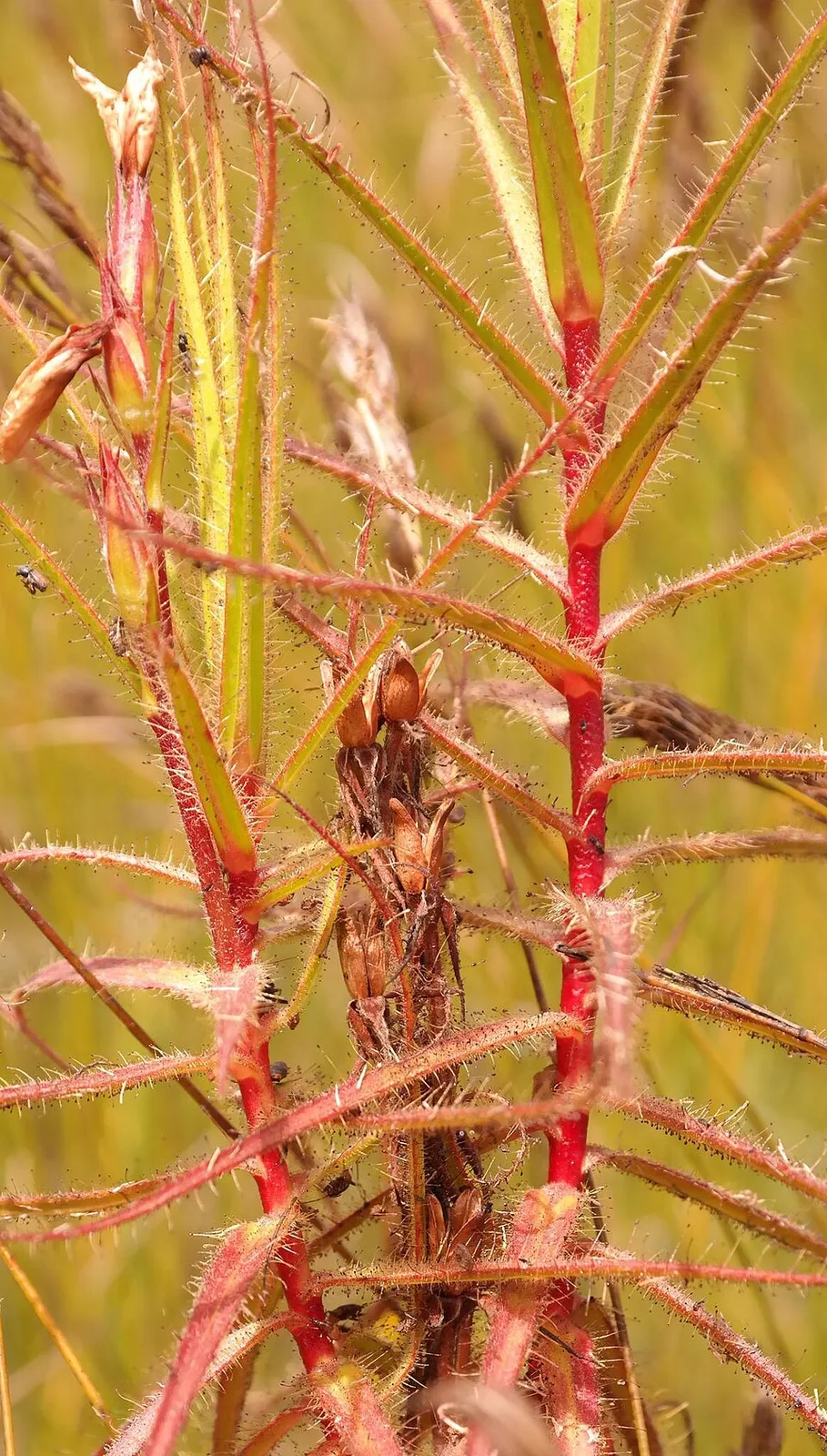
Roridula gorgonias is an intriguing perennial woody shrub endemic to the southwestern Cape Floral Kingdom of South Africa. This unique member of the Roridulaceae family, which comprises only two species, exhibits a distinctive growth habit, typically reaching about 1 meter in height with fewer branches compared to its congener, R. dentata. Its fleshy, succulent leaves, arranged in opposite pairs, are oval to oblong and measure approximately 5 to 10 cm in length.
These leaves are densely covered with specialized glandular hairs that secrete a potent, resinous adhesive, effectively trapping a wide array of insects. Unlike typical carnivorous plants that digest their prey directly, Roridula gorgonias engages in a remarkable symbiotic relationship with a species-specific assassin bug, Pameridea roridulae. The plant's flowers are borne in clusters, featuring five white to pale pink petals and an prominent corona. It thrives in the nutrient-poor, sandy soils of fynbos ecosystems, an environment characterized by warm, dry summers, cool, rainy winters, and a dependence on periodic fires for regeneration.
Its habitat often includes streamsides and damp spots within this scrubby vegetation. The plant's adaptations, including UV-reflective leaves and a subtle, sweet fragrance, are believed to attract insect prey, making Roridula gorgonias a fascinating subject for ecological and botanical study.
Trusted Scientific References
1. Authoritative external sources for Roridula gorgonias
1.1 Wikipedia — Roridula gorgonias
1.2 Kew POWO (Plants of the World Online)
1.3 PubMed — peer-reviewed research
1.4 NCBI Taxonomy Browser
1.5 GBIF — Global Biodiversity
1.6Roridula should be interpreted through verified botanical identity, practical care, and responsible safety language. This recovery note adds the missing context needed for a complete profile: match light to the plant's habit, use well-drained soil, water according to season, and avoid unsupported medicinal or edible claims. For publishing, the plant can be presented as a source-backed indoor plant with clear care guidance, common problem diagnosis, and conservative safety wording.
1.1.Roridula — Key Features
- ✓ <strong>Endemic to the</strong> — Endemic to the Cape Floral Kingdom, South Africa.
- ✓ <strong>Exhibits 'indirect carnivory'</strong> — Exhibits 'indirect carnivory' through a symbiotic relationship with assassin bugs.
- ✓ <strong>Possesses highly adhesive,</strong> — Possesses highly adhesive, resinous glandular hairs for insect trapping.
- ✓ <strong>Leaves are strongly</strong> — Leaves are strongly reflective in ultraviolet wavelengths, attracting prey.
- ✓ <strong>Emits a subtle, sweet, vanilla</strong> — like fragrance, possibly for insect luring.
- ✓ <strong>A specialist plant of the nutrient</strong> — poor fynbos ecosystem.
- ✓ <strong>Belongs to the</strong> — Belongs to the Roridulaceae family, sister to Actinidiaceae and Sarraceniaceae.
- ✓ <strong>Adapts to periodic</strong> — Adapts to periodic fires in its natural habitat for regeneration.
- ✓ <strong>Of significant interest</strong> — Of significant interest for ecological, evolutionary, and phytochemical research.
- ✓ <strong>Not traditionally recognized</strong> — Not traditionally recognized for any direct medicinal applications.
1.2.Roridula — Quick Summary
- ✓ Roridula gorgonias is a unique carnivorous shrub from South Africa's fynbos.
- ✓ It traps insects with sticky, resinous glandular hairs but does not digest them directly.
- ✓ The plant relies on a symbiotic relationship with assassin bugs, which digest prey and provide nutrients.
- ✓ Its leaves are UV-reflective and emit a sweet fragrance to attract insects.
- ✓ Primarily a subject of ecological and phytochemical research, with no established medicinal uses.
- ✓ Cultivated as an ornamental curiosity for its extraordinary adaptations.
2.Roridula — Scientific Identity
3.Roridula — Quick Facts
4.Roridula — Appearance & Identification
5.Roridula — Native Habitat
6.Roridula — Water Requirements
- ✓ Soil Preference — Roridula gorgonias thrives in well-drained, sandy, and nutrient-poor soil, mimicking its native fynbos habitat. A mix of peat, sand, and perlite is often recommended.
- ✓ Light Requirements — Provide bright, direct sunlight for several hours daily. It prefers high light intensity, reflecting its open, sun-exposed natural environment.
- ✓ Watering Regimen — Water sparingly, allowing the soil to dry out almost completely between waterings. Overwatering can lead to root rot, especially in high-humidity indoor environments.
- ✓ Temperature and Humidity — Prefers warm, dry summers and cooler, rainy winters. Maintain moderate humidity; avoid excessively humid conditions which can encourage fungal issues.
- ✓ Nutrient Avoidance — Do not fertilize with traditional plant nutrients, as Roridula gorgonias is adapted to nutrient-scarce soils and obtains nitrogen from insects.
- ✓ Propagation — Primarily propagated from seed, which often requires specific stratification or fire treatment to simulate natural fynbos conditions for germination.
- ✓ Indoor Cultivation — Can be grown indoors in specialized setups such as terrariums or conservatories where light, temperature, and humidity can be carefully controlled.
Reviewed by the Flora Medical Global Botanical Review Panel
Multi-disciplinary editorial group · Botany · Ethnobotany · Herbal-medicine literature
Who reviewed this: This page was checked by the Flora Medical Global Botanical Review Panel — an in-house editorial group of botany graduates, ethnobotany researchers, and horticulture practitioners who collectively maintain our 7,000+ plant encyclopedia. Meet the team.
Our 4-step verification process
1. Taxonomic verification
Scientific names and synonyms cross-checked against Kew POWO, World Flora Online, and The Plant List.
2. Phytochemical & medicinal cross-reference
Active compounds, traditional uses, and reported activities are cross-referenced with PubMed, USDA Dr. Duke's database, and peer-reviewed ethnobotanical literature.
3. Conservation & distribution check
Distribution, ecology, and conservation status confirmed against GBIF occurrence records and the IUCN Red List.
4. Editorial & safety review
Every entry passes an editorial pass for clarity, originality, and safety notices (toxicity, contraindications, dosage caveats) before publication.
Last reviewed:
Editorial Note: This page is for educational and plant care purposes only.
Written by: Flora Medical Global Editorial Team
Reviewed by: Flora Medical Global Botanical Review Panel
Last Updated: June 15, 2026







Roridula — Comments & Community Reviews
Rate this plant