


Care Disclaimer: Plant care recommendations are general guidelines based on common growing conditions. Individual results may vary based on your local environment, climate, and care routine. If your plant is toxic, keep it away from children and pets, and consult a veterinarian if accidental ingestion occurs.
1.Sansevieria Cylindrica (Cylindrical Snake) — Overview
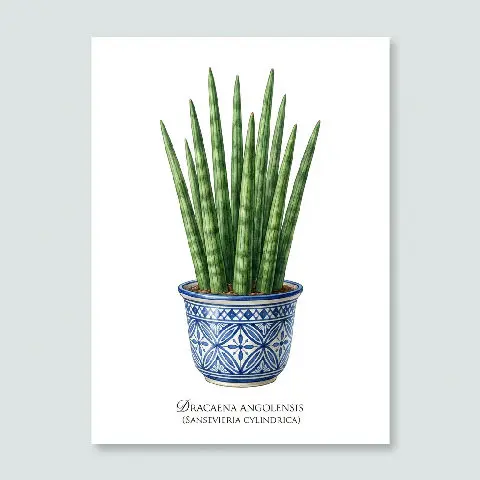
Dracaena angolensis, widely recognized by its former botanical name Sansevieria cylindrica, and commonly known as the Cylindrical Snake Plant or African Spear, is a distinctive perennial herbaceous succulent belonging to the Asparagaceae family. This species is celebrated for its striking architectural form, characterized by stiff, upright, cylindrical leaves that can reach impressive lengths of up to 1 meter (3 feet) and a diameter of approximately 2-3 centimeters. Unlike the more common flat-leaved snake plants, its unique cylindrical morphology gives it a sculptural quality, making it a popular choice in contemporary interior design. The leaves typically display a vibrant green hue, often adorned with subtle grey-green horizontal banding, and their texture can range from smooth to slightly rough depending on the specific cultivar or variety.
The apex of each leaf usually tapers to a pointed, sometimes sharp, tip. Native to the tropical regions of West Africa, Dracaena angolensis thrives in arid to semi-arid environments, predominantly found in savannahs, rocky outcrops, and open woodlands. Its natural habitat suggests a preference for well-drained, sandy or gravelly soils and a remarkable tolerance for periods of drought. While it can withstand full sun in its native range, it often grows in areas that receive filtered light or partial shade, which contributes to its exceptional adaptability as an indoor plant.
The plant's robust rhizomatous root system allows it to spread slowly, forming dense clumps over time and aiding in its exceptional drought resistance by storing water and nutrients. The reproductive structures of the Cylindrical Snake Plant are equally intriguing, though less frequently observed in cultivated settings. Small, delicate, white or cream-colored flowers emerge on tall, slender spikes that can ascend to heights of up to 3 feet (90 cm). These inflorescences are known for their sweet, somewhat musky fragrance, which is most pronounced during the evening hours, attracting nocturnal pollinators in its natural environment.
Trusted Scientific References
1. Authoritative external sources for Dracaena angolensis
1.1 Wikipedia — Dracaena angolensis
1.2 Kew POWO (Plants of the World Online)
1.3 PubMed — peer-reviewed research
1.4 NCBI Taxonomy Browser
1.5 GBIF — Global Biodiversity
1.1.Sansevieria Cylindrica (Cylindrical Snake) — Key Features
- ✓ <strong>Unique Cylindrical Foliage</strong> — Distinctive, stiff, upright cylindrical leaves.
- ✓ <strong>Ornamental Value</strong> — Highly prized for its sculptural, modern aesthetic in interior design.
- ✓ <strong>Air Purifying Qualities</strong> — Known to absorb indoor toxins and odors.
- ✓ <strong>Drought Tolerant</strong> — Excellent resilience in arid and semi-arid conditions.
- ✓ <strong>Low Maintenance</strong> — Easy to care for, suitable for beginners.
- ✓ <strong>Traditional Medicinal Uses</strong> — Extensive history in African and Asian folk medicine.
- ✓ <strong>Rich Phytochemical Profile</strong> — Contains beneficial compounds like saponins and polyphenols.
- ✓ <strong>Antioxidant & Antibacterial</strong> — Scientifically studied for these pharmacological actions.
- ✓ <strong>Rhizomatous Growth</strong> — Spreads slowly via underground rhizomes.
- ✓ <strong>Nocturnal Fragrance</strong> — Flowers emit a sweet, musky scent at night.
1.2.Sansevieria Cylindrica (Cylindrical Snake) — Quick Summary
- ✓ Dracaena angolensis, or Cylindrical Snake Plant, is a striking succulent.
- ✓ Native to West Africa, known for drought tolerance and air purification.
- ✓ Traditionally used for coughs, diarrhea, wounds, and inflammation.
- ✓ Rich in alkaloids, saponins, polyphenols, exhibiting antioxidant and antibacterial properties.
- ✓ Requires well-drained soil and bright indirect light for cultivation.
- ✓ Mildly toxic if ingested; not for internal use without expert supervision.
2.Sansevieria Cylindrica (Cylindrical Snake) — Scientific Identity
3.Sansevieria Cylindrica (Cylindrical Snake) — Quick Facts
4.Sansevieria Cylindrica (Cylindrical Snake) — Appearance & Identification
5.Sansevieria Cylindrica (Cylindrical Snake) — Native Habitat
6.Sansevieria Cylindrica (Cylindrical Snake) — Water Requirements
- ✓ Soil Requirements — Prefers well-drained, sandy, or gravelly soil mixes; a succulent or cactus potting mix is ideal to prevent root rot.
- ✓ Light Conditions — Thrives in bright, indirect light but can tolerate partial shade or even low light conditions, making it highly adaptable for indoor cultivation.
- ✓ Watering Schedule — Requires infrequent watering; allow the soil to dry out completely between waterings to mimic its native arid habitat and prevent overwatering.
- ✓ Temperature & Humidity — Prefers warm temperatures between 18-35°C (65-95°F) and tolerates average indoor humidity; avoid cold drafts.
- ✓ Propagation — Easily propagated by stem cuttings or division of rhizomes; allow cuttings to callus for a few days before planting.
- ✓ Fertilization — Fertilize sparingly during the growing season (spring/summer) with a diluted balanced liquid fertilizer, typically once a month or less.
- ✓ Pest & Disease Management — Generally pest-resistant; watch for mealybugs or spider mites, and ensure good air circulation to prevent fungal issues.
- ✓ Container Choice — Use pots with drainage holes to ensure excess water can escape, preventing waterlogged soil.
Reviewed by the Flora Medical Global Botanical Review Panel
Multi-disciplinary editorial group · Botany · Ethnobotany · Herbal-medicine literature
Who reviewed this: This page was checked by the Flora Medical Global Botanical Review Panel — an in-house editorial group of botany graduates, ethnobotany researchers, and horticulture practitioners who collectively maintain our 7,000+ plant encyclopedia. Meet the team.
Our 4-step verification process
1. Taxonomic verification
Scientific names and synonyms cross-checked against Kew POWO, World Flora Online, and The Plant List.
2. Phytochemical & medicinal cross-reference
Active compounds, traditional uses, and reported activities are cross-referenced with PubMed, USDA Dr. Duke's database, and peer-reviewed ethnobotanical literature.
3. Conservation & distribution check
Distribution, ecology, and conservation status confirmed against GBIF occurrence records and the IUCN Red List.
4. Editorial & safety review
Every entry passes an editorial pass for clarity, originality, and safety notices (toxicity, contraindications, dosage caveats) before publication.
Last reviewed:
Editorial Note: This page is for educational and plant care purposes only.
Written by: Flora Medical Global Editorial Team
Reviewed by: Flora Medical Global Botanical Review Panel
Last Updated: June 15, 2026







Sansevieria Cylindrica (Cylindrical Snake) — Comments & Community Reviews
Rate this plant