
Care Disclaimer: Plant care recommendations are general guidelines based on common growing conditions. Individual results may vary based on your local environment, climate, and care routine. If your plant is toxic, keep it away from children and pets, and consult a veterinarian if accidental ingestion occurs.
1.Sarracenia Purpurea — Overview
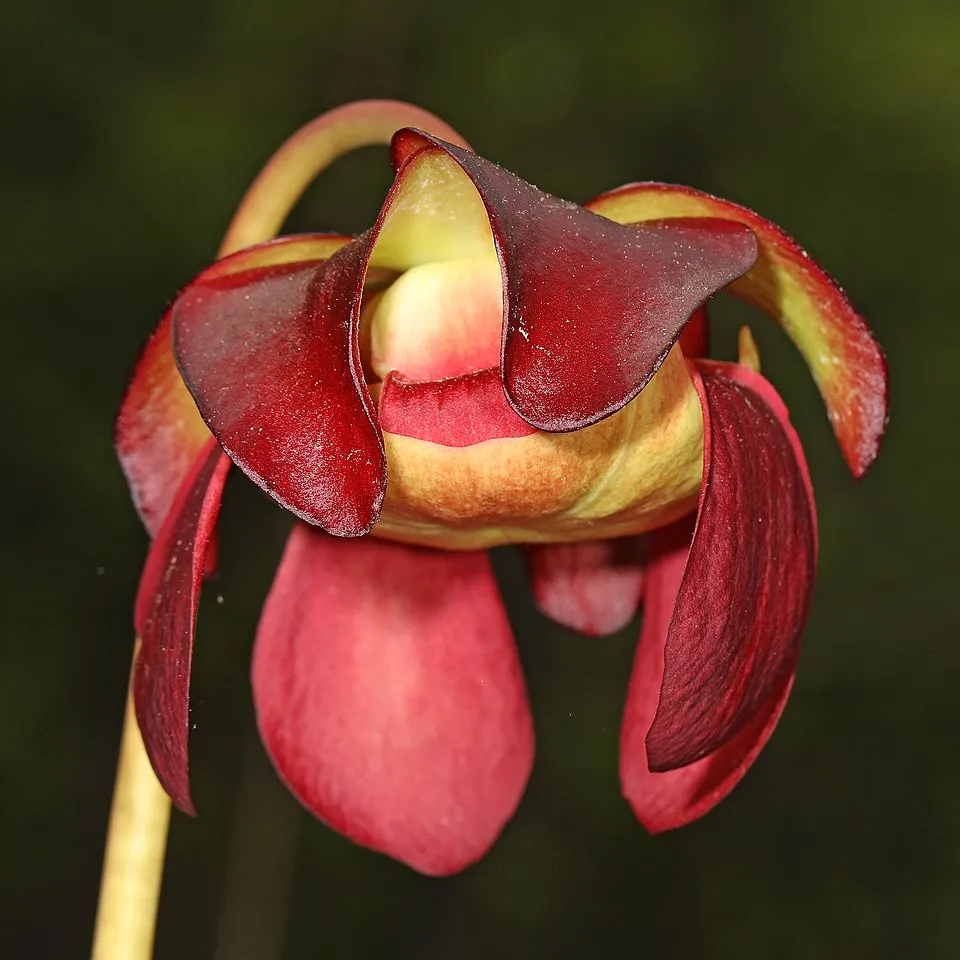
Sarracenia purpurea, commonly known as the purple pitcher plant, is a captivating perennial herbaceous plant indigenous to the diverse wetlands of eastern North America, extending from the Canadian provinces down to the southeastern United States. This remarkable species is a true botanical marvel, primarily distinguished by its highly specialized, pitcher-shaped leaves that function as passive traps for insects. These leaves are robust, tubular structures, often displaying a striking palette of vibrant purples, reds, and greens, which intensifies with direct sunlight exposure. Unlike many other pitcher plants, Sarracenia purpurea possesses a less pronounced, often erect lid (operculum), which uniquely allows rainwater to collect within its pitchers.
The inner surfaces of these pitchers are intricately lined with downward-pointing hairs, creating a slippery barrier that impedes the escape of trapped prey, guiding them into a pool of liquid at the base. This fluid, a complex mixture of the plant's own digestive enzymes and a symbiotic community of commensal bacteria and protozoa, meticulously breaks down the trapped insects. This carnivorous adaptation is crucial for the plant to absorb essential nutrients, particularly nitrogen and phosphorus, which are typically scarce in its preferred acidic, waterlogged, and nutrient-poor bog and fen habitats. Its fibrous, shallow root system anchors the plant and absorbs water, but its primary nutrient acquisition strategy remains its fascinating carnivory.
The plant produces solitary, nodding flowers, typically yellow to deep red-purple, borne on tall, leafless scapes above the pitchers, blooming from late spring to early summer. The distinct umbrella-shaped style of the flower cleverly keeps pollinators separate from the insect traps, ensuring reproductive success.
Trusted Scientific References
1. Authoritative external sources for Sarracenia purpurea
1.1 Wikipedia — Sarracenia purpurea
1.2 Kew POWO (Plants of the World Online)
1.3 PubMed — peer-reviewed research
1.4 NCBI Taxonomy Browser
1.5 GBIF — Global Biodiversity
1.1.Sarracenia Purpurea — Key Features
- ✓ <strong>Carnivorous Adaptation</strong> — Utilizes pitcher-shaped leaves to trap and digest insects for nutrient acquisition.
- ✓ <strong>Native to North America</strong> — Indigenous to bogs, fens, and wetlands across eastern Canada and the U.S.
- ✓ <strong>Unique Pitcher Morphology</strong> — Features a less pronounced lid, allowing rainwater to collect, aiding digestion.
- ✓ <strong>Traditional Medicinal Uses</strong> — Historically employed by indigenous cultures for various health concerns.
- ✓ <strong>Sarapin Extract</strong> — A grandfathered FDA-approved injectable product used by professionals for localized pain.
- ✓ <strong>Rich in Phytochemicals</strong> — Contains triterpenoids, flavonoids, and tannins with potential therapeutic properties.
- ✓ <strong>Specific Habitat Requirements</strong> — Thrives in acidic, nutrient-poor, waterlogged soils and full sun.
- ✓ <strong>Distinctive Flowers</strong> — Produces solitary, colorful flowers on tall scapes, separate from the insect traps.
- ✓ <strong>Cold Hardy</strong> — Requires a winter dormancy period, making it suitable for temperate climates.
- ✓ <strong>Ecological Role</strong> — Contributes to the unique biodiversity of wetland ecosystems.
1.2.Sarracenia Purpurea — Quick Summary
- ✓ Sarracenia purpurea is a carnivorous bog plant native to North America.
- ✓ Known for its distinctive pitcher-shaped leaves that trap insects.
- ✓ Traditionally used for various ailments, including digestive issues and pain.
- ✓ A specific injectable extract, Sarapin, is FDA-approved for pain relief.
- ✓ Scientific evidence for most oral uses is insufficient; safety is not well-established.
- ✓ Contains beneficial phytochemicals like triterpenoids and flavonoids.
2.Sarracenia Purpurea — Scientific Identity
3.Sarracenia Purpurea — Quick Facts
4.Sarracenia Purpurea — Appearance & Identification
5.Sarracenia Purpurea — Native Habitat
6.Sarracenia Purpurea — Water Requirements
- ✓ Substrate Requirements — Use a highly acidic, nutrient-poor mix, typically 50% peat moss and 50% perlite or horticultural sand.
- ✓ Water Quality — Always use distilled water, rainwater, or reverse osmosis water; tap water minerals can be detrimental.
- ✓ Watering Technique — Keep the substrate consistently moist, often by placing pots in a tray of water to mimic bog conditions.
- ✓ Light Exposure — Provide full sun exposure for at least 6-8 hours daily to encourage vibrant pitcher coloration and robust growth.
- ✓ Dormancy Period — Requires a cold dormancy period (35-50°F / 2-10°C) for 3-4 months during winter to thrive long-term.
- ✓ Humidity — Prefers high humidity, which can be maintained in bog gardens or terrariums if grown indoors.
- ✓ Fertilization — Avoid fertilizing through the roots; the plant obtains nutrients carnivorously.
- ✓ Propagation — Can be propagated from seeds, rhizome division, or leaf cuttings, with division being the most common for established plants.
Reviewed by the Flora Medical Global Botanical Review Panel
Multi-disciplinary editorial group · Botany · Ethnobotany · Herbal-medicine literature
Who reviewed this: This page was checked by the Flora Medical Global Botanical Review Panel — an in-house editorial group of botany graduates, ethnobotany researchers, and horticulture practitioners who collectively maintain our 7,000+ plant encyclopedia. Meet the team.
Our 4-step verification process
1. Taxonomic verification
Scientific names and synonyms cross-checked against Kew POWO, World Flora Online, and The Plant List.
2. Phytochemical & medicinal cross-reference
Active compounds, traditional uses, and reported activities are cross-referenced with PubMed, USDA Dr. Duke's database, and peer-reviewed ethnobotanical literature.
3. Conservation & distribution check
Distribution, ecology, and conservation status confirmed against GBIF occurrence records and the IUCN Red List.
4. Editorial & safety review
Every entry passes an editorial pass for clarity, originality, and safety notices (toxicity, contraindications, dosage caveats) before publication.
Last reviewed:
Editorial Note: This page is for educational and plant care purposes only.
Written by: Flora Medical Global Editorial Team
Reviewed by: Flora Medical Global Botanical Review Panel
Last Updated: June 15, 2026







Sarracenia Purpurea — Comments & Community Reviews
Rate this plant