

Care Disclaimer: Plant care recommendations are general guidelines based on common growing conditions. Individual results may vary based on your local environment, climate, and care routine. If your plant is toxic, keep it away from children and pets, and consult a veterinarian if accidental ingestion occurs.
1.Scilla Bifolia — Overview
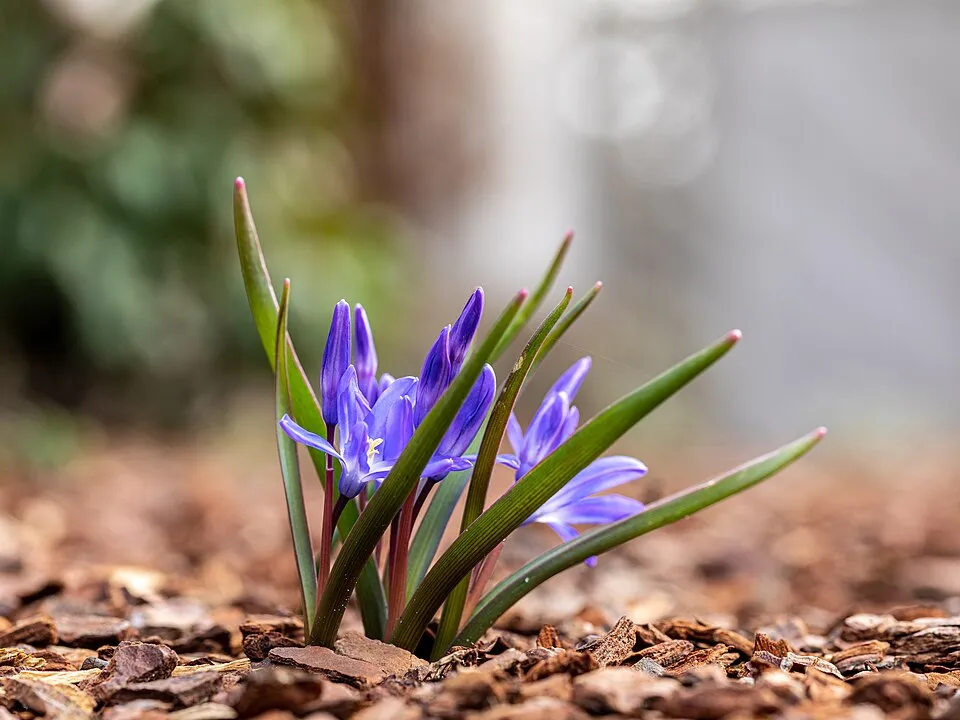
Scilla bifolia, commonly known as two-leaf squill or alpine squill, is a charming perennial herbaceous plant originating from an underground bulb, belonging to the Asparagaceae family. This species is celebrated for its vibrant blue, star-shaped flowers that emerge in early spring, typically from March to May, creating a striking visual display. The plant is characterized by two, or rarely three, narrow, lanceolate, fleshy, and glossy leaves that can reach up to 15 cm in length.
These distinctive leaves clasp the stem up to about its midpoint, providing a unique identification feature. Flowering stems are erect and unbranched, growing 10–20 cm high, bearing a raceme of 6-10 upward-facing flowers, each approximately 1 cm across. While deep violet-blue is most common, varieties with white, pink, or purple tepals also exist.
Native to moist woodlands, meadows, and grasslands across Europe and Western Asia, Scilla bifolia thrives in areas with partial to full shade, often found forming dense clusters under deciduous tree canopies. It prefers well-drained soil rich in organic matter. A key botanical distinction is its upward-facing flowers, differentiating it from the nodding blooms of species like Scilla siberica.
After its flowering period, the foliage persists until summer before dying back, signaling the plant's entry into dormancy until the following spring. Esteemed by gardeners for its beauty and ability to naturalize, Scilla bifolia has also earned the Royal Horticultural Society's Award of Garden Merit for its reliable performance and ornamental appeal.
Trusted Scientific References
1. Authoritative external sources for Scilla bifolia
1.1 Wikipedia — Scilla bifolia
1.2 Kew POWO (Plants of the World Online)
1.3 PubMed — peer-reviewed research
1.4 NCBI Taxonomy Browser
1.5 GBIF — Global Biodiversity
1.6Scilla Bifolia should be interpreted through verified botanical identity, practical care, and responsible safety language. This recovery note adds the missing context needed for a complete profile: match light to the plant's habit, use well-drained soil, water according to season, and avoid unsupported medicinal or edible claims. For publishing, the plant can be presented as a source-backed indoor plant with clear care guidance, common problem diagnosis, and conservative safety wording.
1.1.Scilla Bifolia — Key Features
- ✓ <strong>Botanical Name</strong> — Scilla bifolia.
- ✓ <strong>Common Names</strong> — Two-leaf Squill, Alpine Squill, Bluebell (caution: often confused with other species).
- ✓ <strong>Family</strong> — Asparagaceae.
- ✓ <strong>Active Compounds</strong> — Cardiac glycosides (Scillaren A, Scillaren B).
- ✓ <strong>Traditional Use</strong> — Cardiotonic, diuretic in historical European folk medicine.
- ✓ <strong>Toxicity</strong> — HIGHLY TOXIC if ingested; dangerous for humans and animals.
- ✓ <strong>Bloom Time</strong> — Early spring (March to May).
- ✓ <strong>Flower Color</strong> — Typically deep violet-blue, sometimes white, pink, or purple.
- ✓ <strong>Habitat</strong> — Moist woodlands and meadows across Europe and Western Asia.
- ✓ <strong>Growth Habit</strong> — Perennial herbaceous plant growing from an underground bulb.
1.2.Scilla Bifolia — Quick Summary
- ✓ Potent Cardiac Glycosides — Contains Scillaren A and B, which are cardiotonic but also highly toxic.
- ✓ Highly Toxic Plant — Ingestion of any part, especially the bulb, can be fatal; not for self-medication.
- ✓ Traditional European Use — Historically used as a cardiotonic and diuretic in European folk medicine.
- ✓ Early Spring Bloomer — Valued ornamentally for its vibrant blue flowers in early spring.
- ✓ Botanical Identity — Scientific name is Scilla bifolia, belonging to the Asparagaceae family.
- ✓ Distinctive Leaves — Characterized by two lanceolate leaves clasping the stem.
2.Scilla Bifolia — Scientific Identity
3.Scilla Bifolia — Quick Facts
4.Scilla Bifolia — Appearance & Identification
5.Scilla Bifolia — Native Habitat
6.Scilla Bifolia — Water Requirements
- ✓ Preferred Climate — Thrives in temperate zones (USDA hardiness zones 3-8), tolerating cold winters.
- ✓ Soil Requirements — Prefers well-drained, humus-rich soil, ideally slightly acidic to neutral (pH 6.0-7.0).
- ✓ Light Exposure — Best suited for partial to full shade, especially under deciduous trees where it receives early spring sun before leaf-out.
- ✓ Watering — Requires consistent moisture during its active growth period in spring, becoming drought-tolerant during summer dormancy.
- ✓ Planting — Plant bulbs in autumn, 5-10 cm deep and 10-15 cm apart, for spring bloom.
- ✓ Propagation — Easily propagated by dividing offsets from mature bulbs in late summer or early autumn, or from fresh seeds.
- ✓ Pests and Diseases — Generally robust, but occasionally susceptible to rodent damage to bulbs or slug predation on foliage.
- ✓ Maintenance — Allow foliage to die back naturally after flowering to ensure the bulb stores sufficient energy for the next season.
Reviewed by the Flora Medical Global Botanical Review Panel
Multi-disciplinary editorial group · Botany · Ethnobotany · Herbal-medicine literature
Who reviewed this: This page was checked by the Flora Medical Global Botanical Review Panel — an in-house editorial group of botany graduates, ethnobotany researchers, and horticulture practitioners who collectively maintain our 7,000+ plant encyclopedia. Meet the team.
Our 4-step verification process
1. Taxonomic verification
Scientific names and synonyms cross-checked against Kew POWO, World Flora Online, and The Plant List.
2. Phytochemical & medicinal cross-reference
Active compounds, traditional uses, and reported activities are cross-referenced with PubMed, USDA Dr. Duke's database, and peer-reviewed ethnobotanical literature.
3. Conservation & distribution check
Distribution, ecology, and conservation status confirmed against GBIF occurrence records and the IUCN Red List.
4. Editorial & safety review
Every entry passes an editorial pass for clarity, originality, and safety notices (toxicity, contraindications, dosage caveats) before publication.
Last reviewed:
Editorial Note: This page is for educational and plant care purposes only.
Written by: Flora Medical Global Editorial Team
Reviewed by: Flora Medical Global Botanical Review Panel
Last Updated: June 15, 2026







Scilla Bifolia — Comments & Community Reviews
Rate this plant