
Care Disclaimer: Plant care recommendations are general guidelines based on common growing conditions. Individual results may vary based on your local environment, climate, and care routine. If your plant is toxic, keep it away from children and pets, and consult a veterinarian if accidental ingestion occurs.
1.Sedum Adolphii — Overview
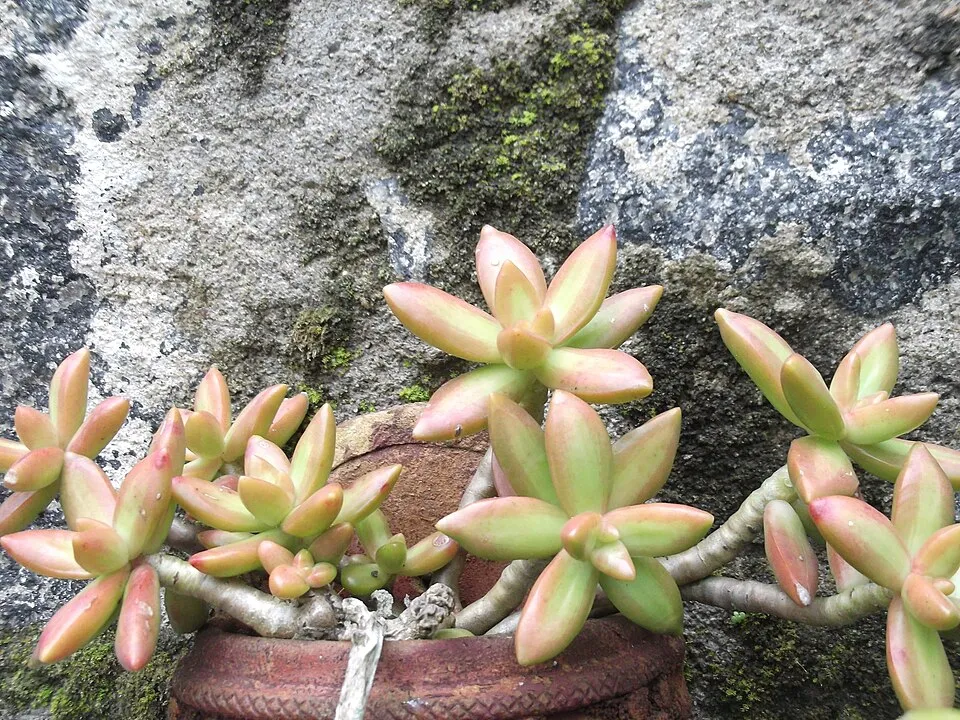
Sedum adolphii, commonly known as Golden Sedum or Adolph's Stonecrop, is a captivating succulent species native to the arid and semi-arid regions of Mexico, primarily found in states like Veracruz and Puebla. This perennial plant, a distinguished member of the Crassulaceae family, exemplifies remarkable adaptive evolution, thriving in environments characterized by scarce water resources. Its distinct morphology is defined by fleshy, turgid leaves, ingeniously designed for efficient water storage, enabling it to withstand prolonged periods of drought. These leaves are typically oblanceolate to spatulate in shape, measuring approximately 2 to 4 cm in length. They display a vibrant spectrum of yellow-green hues, which intensify into warm orange or reddish tints along their margins when exposed to ample sunlight or cooler temperatures. The leaves are arranged in dense, spiraling rosettes or clusters along sprawling stems, gradually forming an attractive, mat-like ground cover.
The stems of Sedum adolphii are relatively slender, often exhibiting a trailing or decumbent growth habit. They possess the unique ability to root along their length wherever they make contact with the soil, significantly contributing to the plant's natural spreading tendency. Its root system is characteristically fibrous and shallow, an adaptation optimized for rapidly absorbing surface moisture after infrequent rainfall events. During its typical blooming season, spanning from late spring through summer, the plant produces delicate yet cheerful inflorescences. These consist of small, star-shaped flowers, usually a bright yellow, clustered in terminal cymes that emerge gracefully above the foliage. Each flower typically possesses five petals, making them highly attractive to a diverse range of pollinators, predominantly bees and butterflies, which are vital for its reproductive success.
Ecologically, Sedum adolphii functions as a hardy pioneer species, frequently colonizing rocky slopes, cliffs, and dry scrublands at elevations ranging from 1,200 to 2,800 meters. Its widespread native habitat across various Mexican states underscores its adaptability to diverse microclimates within its preferred dry, sunny conditions. A pivotal physiological adaptation is its capacity to perform Crassulacean Acid Metabolism (CAM) photosynthesis. This mechanism allows the plant to open its stomata at night to absorb carbon dioxide, minimizing water loss during the day when temperatures are high, furthe ...[CURRENT TEXT EXISTS: 3049 chars]
1.1.Sedum Adolphii — Key Features
- ✓ <strong>Succulent Morphology</strong> — Features fleshy, water-storing oblanceolate to spatulate leaves that display vibrant yellow-green to orange-red hues.
- ✓ <strong>Drought Tolerance</strong> — Highly adapted to arid conditions through water-storing tissues and Crassulacean Acid Metabolism (CAM) photosynthesis.
- ✓ <strong>Mat</strong> — forming Growth — Produces sprawling, decumbent stems that readily root, forming a dense ground cover over time.
- ✓ <strong>Showy Flowers</strong> — Bears small, star-shaped, bright yellow flowers arranged in terminal cymes during its late spring to summer blooming season.
- ✓ <strong>Low Maintenance</strong> — Requires minimal care once established, making it an excellent choice for xeriscaping and low-water gardens.
- ✓ <strong>Ornamental Value</strong> — Highly prized for its striking foliage coloration and ease of cultivation in rock gardens, containers, and as an indoor accent.
- ✓ <strong>Native to Mexico</strong> — Indigenous to the arid and semi-arid regions of Mexico, demonstrating resilience in challenging environments.
- ✓ <strong>CAM Photosynthesis</strong> — A key physiological adaptation allowing efficient water use by opening stomata at night.
- ✓ <strong>Easy Propagation</strong> — Readily multiplies from simple stem or leaf cuttings, making it simple to share and expand collections.
- ✓ <strong>Cold Sensitivity</strong> — Not frost-hardy, necessitating protection from freezing temperatures in colder climates.
1.2.Sedum Adolphii — Quick Summary
- ✓ Primary Use — Ornamental succulent with potential traditional topical applications for minor skin issues and inflammation.
- ✓ Key Compounds — Rich in flavonoids, phenolic acids, saponins, and triterpenoids, contributing to antioxidant and anti-inflammatory effects.
- ✓ Growth Habit — Drought-tolerant, mat-forming perennial, ideal for xeriscaping and rock gardens.
- ✓ Safety Note — Primarily recommended for external use; internal use requires caution and professional guidance due to limited safety data.
- ✓ Propagation — Extremely easy to propagate from stem or leaf cuttings, making it popular for gardeners.
- ✓ Care Requirement — Thrives in full sun with well-draining soil, highly susceptible to overwatering and frost.
2.Sedum Adolphii — Scientific Identity
3.Sedum Adolphii — Quick Facts
4.Sedum Adolphii — Appearance & Identification
5.Sedum Adolphii — Native Habitat
6.Sedum Adolphii — Water Requirements
- ✓ Light Requirements — *Sedum adolphii* thrives in full sun exposure, needing at least 6 hours of direct sunlight daily to maintain its vibrant yellow-green to orange-red coloration.
- ✓ Soil Composition — Requires well-draining soil, ideally a succulent or cactus mix, to prevent root rot. A sandy or gritty loam with good aeration is crucial.
- ✓ Watering Schedule — As a drought-tolerant succulent, it needs infrequent watering. Allow the soil to dry out completely between waterings, especially during cooler months.
- ✓ Temperature & Hardiness — Not frost-hardy; protect from freezing temperatures. Best suited for USDA Hardiness Zones 9-11 outdoors, or as a houseplant in colder climates.
- ✓ Fertilization — Fertilize sparingly, if at all. A diluted, balanced liquid fertilizer can be applied once in spring for outdoor plants, or during active growth for indoor specimens.
- ✓ Propagation — Extremely easy to propagate from stem or leaf cuttings. Simply allow cuttings to callus for a few days before planting in well-draining soil.
- ✓ Container Growing — Ideal for containers, rock gardens, and xeriscaping due to its compact size and low water needs. Ensure pots have drainage holes.
- ✓ Pruning — Minimal pruning is required, mainly to remove leggy growth or dead leaves to maintain its compact and attractive form.
Reviewed by the Flora Medical Global Botanical Review Panel
Multi-disciplinary editorial group · Botany · Ethnobotany · Herbal-medicine literature
Who reviewed this: This page was checked by the Flora Medical Global Botanical Review Panel — an in-house editorial group of botany graduates, ethnobotany researchers, and horticulture practitioners who collectively maintain our 7,000+ plant encyclopedia. Meet the team.
Our 4-step verification process
1. Taxonomic verification
Scientific names and synonyms cross-checked against Kew POWO, World Flora Online, and The Plant List.
2. Phytochemical & medicinal cross-reference
Active compounds, traditional uses, and reported activities are cross-referenced with PubMed, USDA Dr. Duke's database, and peer-reviewed ethnobotanical literature.
3. Conservation & distribution check
Distribution, ecology, and conservation status confirmed against GBIF occurrence records and the IUCN Red List.
4. Editorial & safety review
Every entry passes an editorial pass for clarity, originality, and safety notices (toxicity, contraindications, dosage caveats) before publication.
Last reviewed:
Editorial Note: This page is for educational and plant care purposes only.
Written by: Flora Medical Global Editorial Team
Reviewed by: Flora Medical Global Botanical Review Panel
Last Updated: June 15, 2026







Sedum Adolphii — Comments & Community Reviews
Rate this plant