
Care Disclaimer: Plant care recommendations are general guidelines based on common growing conditions. Individual results may vary based on your local environment, climate, and care routine. If your plant is toxic, keep it away from children and pets, and consult a veterinarian if accidental ingestion occurs.
1.Selaginella Kraussiana — Overview
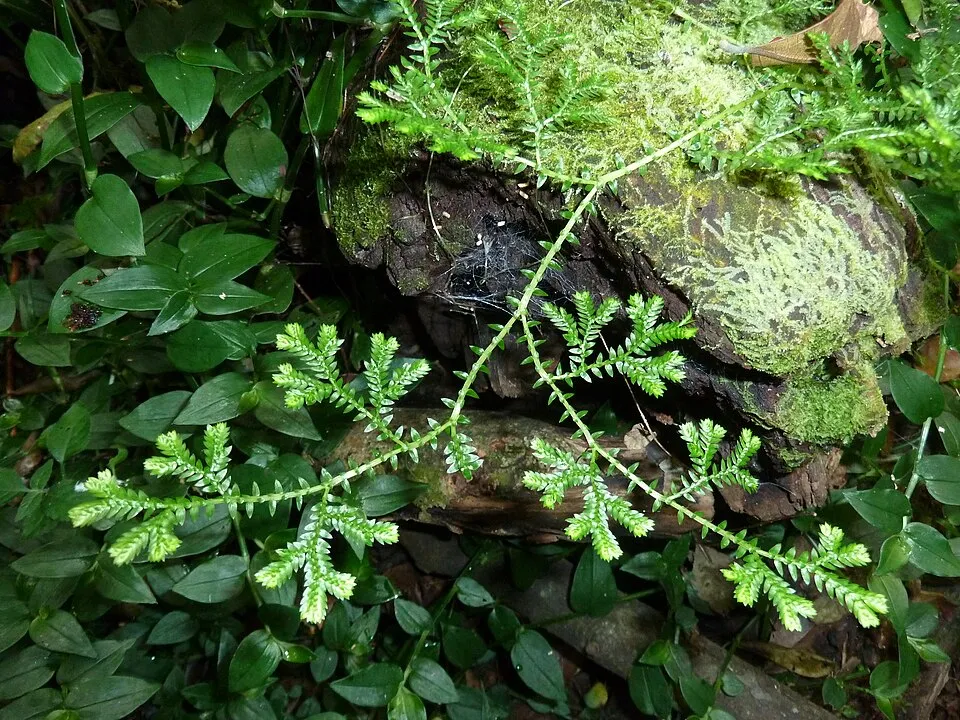
Selaginella kraussiana, commonly known as African clubmoss, Krauss' spikemoss, or trailing spikemoss, is a captivating perennial herbaceous plant belonging to the ancient family Selaginellaceae, representing one of the oldest extant lineages of vascular plants, the lycophytes. This species is admired for its delicate, fern-like appearance and its remarkable ability to form dense, vibrant green mats or cushions, making it a highly valued ground cover in horticulture and a popular choice for terrariums and indoor plant collections. Morphologically, it is characterized by small, scale-like leaves, known as microphylls, which are typically lanceolate to ovate and arranged spirally along slender, creeping stems.
These stems branch profusely, creating a lush, layered texture that can spread horizontally, covering significant areas. While its mature height usually ranges from a modest 10 to 30 centimeters, its lateral spread can be much wider, forming an expansive carpet of foliage. Unlike true mosses, Selaginella possesses true vascular tissue, distinguishing it as a more evolutionarily advanced plant.
The root system is shallow and fibrous, efficiently anchoring the plant and absorbing moisture from the upper soil layers.
Geographically, Selaginella kraussiana is indigenous to tropical and subtropical regions of Southern Africa, particularly thriving in parts of South Africa, Zimbabwe, and Mozambique. Its natural habitat is typically found in shaded, moist, and often humid environments, such as forest floors, stream banks, and rocky crevices, where it flourishes under the protective canopy of larger vegetation. This preference for high humidity and consistent moisture levels is crucial to its survival and explains its adaptability to indoor cultivation in humid household environments like bathrooms.
Taxonomically, it is classified within the genus Selaginella, which is the sole surviving member and the largest genus of heterosporous lycophytes, encompassing approximately 700 to 750 species globally. Its unique morphology includes the presence of ligules at the base of its microphylls, a distinctive feature within the genus.
Trusted Scientific References
1. Authoritative external sources for Selaginella kraussiana
1.1 Wikipedia — Selaginella kraussiana
1.2 Kew POWO (Plants of the World Online)
1.3 PubMed — peer-reviewed research
1.4 NCBI Taxonomy Browser
1.5 GBIF — Global Biodiversity
1.1.Selaginella Kraussiana — Key Features
- ✓ <strong>Ancient Lycophyte</strong> — Belongs to the Selaginellaceae family, an ancient lineage of vascular plants.
- ✓ <strong>Delicate Fern</strong> — like Appearance — Features small, scale-like microphylls and creeping stems.
- ✓ <strong>Horticultural Value</strong> — Highly prized as a ground cover, terrarium plant, and ornamental specimen.
- ✓ <strong>Rich in Flavonoids</strong> — Contains a high concentration of biflavonoids, such as amentoflavone and robustaflavone.
- ✓ <strong>Anti</strong> — inflammatory & Antioxidant — Key medicinal properties attributed to its phytochemical profile.
- ✓ <strong>Traditional African Medicine</strong> — Utilized ethnobotanically for a range of ailments in its native regions.
- ✓ <strong>Moisture & Shade Loving</strong> — Thrives in humid, shaded environments, mimicking its natural forest habitat.
- ✓ <strong>Vascular Plant</strong> — Possesses true vascular tissue, distinguishing it from true mosses.
- ✓ <strong>Heterosporous</strong> — Produces two different types of spores, a characteristic of the genus Selaginella.
- ✓ <strong>Potential for Modern Medicine</strong> — Under investigation for anti-diabetic, anticancer, and neuroprotective activities.
1.2.Selaginella Kraussiana — Quick Summary
- ✓ Ancient lycophyte with delicate, fern-like foliage, popular as ground cover and terrarium plant.
- ✓ Rich in bioactive compounds, especially biflavonoids, contributing to its medicinal value.
- ✓ Ethnomedicinally used for anti-inflammatory, antioxidant, anti-diabetic, and wound healing properties.
- ✓ Thrives in shaded, moist, humid environments, native to Southern Africa.
- ✓ Requires careful consideration of dosage and potential interactions due to limited human safety data.
- ✓ A promising subject for further pharmacological research into its therapeutic potential.
2.Selaginella Kraussiana — Scientific Identity
3.Selaginella Kraussiana — Quick Facts
4.Selaginella Kraussiana — Appearance & Identification
5.Selaginella Kraussiana — Native Habitat
6.Selaginella Kraussiana — Water Requirements
- ✓ Light — Prefers low to moderate light; avoid direct, intense sunlight which can scorch its delicate foliage.
- ✓ Soil — Requires consistently moist, well-draining, humus-rich soil, ideally with a slightly acidic to neutral pH.
- ✓ Humidity — Thrives in high humidity environments; misting regularly or placing in terrariums/bathrooms is highly beneficial.
- ✓ Watering — Keep the soil consistently damp but never waterlogged; use distilled or rainwater to prevent mineral buildup.
- ✓ Temperature — Best grown in warm temperatures, typically between 18°C and 27°C (65°F-80°F); protect from cold drafts.
- ✓ Propagation — Easily propagated by stem cuttings, which root readily in moist soil or water, or by dividing established clumps.
- ✓ Fertilization — Feed sparingly with a diluted liquid fertilizer (half-strength) every 2-4 weeks during the growing season (spring/summer).
- ✓ Pruning — Minimal pruning is needed, primarily to remove any yellowing or dead foliage to maintain its neat appearance.
Reviewed by the Flora Medical Global Botanical Review Panel
Multi-disciplinary editorial group · Botany · Ethnobotany · Herbal-medicine literature
Who reviewed this: This page was checked by the Flora Medical Global Botanical Review Panel — an in-house editorial group of botany graduates, ethnobotany researchers, and horticulture practitioners who collectively maintain our 7,000+ plant encyclopedia. Meet the team.
Our 4-step verification process
1. Taxonomic verification
Scientific names and synonyms cross-checked against Kew POWO, World Flora Online, and The Plant List.
2. Phytochemical & medicinal cross-reference
Active compounds, traditional uses, and reported activities are cross-referenced with PubMed, USDA Dr. Duke's database, and peer-reviewed ethnobotanical literature.
3. Conservation & distribution check
Distribution, ecology, and conservation status confirmed against GBIF occurrence records and the IUCN Red List.
4. Editorial & safety review
Every entry passes an editorial pass for clarity, originality, and safety notices (toxicity, contraindications, dosage caveats) before publication.
Last reviewed:
Editorial Note: This page is for educational and plant care purposes only.
Written by: Flora Medical Global Editorial Team
Reviewed by: Flora Medical Global Botanical Review Panel
Last Updated: June 15, 2026







Selaginella Kraussiana — Comments & Community Reviews
Rate this plant