

Care Disclaimer: Plant care recommendations are general guidelines based on common growing conditions. Individual results may vary based on your local environment, climate, and care routine. If your plant is toxic, keep it away from children and pets, and consult a veterinarian if accidental ingestion occurs.
1.Senecio Vitalis — Overview
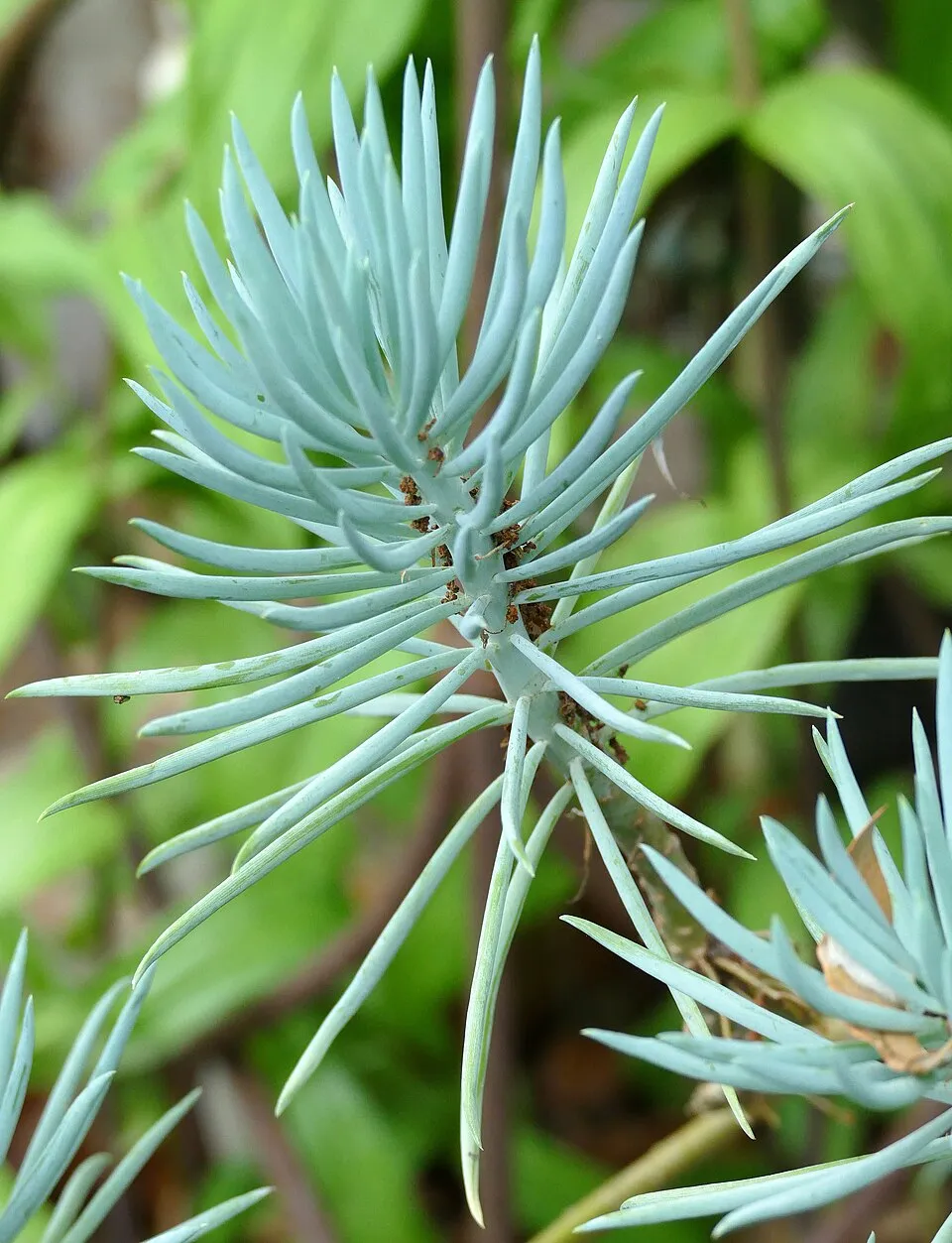
Senecio vitalis, commonly known as the Trailing Ice Plant or Blue Chalksticks, is a captivating perennial succulent herb indigenous to the arid and semi-arid landscapes of South Africa. This resilient species belongs to the vast Asteraceae family, one of the largest and most diverse plant families globally. Its morphology is meticulously adapted to survive in challenging, well-drained, often rocky or sandy soils.
The plant is characterized by remarkably thick, fleshy, and elongated leaves, typically displaying a striking glaucous green to silvery grey-green hue. These leaves are often coated with a subtle waxy cuticle, a key adaptation that significantly minimizes water loss and enhances its renowned drought resistance.
Senecio vitalis exhibits a prostrate or sprawling growth habit, with robust, cylindrical stems that can extend several feet in length. These stems gracefully trail over embankments, cascade elegantly from hanging baskets, or form a dense, attractive ground cover. Individual leaves are oblong to linear-lanceolate, measuring up to 8 cm (approximately 3 inches) long, and are typically arranged spirally along the stems, culminating in a more compact, rosette-like formation at the stem tips.
The inflorescence consists of small, cheerful, bright yellow capitula, characteristic of the Asteraceae family. These button-like flowers emerge predominantly from late winter through early spring, offering a vibrant contrast to its cool-toned foliage. Each flower head is composed of numerous tiny disc florets, with ray florets usually absent or inconspicuous in this particular species.
The root system is generally shallow and fibrous, efficiently designed to absorb surface moisture. Taxonomically, while Senecio vitalis is primarily valued for its ornamental appeal and ease of cultivation, it is part of a diverse genus where many species are known for either medicinal properties, ornamental value, or significant toxicity due to pyrrolizidine alkaloids.
Trusted Scientific References
1. Authoritative external sources for Senecio vitalis
1.1 Wikipedia — Senecio vitalis
1.2 Kew POWO (Plants of the World Online)
1.3 PubMed — peer-reviewed research
1.4 NCBI Taxonomy Browser
1.5 GBIF — Global Biodiversity
1.1.Senecio Vitalis — Key Features
- ✓ <strong>Glaucous Foliage</strong> — Distinctive silvery-blue-green, fleshy leaves.
- ✓ <strong>Succulent Nature</strong> — Highly adapted for water storage and drought tolerance.
- ✓ <strong>Trailing Growth Habit</strong> — Ideal for groundcover, hanging baskets, or cascading over walls.
- ✓ <strong>South African Native</strong> — Originates from arid and semi-arid regions.
- ✓ <strong>Low Maintenance</strong> — Requires minimal watering and care once established.
- ✓ <strong>Bright Yellow Flowers</strong> — Small, button-like blooms appearing in late winter to early spring.
- ✓ <strong>Ornamental Value</strong> — Highly prized for its unique aesthetic in gardens and containers.
- ✓ <strong>Asteraceae Family Member</strong> — Part of a large and diverse plant family.
- ✓ <strong>Pyrrolizidine Alkaloid Risk (Genus)</strong> — Shares genus with species known for severe toxicity.
- ✓ <strong>Adaptable to Poor Soils</strong> — Thrives in well-drained, sandy, or rocky substrates.
1.2.Senecio Vitalis — Quick Summary
- ✓ Senecio vitalis is an ornamental succulent, known as Blue Chalksticks or Trailing Ice Plant.
- ✓ Native to South Africa, it thrives in arid conditions with glaucous, fleshy leaves.
- ✓ Belongs to the Senecio genus, which is notorious for containing toxic pyrrolizidine alkaloids (PAs).
- ✓ Primarily cultivated for its aesthetic appeal, it is NOT recommended for internal medicinal use.
- ✓ Ingestion of any Senecio species can lead to severe liver damage and other adverse health effects.
- ✓ Requires minimal water and bright sunlight, making it an easy-care ornamental.
2.Senecio Vitalis — Scientific Identity
3.Senecio Vitalis — Quick Facts
4.Senecio Vitalis — Appearance & Identification
5.Senecio Vitalis — Native Habitat
6.Senecio Vitalis — Water Requirements
- ✓ Sunlight — Requires full sun to partial shade; prefers bright, direct sunlight for best growth and color.
- ✓ Soil — Thrives in well-drained, sandy, or rocky soil; prefers a slightly acidic to neutral pH.
- ✓ Watering — Drought-tolerant; water sparingly, allowing soil to dry out completely between waterings, especially in winter.
- ✓ Temperature — Prefers warm temperatures (18-24°C / 65-75°F); not frost-tolerant and requires protection in colder climates.
- ✓ Propagation — Easily propagated by stem cuttings; allow cuttings to callus for a few days before planting in well-drained soil.
- ✓ Fertilization — Low feeder; a diluted balanced liquid fertilizer can be applied once a year during the growing season.
- ✓ Pruning — Prune as needed to maintain shape, control spread, and remove leggy growth or spent flowers.
- ✓ Pests & Diseases — Generally pest-resistant but can be susceptible to mealybugs and aphids, especially in humid conditions.
Reviewed by the Flora Medical Global Botanical Review Panel
Multi-disciplinary editorial group · Botany · Ethnobotany · Herbal-medicine literature
Who reviewed this: This page was checked by the Flora Medical Global Botanical Review Panel — an in-house editorial group of botany graduates, ethnobotany researchers, and horticulture practitioners who collectively maintain our 7,000+ plant encyclopedia. Meet the team.
Our 4-step verification process
1. Taxonomic verification
Scientific names and synonyms cross-checked against Kew POWO, World Flora Online, and The Plant List.
2. Phytochemical & medicinal cross-reference
Active compounds, traditional uses, and reported activities are cross-referenced with PubMed, USDA Dr. Duke's database, and peer-reviewed ethnobotanical literature.
3. Conservation & distribution check
Distribution, ecology, and conservation status confirmed against GBIF occurrence records and the IUCN Red List.
4. Editorial & safety review
Every entry passes an editorial pass for clarity, originality, and safety notices (toxicity, contraindications, dosage caveats) before publication.
Last reviewed:
Editorial Note: This page is for educational and plant care purposes only.
Written by: Flora Medical Global Editorial Team
Reviewed by: Flora Medical Global Botanical Review Panel
Last Updated: June 15, 2026







Senecio Vitalis — Comments & Community Reviews
Rate this plant