


Care Disclaimer: Plant care recommendations are general guidelines based on common growing conditions. Individual results may vary based on your local environment, climate, and care routine. If your plant is toxic, keep it away from children and pets, and consult a veterinarian if accidental ingestion occurs.
1.Staghorn Fern — Overview
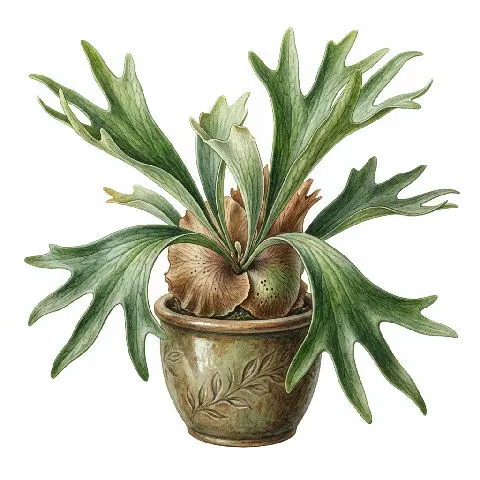
The Staghorn Fern, scientifically known as Platycerium bifurcatum, is a captivating epiphytic fern belonging to the Polypodiaceae family. Native to the lush rainforests of Australia, New Guinea, and parts of Southeast Asia, it naturally thrives by attaching itself to tree trunks and branches, absorbing nutrients and moisture from the surrounding air and decaying organic matter rather than soil.
This fascinating growth habit classifies it as an epiphyte, showcasing a remarkable adaptation to arboreal environments.
Its common name, Staghorn Fern, is derived from its two distinct types of fronds that strikingly resemble the antlers of deer or elk. The sterile basal fronds, often referred to as 'shield fronds', are broad, flattened, and typically turn brown with age, pressing tightly against the mounting surface. These fronds serve a crucial protective role, shielding the fern's rhizome and roots while also collecting falling debris and moisture to nourish the plant.
In contrast, the fertile foliar fronds are green, pendulous, and deeply lobed, projecting outwards and upwards to maximize light exposure. These 'antler fronds' are responsible for spore production, typically found on their undersides, enabling the fern's reproduction.
Platycerium bifurcatum is widely cultivated globally as an ornamental plant due to its unique and exotic appearance, making it a popular choice for indoor gardens, hanging displays, and mounted specimens. While primarily valued for its aesthetic appeal, its epiphytic nature and ability to absorb airborne elements contribute to its ecological and potential environmental benefits, including air purification and local humidity enhancement.
Its capacity to naturalize in suitable subtropical climates, as observed in southern Florida, further highlights its adaptability and resilience outside its native range.
Trusted Scientific References
1. Authoritative external sources for Platycerium bifurcatum
1.1 Wikipedia — Platycerium bifurcatum
1.2 Kew POWO (Plants of the World Online)
1.3 PubMed — peer-reviewed research
1.4 NCBI Taxonomy Browser
1.5 GBIF — Global Biodiversity
1.1.Staghorn Fern — Key Features
- ✓ <strong>Epiphytic Growth Habit</strong> — Thrives on trees, not soil.
- ✓ <strong>Antler</strong> — like Foliar Fronds — Resemble deer antlers, fertile and spore-producing.
- ✓ <strong>Shield</strong> — like Basal Fronds — Sterile, flatten against mounting surface, protect roots.
- ✓ <strong>Air Purifying Qualities</strong> — Helps filter indoor air and increase humidity.
- ✓ <strong>Low Maintenance Ornamental</strong> — Relatively easy to care for with proper conditions.
- ✓ <strong>Native to Australasia</strong> — Indigenous to Australia, New Guinea, and Indonesia.
- ✓ <strong>Non</strong> — Toxic to Pets (Generally) — Considered safe for household animals.
- ✓ <strong>Humidity</strong> — Loving — Requires consistent high humidity to flourish.
- ✓ <strong>Unique Aesthetic Appeal</strong> — Highly valued for its striking and exotic appearance.
- ✓ <strong>Spore Reproduction</strong> — Reproduces via spores found on its fertile fronds.
1.2.Staghorn Fern — Quick Summary
- ✓ Epiphytic fern with distinctive antler-like fronds.
- ✓ Native to Australia, New Guinea, and Indonesia.
- ✓ Primarily cultivated as a popular ornamental houseplant.
- ✓ Contributes to indoor air quality and stress reduction.
- ✓ No direct traditional or modern medicinal uses documented.
- ✓ Generally considered non-toxic to humans and pets.
2.Staghorn Fern — Scientific Identity
3.Staghorn Fern — Quick Facts
4.Staghorn Fern — Appearance & Identification
5.Staghorn Fern — Native Habitat
6.Staghorn Fern — Water Requirements
- Cultivating Platycerium bifurcatum effectively involves mimicking its natural epiphytic habitat, requiring specific attention to its mounting, watering, and environmental conditions.
- ✓ Mounting — Typically grown mounted on a slab of wood (e.g., cork bark, cedar) or in a hanging basket lined with sphagnum moss, allowing its basal fronds to adhere naturally.
- ✓ Growing Medium — Use a well-draining, airy, and moisture-retentive substrate such as sphagnum moss, coco coir, or a coarse orchid mix, avoiding heavy potting soil.
- ✓ Light Requirements — Prefers bright, indirect light. Direct sun can scorch its fronds, while insufficient light may hinder growth and frond development.
- ✓ Watering — Water thoroughly when the medium feels dry to the touch, either by soaking the entire mount or by watering the moss directly. Allow excess water to drain completely.
- ✓ Humidity — Thrives in high humidity environments (60-80%). Regular misting, especially during dry periods, or placement near a humidifier is beneficial.
- ✓ Temperature — Optimal temperatures range from 18-29°C (65-85°F). Protect from frost, as it is sensitive to cold temperatures.
- ✓ Fertilization — Feed sparingly with a diluted, balanced liquid fertilizer (e.g., 1/4 strength) every 2-4 weeks during the growing season (spring and summer).
- ✓ Propagation — Can be propagated from spores, though this is a slow process, or by carefully dividing pups (offshoots) that form at the base of mature plants.
Reviewed by the Flora Medical Global Botanical Review Panel
Multi-disciplinary editorial group · Botany · Ethnobotany · Herbal-medicine literature
Who reviewed this: This page was checked by the Flora Medical Global Botanical Review Panel — an in-house editorial group of botany graduates, ethnobotany researchers, and horticulture practitioners who collectively maintain our 7,000+ plant encyclopedia. Meet the team.
Our 4-step verification process
1. Taxonomic verification
Scientific names and synonyms cross-checked against Kew POWO, World Flora Online, and The Plant List.
2. Phytochemical & medicinal cross-reference
Active compounds, traditional uses, and reported activities are cross-referenced with PubMed, USDA Dr. Duke's database, and peer-reviewed ethnobotanical literature.
3. Conservation & distribution check
Distribution, ecology, and conservation status confirmed against GBIF occurrence records and the IUCN Red List.
4. Editorial & safety review
Every entry passes an editorial pass for clarity, originality, and safety notices (toxicity, contraindications, dosage caveats) before publication.
Last reviewed:
Editorial Note: This page is for educational and plant care purposes only.
Written by: Flora Medical Global Editorial Team
Reviewed by: Flora Medical Global Botanical Review Panel
Last Updated: June 15, 2026







Staghorn Fern — Comments & Community Reviews
Rate this plant