
Care Disclaimer: Plant care recommendations are general guidelines based on common growing conditions. Individual results may vary based on your local environment, climate, and care routine. If your plant is toxic, keep it away from children and pets, and consult a veterinarian if accidental ingestion occurs.
1.Stromanthe Magic Star — Overview
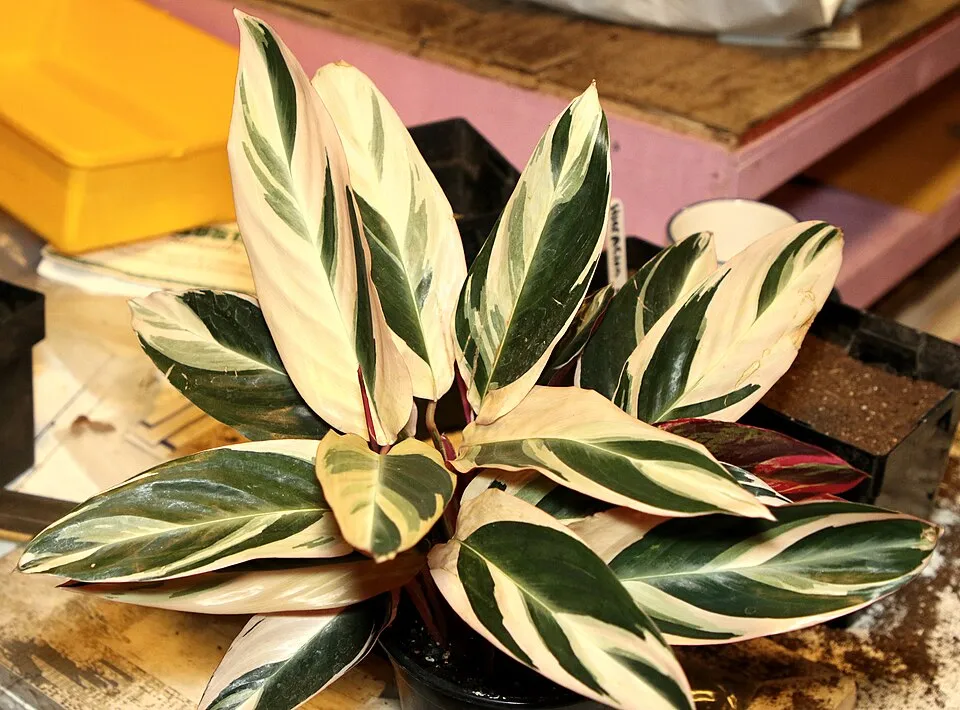
Stromanthe sanguinea 'Magic Star', often referred to simply as Stromanthe Magic Star, is a highly ornamental herbaceous perennial belonging to the Marantaceae family, commonly known as the prayer plant family. This cultivar is a striking selection of a species native to the humid tropical rainforests of Brazil, where it thrives as an understory plant, preferring the dappled shade beneath dense canopies. It typically reaches a height of 30 to 50 cm, but under ideal conditions, the main species can grow up to 1.5 meters.
The most distinctive feature of 'Magic Star' is its variegated foliage. The lanceolate to oblong leaves, which can grow up to 30 cm long, display an intricate pattern of deep green interspersed with irregular cream or pale green streaks and flecks, creating a 'star-like' or speckled appearance on the upper surface. The undersides of the leaves are a rich burgundy or magenta, which becomes more visible as the plant exhibits nyctinasty, folding its leaves upwards at night, a characteristic shared with other Marantaceae members.
Each leaf arises on sturdy, often reddish petioles from the crown of the plant, possessing a pulvinus at the petiole's base that facilitates these diurnal movements. While primarily grown for its foliage, in its native habitat or under specific greenhouse conditions, 'Magic Star' can produce small, tubular, pale pink or white flowers subtended by colorful orange-red bracts, arranged in panicles. However, flowering is rare when cultivated indoors.
Trusted Scientific References
1. Authoritative external sources for Stromanthe sanguinea Magic Star
1.1 Wikipedia — Stromanthe sanguinea Magic Star
1.2 Kew POWO (Plants of the World Online)
1.3 PubMed — peer-reviewed research
1.4 NCBI Taxonomy Browser
1.5 GBIF — Global Biodiversity
1.6Stromanthe Magic Star should be interpreted through verified botanical identity, practical care, and responsible safety language. This recovery note adds the missing context needed for a complete profile: match light to the plant's habit, use well-drained soil, water according to season, and avoid unsupported medicinal or edible claims. For publishing, the plant can be presented as a source-backed indoor plant with clear care guidance, common problem diagnosis, and conservative safety wording.
1.1.Stromanthe Magic Star — Key Features
- ✓ <strong>Striking Variegated Foliage</strong> — Deep green leaves with cream/pale green 'star-like' patterns.
- ✓ <strong>Burgundy Undersides</strong> — The reverse of the leaves displays a vibrant magenta or burgundy color.
- ✓ <strong>Nyctinastic Movement</strong> — Leaves fold upwards at night, resembling praying hands.
- ✓ <strong>Tropical Herbaceous Perennial</strong> — A non-woody plant that lives for more than two years in tropical climates.
- ✓ <strong>Air Purifying Qualities</strong> — Contributes to cleaner indoor air by absorbing pollutants.
- ✓ <strong>Non</strong> — Toxic — Safe for homes with pets and children.
- ✓ <strong>High Humidity Lover</strong> — Thrives in environments with consistent high moisture.
- ✓ <strong>Indirect Light Preference</strong> — Prefers filtered or dappled light conditions.
- ✓ <strong>Compact Growth Habit</strong> — Typically grows 30-50 cm tall, suitable for indoor containers.
- ✓ <strong>Member of Prayer Plant Family (Marantaceae)</strong> — Shares characteristics with Maranta and Calathea.
1.2.Stromanthe Magic Star — Quick Summary
- ✓ Stunning variegated foliage with green, cream, and pink hues.
- ✓ Native to Brazilian rainforests, thrives in warm, humid conditions.
- ✓ Exhibits nyctinasty, with leaves folding up at night.
- ✓ Primarily an ornamental plant, known for air purification.
- ✓ Non-toxic to pets and humans, safe for indoor environments.
- ✓ Requires bright, indirect light and consistent moisture.
2.Stromanthe Magic Star — Scientific Identity
3.Stromanthe Magic Star — Quick Facts
4.Stromanthe Magic Star — Appearance & Identification
5.Stromanthe Magic Star — Native Habitat
6.Stromanthe Magic Star — Water Requirements
- ✓ Soil — Use a well-draining, rich potting mix, preferably peat-based with perlite or orchid bark to ensure aeration and moisture retention.
- ✓ Light — Provide bright, indirect light; direct sunlight can scorch the delicate leaves. An east-facing window or filtered light is ideal.
- ✓ Watering — Keep the soil consistently moist but not waterlogged. Allow the top inch of soil to dry out between waterings. Use distilled or rainwater to avoid fluoride toxicity.
- ✓ Humidity — Requires high humidity, ideally between 60-80%. Use a humidifier, pebble tray, or mist frequently, especially in dry indoor environments.
- ✓ Temperature — Maintain warm temperatures between 18-27°C (65-80°F). Avoid sudden temperature fluctuations and cold drafts.
- ✓ Fertilization — Feed monthly during the growing season (spring and summer) with a balanced, diluted liquid fertilizer. Reduce or stop feeding in autumn and winter.
- ✓ Repotting — Repot every 1-2 years in spring to refresh the soil and accommodate root growth, moving up one pot size.
Reviewed by the Flora Medical Global Botanical Review Panel
Multi-disciplinary editorial group · Botany · Ethnobotany · Herbal-medicine literature
Who reviewed this: This page was checked by the Flora Medical Global Botanical Review Panel — an in-house editorial group of botany graduates, ethnobotany researchers, and horticulture practitioners who collectively maintain our 7,000+ plant encyclopedia. Meet the team.
Our 4-step verification process
1. Taxonomic verification
Scientific names and synonyms cross-checked against Kew POWO, World Flora Online, and The Plant List.
2. Phytochemical & medicinal cross-reference
Active compounds, traditional uses, and reported activities are cross-referenced with PubMed, USDA Dr. Duke's database, and peer-reviewed ethnobotanical literature.
3. Conservation & distribution check
Distribution, ecology, and conservation status confirmed against GBIF occurrence records and the IUCN Red List.
4. Editorial & safety review
Every entry passes an editorial pass for clarity, originality, and safety notices (toxicity, contraindications, dosage caveats) before publication.
Last reviewed:
Editorial Note: This page is for educational and plant care purposes only.
Written by: Flora Medical Global Editorial Team
Reviewed by: Flora Medical Global Botanical Review Panel
Last Updated: June 15, 2026







Stromanthe Magic Star — Comments & Community Reviews
Rate this plant