
Care Disclaimer: Plant care recommendations are general guidelines based on common growing conditions. Individual results may vary based on your local environment, climate, and care routine. If your plant is toxic, keep it away from children and pets, and consult a veterinarian if accidental ingestion occurs.
1.Sulcorebutia Rauschii — Overview
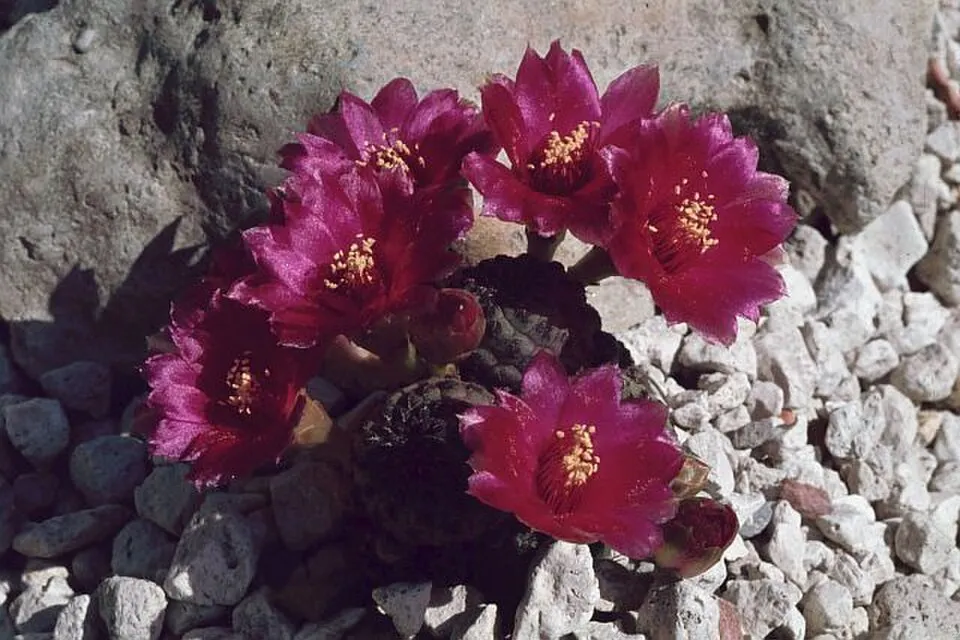
Sulcorebutia rauschii, a captivating perennial succulent, is an esteemed member of the Cactaceae family, native to the arid, rocky slopes of the Bolivian Andes, specifically found at elevations between 2,500 and 3,500 meters. This specific epithet honors Walter Rausch, a prominent Austrian botanist and cactus expert, highlighting its taxonomic significance. Characteristically small and compact, this species typically forms a solitary, globular to slightly cylindrical stem, reaching a modest height of approximately 10-15 cm and a diameter of 5-8 cm. Over time, mature specimens may produce offsets, forming small clusters or mounds. The stem is distinguished by its deep, often dark green to brownish-purple coloration, a hue that intensifies under strong sunlight, providing a striking contrast to its vibrant blooms.
The surface of the stem is elegantly adorned with prominent, spiraling ribs, which are divided into small, conical tubercles. Each tubercle hosts a small areole, typically producing short, stiff, white or yellowish spines that are not particularly dense or aggressive, contributing to its appealing, 'soft' aesthetic. The root system is generally fibrous but can develop a somewhat thickened taproot in older specimens, aiding in water storage during prolonged dry periods. The most celebrated feature of Sulcorebutia rauschii is undoubtedly its spectacular floral display. In late spring to early summer, funnel-shaped flowers emerge profusely from the apex of the stem, often completely obscuring the plant body.
These blooms are renowned for their intense and varied coloration, ranging from brilliant yellows and fiery oranges to deep reds, magentas, and even violet shades, frequently with contrasting throats. The vibrant hues and delicate petals make them highly sought after by collectors. As a member of the Cactaceae, Sulcorebutia rauschii exhibits classic xerophytic adaptations, including a thick cuticle, CAM (Crassulacean Acid Metabolism) photosynthesis for efficient water use, and specialized stem tissues for water storage. Its natural habitat, characterized by high altitudes, intense sunlight, and well-drained mineral soils, underscores its resilience and specific environmental requirements.
Trusted Scientific References
1. Authoritative external sources for Sulcorebutia rauschii
1.1 Wikipedia — Sulcorebutia rauschii
1.2 Kew POWO (Plants of the World Online)
1.3 PubMed — peer-reviewed research
1.4 NCBI Taxonomy Browser
1.5 GBIF — Global Biodiversity
1.1.Sulcorebutia Rauschii — Key Features
- ✓ <strong>Striking Stem Coloration</strong> — Dark green to brownish-purple stems intensify in strong sunlight.
- ✓ <strong>Profuse, Bright Flowers</strong> — Produces funnel-shaped flowers in yellows, oranges, reds, and magentas.
- ✓ <strong>Compact, Globular Form</strong> — Small, solitary or clustering growth habit ideal for pots and collections.
- ✓ <strong>Xerophytic Adaptations</strong> — Highly adapted to arid environments with efficient water storage.
- ✓ <strong>Easy to Care For</strong> — Relatively low maintenance once its specific light and water needs are met.
- ✓ <strong>Bolivian Andes Native</strong> — Originates from high-altitude, rocky regions of Bolivia.
- ✓ <strong>Spiraling Ribs and Tubercles</strong> — Distinctive stem texture with small, soft spines.
- ✓ <strong>Cold Hardiness</strong> — Tolerates mild frost, but prefers cool, dry winter dormancy.
- ✓ <strong>Collector's Item</strong> — Highly sought after by succulent and cactus enthusiasts globally.
- ✓ <strong>CAM Photosynthesis</strong> — Efficiently conserves water by opening stomata at night.
1.2.Sulcorebutia Rauschii — Quick Summary
- ✓ Sulcorebutia rauschii is a small, vibrant Bolivian cactus known for its striking stem colors and profuse, colorful flowers.
- ✓ It's highly prized by collectors for its aesthetic appeal and relatively easy care requirements.
- ✓ This xerophytic plant thrives in full sun and well-draining mineral soil, requiring minimal water.
- ✓ Primarily an ornamental plant, it offers psychological well-being through cultivation.
- ✓ Care involves careful watering, adequate light, and protection from excessive moisture in winter.
- ✓ While not traditionally medicinal, its presence may contribute to a calming environment.
2.Sulcorebutia Rauschii — Scientific Identity
3.Sulcorebutia Rauschii — Quick Facts
4.Sulcorebutia Rauschii — Appearance & Identification
5.Sulcorebutia Rauschii — Native Habitat
6.Sulcorebutia Rauschii — Water Requirements
- ✓ Sunlight — Requires full sun to light shade; strong light enhances stem coloration and flower production.
- ✓ Watering — Water moderately during the growing season (spring/summer), allowing soil to dry completely between waterings; keep strictly dry in winter.
- ✓ Soil — Prefers a very permeable, coarse mineral soil with excellent drainage to prevent root rot.
- ✓ Temperature — Frost hardy down to -5°C (23°F) but best overwintered in a cool, dry place (0-10°C) for optimal health and flowering.
- ✓ Potting — Use deep pots to accommodate its taproot; repot every 2-3 years with fresh, well-draining potting mix.
- ✓ Fertilization — Apply a high-potassium liquid feed occasionally during the active growing period for robust growth and flowering.
- ✓ Air Circulation — Good air circulation is crucial to prevent fungal diseases, especially in humid conditions.
- ✓ Propagation — Easily propagated from offsets (pups) or by seeds, which require specific germination conditions.
Reviewed by the Flora Medical Global Botanical Review Panel
Multi-disciplinary editorial group · Botany · Ethnobotany · Herbal-medicine literature
Who reviewed this: This page was checked by the Flora Medical Global Botanical Review Panel — an in-house editorial group of botany graduates, ethnobotany researchers, and horticulture practitioners who collectively maintain our 7,000+ plant encyclopedia. Meet the team.
Our 4-step verification process
1. Taxonomic verification
Scientific names and synonyms cross-checked against Kew POWO, World Flora Online, and The Plant List.
2. Phytochemical & medicinal cross-reference
Active compounds, traditional uses, and reported activities are cross-referenced with PubMed, USDA Dr. Duke's database, and peer-reviewed ethnobotanical literature.
3. Conservation & distribution check
Distribution, ecology, and conservation status confirmed against GBIF occurrence records and the IUCN Red List.
4. Editorial & safety review
Every entry passes an editorial pass for clarity, originality, and safety notices (toxicity, contraindications, dosage caveats) before publication.
Last reviewed:
Editorial Note: This page is for educational and plant care purposes only.
Written by: Flora Medical Global Editorial Team
Reviewed by: Flora Medical Global Botanical Review Panel
Last Updated: June 15, 2026







Sulcorebutia Rauschii — Comments & Community Reviews
Rate this plant