
Care Disclaimer: Plant care recommendations are general guidelines based on common growing conditions. Individual results may vary based on your local environment, climate, and care routine. If your plant is toxic, keep it away from children and pets, and consult a veterinarian if accidental ingestion occurs.
1.Syngonium White Butterfly — Overview
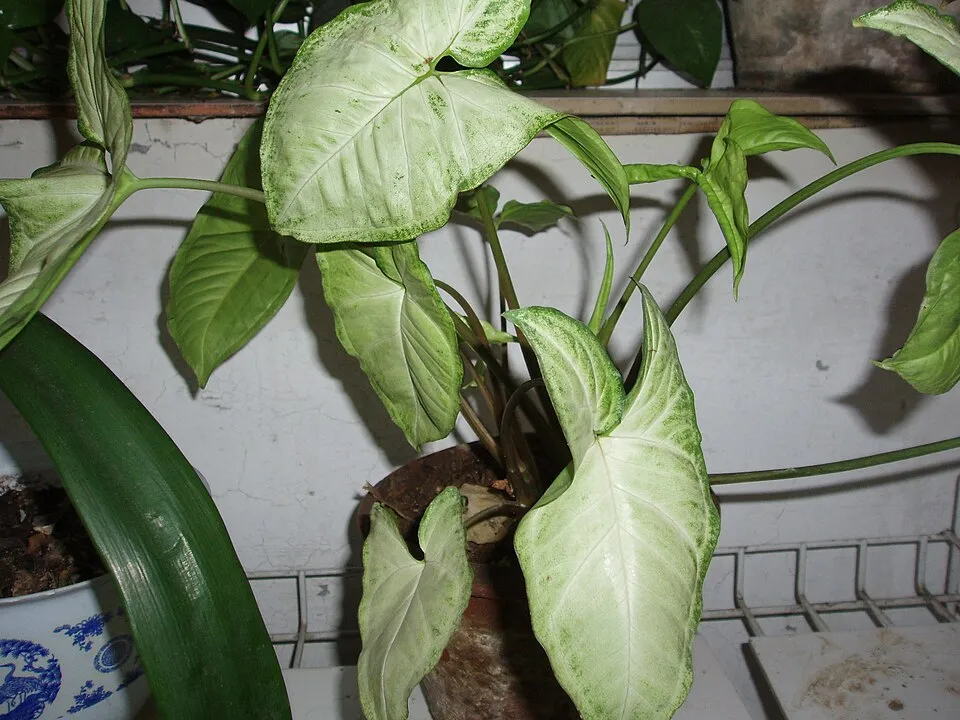
Syngonium podophyllum 'White Butterfly' is a captivating cultivar of the Arrowhead Plant, belonging to the Araceae family. This evergreen climbing aroid is native to the tropical rainforests spanning from Mexico through Central America to South America, including Brazil, Bolivia, and the Caribbean. In its natural habitat, it exhibits an epiphytic or hemiepiphytic growth habit, utilizing aerial roots to climb trees and absorb moisture and nutrients from the air and surrounding debris.
The plant's morphology changes significantly with maturity; juvenile forms display characteristic arrow-shaped or sagittate leaves, while mature specimens develop deeply lobed or even pedate leaves, sometimes with up to eleven segments. The 'White Butterfly' cultivar is particularly prized for its striking variegation, featuring vibrant creamy white to light green centers that contrast beautifully with darker green margins, with the white coloration often intensifying as the plant ages. Its stems can reach lengths of 10 to 20 meters in the wild, anchoring themselves with adventitious roots.
This plant thrives in warm, humid environments with dappled sunlight, mimicking its understory rainforest origins. While primarily cultivated as an ornamental, its adaptability and air-purifying qualities make it a popular indoor plant globally.
Trusted Scientific References
1. Authoritative external sources for Syngonium podophyllum White Butterfly
1.1 Wikipedia — Syngonium podophyllum White Butterfly
1.2 Kew POWO (Plants of the World Online)
1.3 PubMed — peer-reviewed research
1.4 NCBI Taxonomy Browser
1.5 GBIF — Global Biodiversity
1.6Syngonium White Butterfly should be interpreted through verified botanical identity, practical care, and responsible safety language. This recovery note adds the missing context needed for a complete profile: match light to the plant's habit, use well-drained soil, water according to season, and avoid unsupported medicinal or edible claims. For publishing, the plant can be presented as a source-backed indoor plant with clear care guidance, common problem diagnosis, and conservative safety wording.
1.1.Syngonium White Butterfly — Key Features
- ✓ <strong>Striking variegated foliage</strong> — Striking variegated foliage with creamy white and green patterns.
- ✓ <strong>Arrowhead</strong> — shaped leaves (juvenile) evolving to lobed leaves (mature).
- ✓ <strong>Natural climbing vine,</strong> — Natural climbing vine, adaptable to trailing or upright growth.
- ✓ <strong>Excellent air purifier,</strong> — Excellent air purifier, removing common indoor pollutants.
- ✓ <strong>Thrives in warm,</strong> — Thrives in warm, humid environments with indirect light.
- ✓ <strong>Relatively low maintenance</strong> — Relatively low maintenance for indoor cultivation.
- ✓ <strong>Contains irritating calcium</strong> — Contains irritating calcium oxalate crystals, making it toxic.
- ✓ <strong>Popular houseplant for</strong> — Popular houseplant for aesthetic appeal and health benefits.
- ✓ <strong>Fast</strong> — growing habit under optimal conditions.
- ✓ <strong>Native to tropical</strong> — Native to tropical regions of Central and South America.
1.2.Syngonium White Butterfly — Quick Summary
- ✓ Ornamental tropical plant with striking variegated leaves.
- ✓ Contains calcium oxalate crystals, making it toxic if ingested.
- ✓ Known for air-purifying qualities, removing common indoor toxins.
- ✓ Requires bright, indirect light and high humidity for optimal growth.
- ✓ Easy to care for as a houseplant, but needs careful handling.
- ✓ Traditional uses are limited and lack significant scientific support.
2.Syngonium White Butterfly — Scientific Identity
3.Syngonium White Butterfly — Quick Facts
4.Syngonium White Butterfly — Appearance & Identification
5.Syngonium White Butterfly — Native Habitat
6.Syngonium White Butterfly — Water Requirements
- ✓ Soil Preference — Thrives in well-draining, peat-based potting mixes rich in organic matter.
- ✓ Watering Schedule — Water thoroughly when the top 1-2 inches of soil feel dry; avoid overwatering to prevent root rot.
- ✓ Light Requirements — Prefers bright, indirect light. Direct sunlight can scorch leaves and diminish variegation.
- ✓ Humidity Needs — Requires high humidity (60%+) and benefits from regular misting, pebble trays, or a humidifier.
- ✓ Temperature Range — Ideal temperatures are between 18-24°C (65-75°F); avoid sudden temperature drops.
- ✓ Fertilization — Feed with a balanced liquid houseplant fertilizer every 2-4 weeks during the growing season (spring-summer).
- ✓ Pruning — Prune to maintain shape, encourage bushier growth, and remove leggy stems, promoting a fuller appearance.
- ✓ Repotting — Repot every 1-2 years or when root-bound, typically in spring, to a slightly larger pot.
Reviewed by the Flora Medical Global Botanical Review Panel
Multi-disciplinary editorial group · Botany · Ethnobotany · Herbal-medicine literature
Who reviewed this: This page was checked by the Flora Medical Global Botanical Review Panel — an in-house editorial group of botany graduates, ethnobotany researchers, and horticulture practitioners who collectively maintain our 7,000+ plant encyclopedia. Meet the team.
Our 4-step verification process
1. Taxonomic verification
Scientific names and synonyms cross-checked against Kew POWO, World Flora Online, and The Plant List.
2. Phytochemical & medicinal cross-reference
Active compounds, traditional uses, and reported activities are cross-referenced with PubMed, USDA Dr. Duke's database, and peer-reviewed ethnobotanical literature.
3. Conservation & distribution check
Distribution, ecology, and conservation status confirmed against GBIF occurrence records and the IUCN Red List.
4. Editorial & safety review
Every entry passes an editorial pass for clarity, originality, and safety notices (toxicity, contraindications, dosage caveats) before publication.
Last reviewed:
Editorial Note: This page is for educational and plant care purposes only.
Written by: Flora Medical Global Editorial Team
Reviewed by: Flora Medical Global Botanical Review Panel
Last Updated: June 15, 2026







Syngonium White Butterfly — Comments & Community Reviews
Rate this plant