

Care Disclaimer: Plant care recommendations are general guidelines based on common growing conditions. Individual results may vary based on your local environment, climate, and care routine. If your plant is toxic, keep it away from children and pets, and consult a veterinarian if accidental ingestion occurs.
1.Tacca Chantrieri — Overview
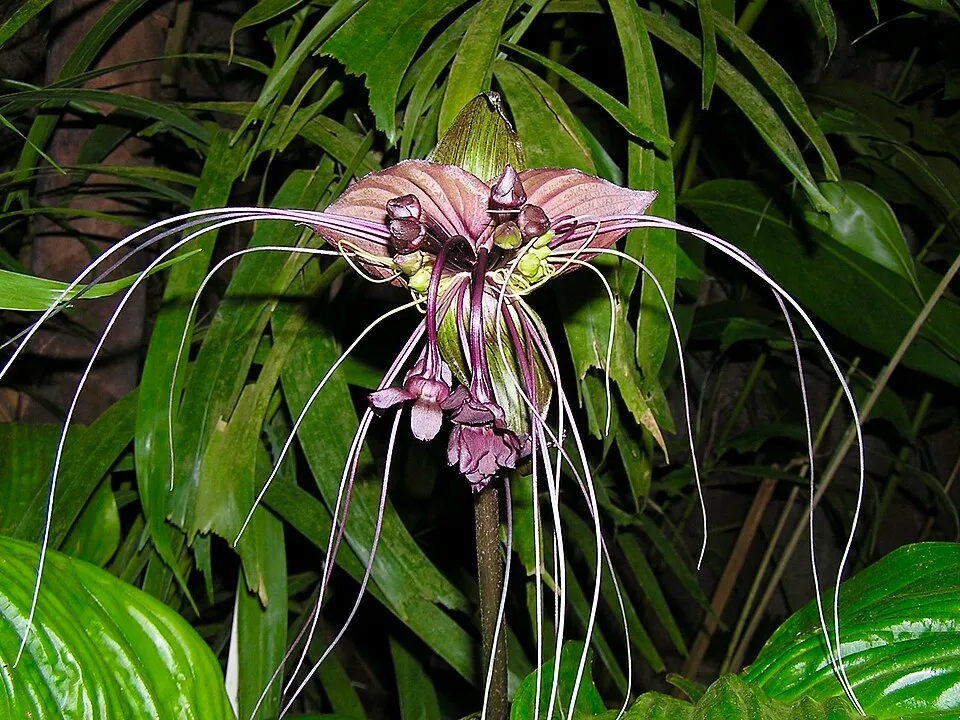
Tacca chantrieri, famously known as the Black Bat Flower or Devil's Flower, is an extraordinary perennial herb belonging to the Dioscoreaceae family, which also encompasses true yams. This captivating plant is indigenous to the humid tropical and subtropical rainforest understories of Southeast Asia, specifically found across Malaysia, Thailand, and southern China. Its distinctive morphology includes a striking inflorescence that mimics a bat in flight, characterized by dark purple to black bracts, long filamentous 'whiskers' (bracteoles), and a central cluster of smaller, darker flowers.
Unlike its edible relatives, Tacca chantrieri is primarily cultivated for its ornamental appeal, as its rhizomes are fibrous and possess a bitter taste. The plant thrives in environments offering deep shade, consistently moist yet well-drained soil, and high humidity, conditions typical of its native rainforest habitat. These specific ecological requirements have shaped its botanical characteristics, leading to its preference for filtered light and a stable, humid microclimate.
Historically, indigenous communities have been fascinated by its unique and somewhat eerie beauty, sometimes attributing mystical or superstitious properties to it. While not widely documented in classic medicinal texts, traditional practices in its native regions have utilized its rhizomes as a strong purgative or emetic, primarily to expel intestinal parasites. Modern scientific inquiry into Tacca chantrieri has intensified, revealing a rich phytochemical profile including steroidal saponins, flavonoids, and triterpenoids, which are now being investigated for potential pharmacological activities such as anti-inflammatory and cytotoxic effects.
Trusted Scientific References
1. Authoritative external sources for Tacca chantrieri
1.1 Wikipedia — Tacca chantrieri
1.2 Kew POWO (Plants of the World Online)
1.3 PubMed — peer-reviewed research
1.4 NCBI Taxonomy Browser
1.5 GBIF — Global Biodiversity
1.6Tacca Chantrieri should be interpreted through verified botanical identity, practical care, and responsible safety language. This recovery note adds the missing context needed for a complete profile: match light to the plant's habit, use well-drained soil, water according to season, and avoid unsupported medicinal or edible claims. For publishing, the plant can be presented as a source-backed indoor plant with clear care guidance, common problem diagnosis, and conservative safety wording.
1.1.Tacca Chantrieri — Key Features
- ✓ <strong>Striking Appearance</strong> — Unique, dark, bat-like inflorescence with long 'whiskers'.
- ✓ <strong>Tropical Origin</strong> — Native to humid rainforests of Southeast Asia.
- ✓ <strong>Dioscoreaceae Family</strong> — Related to true yams, but primarily ornamental.
- ✓ <strong>Medicinal Rhizomes</strong> — Traditionally used for purgative and anti-parasitic actions.
- ✓ <strong>Rich Phytochemistry</strong> — Contains steroidal saponins, flavonoids, and triterpenoids.
- ✓ <strong>Antioxidant Activity</strong> — Exhibits significant free radical scavenging properties.
- ✓ <strong>Anticancer Potential</strong> — Demonstrated cytotoxic effects against various cancer cells.
- ✓ <strong>Chemo</strong> — sensitizing Effects — May enhance effectiveness of chemotherapy drugs.
- ✓ <strong>Shade</strong> — Loving Plant — Prefers deep shade and high humidity.
- ✓ <strong>Ornamental Value</strong> — Highly prized as an exotic houseplant or garden specimen.
1.2.Tacca Chantrieri — Quick Summary
- ✓ Black Bat Flower (Tacca chantrieri) is an ornamental plant from Southeast Asia.
- ✓ Known for its unique, bat-like dark inflorescence.
- ✓ Traditional uses include purgative and anti-parasitic properties from rhizomes.
- ✓ Modern research highlights antioxidant, anti-inflammatory, and cytotoxic effects, particularly against cancer cells.
- ✓ Contains steroidal saponins, flavonoids, and triterpenoids.
- ✓ Requires careful handling due to potent effects and potential toxicity, not for self-medication.
2.Tacca Chantrieri — Scientific Identity
3.Tacca Chantrieri — Quick Facts
4.Tacca Chantrieri — Appearance & Identification
5.Tacca Chantrieri — Native Habitat
6.Tacca Chantrieri — Water Requirements
- ✓ Soil Preference — Requires well-drained, humus-rich, slightly acidic to neutral soil (pH 6.0-7.0).
- ✓ Light Conditions — Thrives in deep to partial shade; direct sunlight can scorch its leaves.
- ✓ Watering — Needs consistent moisture; keep soil evenly damp but not waterlogged. High humidity is crucial.
- ✓ Temperature — Prefers warm temperatures, ideally between 20-30°C (68-86°F); sensitive to cold.
- ✓ Humidity — Requires high humidity (70-90%); misting or a humidity tray is beneficial.
- ✓ Fertilization — Feed monthly during growing season with a balanced liquid fertilizer diluted to half strength.
- ✓ Propagation — Primarily propagated by rhizome division or seeds, though seeds can be slow to germinate.
- ✓ Pests and Diseases — Generally resistant, but watch for spider mites in dry conditions and root rot from overwatering.
Reviewed by the Flora Medical Global Botanical Review Panel
Multi-disciplinary editorial group · Botany · Ethnobotany · Herbal-medicine literature
Who reviewed this: This page was checked by the Flora Medical Global Botanical Review Panel — an in-house editorial group of botany graduates, ethnobotany researchers, and horticulture practitioners who collectively maintain our 7,000+ plant encyclopedia. Meet the team.
Our 4-step verification process
1. Taxonomic verification
Scientific names and synonyms cross-checked against Kew POWO, World Flora Online, and The Plant List.
2. Phytochemical & medicinal cross-reference
Active compounds, traditional uses, and reported activities are cross-referenced with PubMed, USDA Dr. Duke's database, and peer-reviewed ethnobotanical literature.
3. Conservation & distribution check
Distribution, ecology, and conservation status confirmed against GBIF occurrence records and the IUCN Red List.
4. Editorial & safety review
Every entry passes an editorial pass for clarity, originality, and safety notices (toxicity, contraindications, dosage caveats) before publication.
Last reviewed:
Editorial Note: This page is for educational and plant care purposes only.
Written by: Flora Medical Global Editorial Team
Reviewed by: Flora Medical Global Botanical Review Panel
Last Updated: June 15, 2026







Tacca Chantrieri — Comments & Community Reviews
Rate this plant