
Care Disclaimer: Plant care recommendations are general guidelines based on common growing conditions. Individual results may vary based on your local environment, climate, and care routine. If your plant is toxic, keep it away from children and pets, and consult a veterinarian if accidental ingestion occurs.
1.Thanksgiving Cactus — Overview
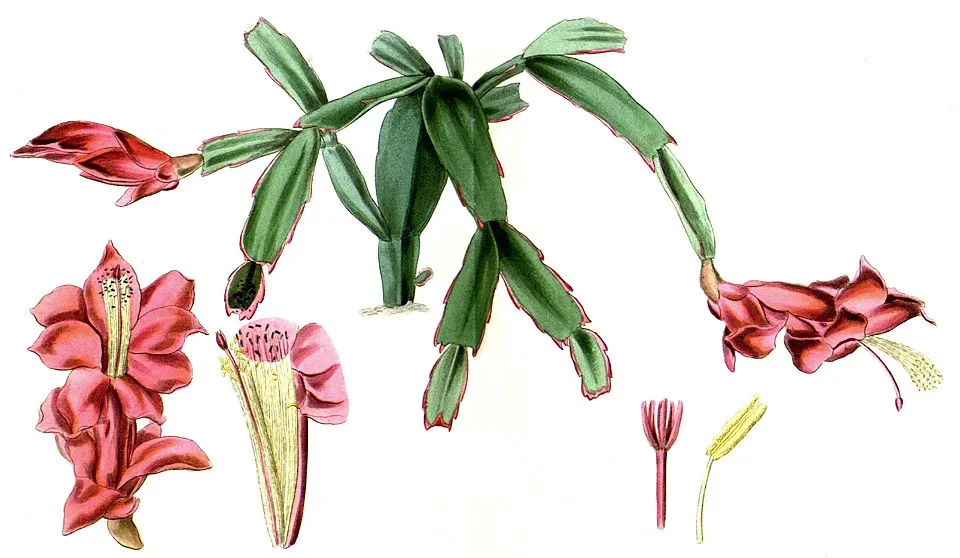
The Thanksgiving Cactus, botanically designated as Schlumbergera truncata, is an intriguing epiphytic succulent belonging to the Cactaceae family, specifically the Rhipsalideae tribe. Native to the humid, coastal mountains of southeastern Brazil, this species thrives not in arid deserts, but as an epiphyte, growing on trees or rocks within the rainforest understory. Its common names, such as 'Thanksgiving Cactus,' 'Crab Cactus,' or 'Holiday Cactus,' reflect its characteristic blooming period from late autumn into early winter in the Northern Hemisphere. Unlike many cacti, S.
truncata features flattened, segmented stems that are often mistaken for leaves. These segments are true stems, deeply toothed or 'truncated' along their margins, a feature that distinguishes it from related species like the Christmas Cactus (Schlumbergera x buckleyi) which has more rounded segments. These stem segments are vital for photosynthesis and water storage. The plant produces striking, tubular, zygomorphic flowers that emerge from areoles at the tips of the segments.
These vibrant blooms come in a spectrum of colors including reds, pinks, oranges, whites, and purples, often displaying contrasting throats. This extended flowering period, coupled with its relatively easy care requirements, has cemented its status as a globally cherished ornamental houseplant. While primarily cultivated for its aesthetic appeal, its botanical lineage within the Cactaceae family suggests a potential, though largely undocumented, phytochemical richness that warrants further scientific investigation beyond its ornamental value.
Trusted Scientific References
1. Authoritative external sources for Schlumbergera truncata
1.1 Wikipedia — Schlumbergera truncata
1.2 Kew POWO (Plants of the World Online)
1.3 PubMed — peer-reviewed research
1.4 NCBI Taxonomy Browser
1.5 GBIF — Global Biodiversity
1.6Thanksgiving Cactus should be interpreted through verified botanical identity, practical care, and responsible safety language. This recovery note adds the missing context needed for a complete profile: match light to the plant's habit, use well-drained soil, water according to season, and avoid unsupported medicinal or edible claims. For publishing, the plant can be presented as a source-backed indoor plant with clear care guidance, common problem diagnosis, and conservative safety wording.
1.1.Thanksgiving Cactus — Key Features
- ✓ <strong>Epiphytic Growth</strong> — Naturally grows on trees or rocks.
- ✓ <strong>Segmented Stems</strong> — Flattened, leaf-like stem segments with 'truncated' margins.
- ✓ <strong>Winter Blooms</strong> — Flowers profusely in late fall and early winter.
- ✓ <strong>Zygomorphic Flowers</strong> — Bilaterally symmetrical, tubular flowers in diverse colors.
- ✓ <strong>Low Maintenance</strong> — Relatively easy to care for, popular houseplant.
- ✓ <strong>Non</strong> — Toxic — Safe for homes with children and pets.
- ✓ <strong>High Humidity Tolerance</strong> — Thrives in moist air conditions.
- ✓ <strong>Drought Tolerant (Moderate)</strong> — Can withstand short periods of dryness.
- ✓ <strong>Arching/Pendulous Habit</strong> — Ideal for hanging baskets and elevated displays.
- ✓ <strong>Pet</strong> — Friendly — A safe choice for plant enthusiasts with animals.
1.2.Thanksgiving Cactus — Quick Summary
- ✓ Epiphytic cactus native to Brazilian rainforests.
- ✓ Blooms in late autumn/early winter, coinciding with Thanksgiving.
- ✓ Features flattened, segmented stems and vibrant, tubular flowers.
- ✓ Primarily an ornamental houseplant, non-toxic to humans and pets.
- ✓ Requires bright, indirect light, well-draining soil, and high humidity.
- ✓ Potential for antioxidant and anti-inflammatory benefits based on related Cactaceae species.
2.Thanksgiving Cactus — Scientific Identity
3.Thanksgiving Cactus — Quick Facts
4.Thanksgiving Cactus — Appearance & Identification
5.Thanksgiving Cactus — Native Habitat
6.Thanksgiving Cactus — Water Requirements
- ✓ Light — Prefers bright, indirect light; direct summer sun can scorch stems.
- ✓ Soil — Requires well-draining, porous potting mix, typically an orchid bark or cactus blend.
- ✓ Watering — Water thoroughly when the top inch of soil is dry, then allow to dry out before re-watering; avoid overwatering.
- ✓ Humidity — Thrives in high humidity, benefiting from misting or a pebble tray.
- ✓ Temperature — Ideal temperatures are 70-80°F (21-27°C) during growing season, cooler (50-60°F / 10-15°C) in fall to promote blooming.
- ✓ Fertilization — Fertilize monthly with a balanced liquid fertilizer during active growth (spring/summer), reduce in fall and winter.
- ✓ Pruning — Prune after flowering to encourage bushier growth and more blooms next season.
- ✓ Propagation — Easily propagated by stem cuttings; allow cuttings to callus for a few days before planting.
Reviewed by the Flora Medical Global Botanical Review Panel
Multi-disciplinary editorial group · Botany · Ethnobotany · Herbal-medicine literature
Who reviewed this: This page was checked by the Flora Medical Global Botanical Review Panel — an in-house editorial group of botany graduates, ethnobotany researchers, and horticulture practitioners who collectively maintain our 7,000+ plant encyclopedia. Meet the team.
Our 4-step verification process
1. Taxonomic verification
Scientific names and synonyms cross-checked against Kew POWO, World Flora Online, and The Plant List.
2. Phytochemical & medicinal cross-reference
Active compounds, traditional uses, and reported activities are cross-referenced with PubMed, USDA Dr. Duke's database, and peer-reviewed ethnobotanical literature.
3. Conservation & distribution check
Distribution, ecology, and conservation status confirmed against GBIF occurrence records and the IUCN Red List.
4. Editorial & safety review
Every entry passes an editorial pass for clarity, originality, and safety notices (toxicity, contraindications, dosage caveats) before publication.
Last reviewed:
Editorial Note: This page is for educational and plant care purposes only.
Written by: Flora Medical Global Editorial Team
Reviewed by: Flora Medical Global Botanical Review Panel
Last Updated: June 15, 2026







Thanksgiving Cactus — Comments & Community Reviews
Rate this plant