

Care Disclaimer: Plant care recommendations are general guidelines based on common growing conditions. Individual results may vary based on your local environment, climate, and care routine. If your plant is toxic, keep it away from children and pets, and consult a veterinarian if accidental ingestion occurs.
1.Tillandsia Bulbosa — Overview
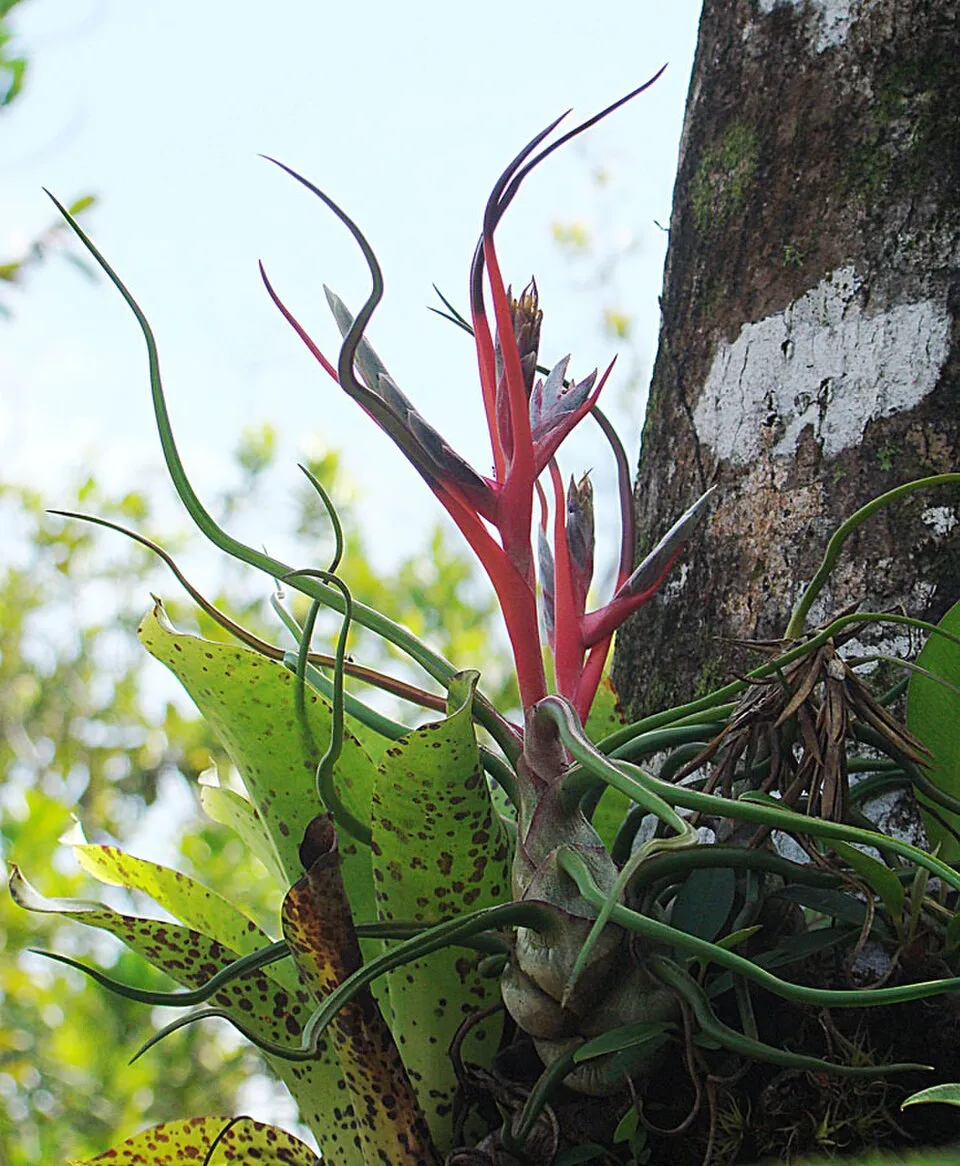
Tillandsia bulbosa, commonly known as the bulbous air plant, is a distinctive perennial epiphyte belonging to the Bromeliaceae family. Native to the humid tropical and subtropical regions spanning Mexico and Central America, it thrives in environments with abundant moisture and filtered light. This remarkable plant is characterized by its unique pseudobulbous base, which serves as a natural reservoir for water and nutrients, enabling its survival in arid periods.
From this bulbous structure emerge elongated, often contorted, and delicate leaves, typically arranged in a spiral fashion, reaching lengths of 20 to 30 centimeters. The leaves are densely covered with specialized trichomes—minute, silvery, hair-like scales—that are crucial for efficiently absorbing atmospheric moisture and dissolved nutrients directly from the air. As an epiphyte, Tillandsia bulbosa anchors itself to host trees or rocky outcrops without drawing sustenance from them, embodying a non-parasitic relationship.
During its reproductive phase, it produces a vibrant inflorescence with striking pink or purple flowers that arise from a thick, often colorful, stalk, attracting a variety of pollinators such as hummingbirds and insects. Its ability to flourish without soil, relying solely on atmospheric resources, makes it a fascinating botanical specimen and a popular choice for indoor cultivation in terrariums or mounted displays.
Trusted Scientific References
1. Authoritative external sources for Tillandsia bulbosa
1.1 Wikipedia — Tillandsia bulbosa
1.2 Kew POWO (Plants of the World Online)
1.3 PubMed — peer-reviewed research
1.4 NCBI Taxonomy Browser
1.5 GBIF — Global Biodiversity
1.6Tillandsia Bulbosa should be interpreted through verified botanical identity, practical care, and responsible safety language. This recovery note adds the missing context needed for a complete profile: match light to the plant's habit, use well-drained soil, water according to season, and avoid unsupported medicinal or edible claims. For publishing, the plant can be presented as a source-backed indoor plant with clear care guidance, common problem diagnosis, and conservative safety wording.
1.1.Tillandsia Bulbosa — Key Features
- ✓ <strong>Epiphytic Growth Habit</strong> — Thrives without soil, attaching to hosts.
- ✓ <strong>Bulbous Pseudobulb</strong> — Unique water and nutrient storage structure.
- ✓ <strong>Trichome</strong> — Covered Leaves — Specialized scales for atmospheric absorption.
- ✓ <strong>Vibrant Inflorescence</strong> — Produces striking pink/purple flowers.
- ✓ <strong>Low Maintenance (for an epiphyte)</strong> — Adaptable to indoor conditions.
- ✓ <strong>Air Purifying Qualities</strong> — Contributes to indoor air quality.
- ✓ <strong>Non</strong> — Parasitic — Coexists with host plants without harm.
- ✓ <strong>Drought Tolerant</strong> — Due to water storage in its bulbous base.
- ✓ <strong>Ornamental Value</strong> — Highly prized for its aesthetic appeal.
- ✓ <strong>Humidity Dependent</strong> — Requires consistent moisture in its environment.
1.2.Tillandsia Bulbosa — Quick Summary
- ✓ Epiphytic bromeliad from Central America, no soil needed.
- ✓ Bulbous base stores water; leaves absorb moisture via trichomes.
- ✓ Primarily ornamental, contributes to air quality and mood.
- ✓ Contains flavonoids and phenolic acids, potential for future research.
- ✓ Requires bright, indirect light, good air circulation, and regular misting.
- ✓ Generally safe, but avoid ingestion and check for skin sensitivity.
2.Tillandsia Bulbosa — Scientific Identity
3.Tillandsia Bulbosa — Quick Facts
4.Tillandsia Bulbosa — Appearance & Identification
5.Tillandsia Bulbosa — Native Habitat
6.Tillandsia Bulbosa — Water Requirements
- ✓ Air Circulation — Requires excellent air movement; avoid enclosed spaces without ventilation.
- ✓ Watering — Mist thoroughly 2-3 times per week, or soak for 20-30 minutes once a week.
- ✓ Light — Thrives in bright, indirect light; direct sun can scorch leaves.
- ✓ Mounting — Best grown mounted on wood, cork, or rock; do not plant in soil.
- ✓ Humidity — Prefers high humidity (60-80%); supplement with misting if air is dry.
- ✓ Fertilization — Use a bromeliad-specific fertilizer at 1/4 strength, once a month during growing season.
- ✓ Temperature — Ideal temperatures range from 15°C to 30°C (60°F to 85°F).
- ✓ Drainage — Ensure rapid drying after watering to prevent rot in the bulbous base.
Reviewed by the Flora Medical Global Botanical Review Panel
Multi-disciplinary editorial group · Botany · Ethnobotany · Herbal-medicine literature
Who reviewed this: This page was checked by the Flora Medical Global Botanical Review Panel — an in-house editorial group of botany graduates, ethnobotany researchers, and horticulture practitioners who collectively maintain our 7,000+ plant encyclopedia. Meet the team.
Our 4-step verification process
1. Taxonomic verification
Scientific names and synonyms cross-checked against Kew POWO, World Flora Online, and The Plant List.
2. Phytochemical & medicinal cross-reference
Active compounds, traditional uses, and reported activities are cross-referenced with PubMed, USDA Dr. Duke's database, and peer-reviewed ethnobotanical literature.
3. Conservation & distribution check
Distribution, ecology, and conservation status confirmed against GBIF occurrence records and the IUCN Red List.
4. Editorial & safety review
Every entry passes an editorial pass for clarity, originality, and safety notices (toxicity, contraindications, dosage caveats) before publication.
Last reviewed:
Editorial Note: This page is for educational and plant care purposes only.
Written by: Flora Medical Global Editorial Team
Reviewed by: Flora Medical Global Botanical Review Panel
Last Updated: June 15, 2026







Tillandsia Bulbosa — Comments & Community Reviews
Rate this plant