

Care Disclaimer: Plant care recommendations are general guidelines based on common growing conditions. Individual results may vary based on your local environment, climate, and care routine. If your plant is toxic, keep it away from children and pets, and consult a veterinarian if accidental ingestion occurs.
1.Tillandsia Funckiana — Overview
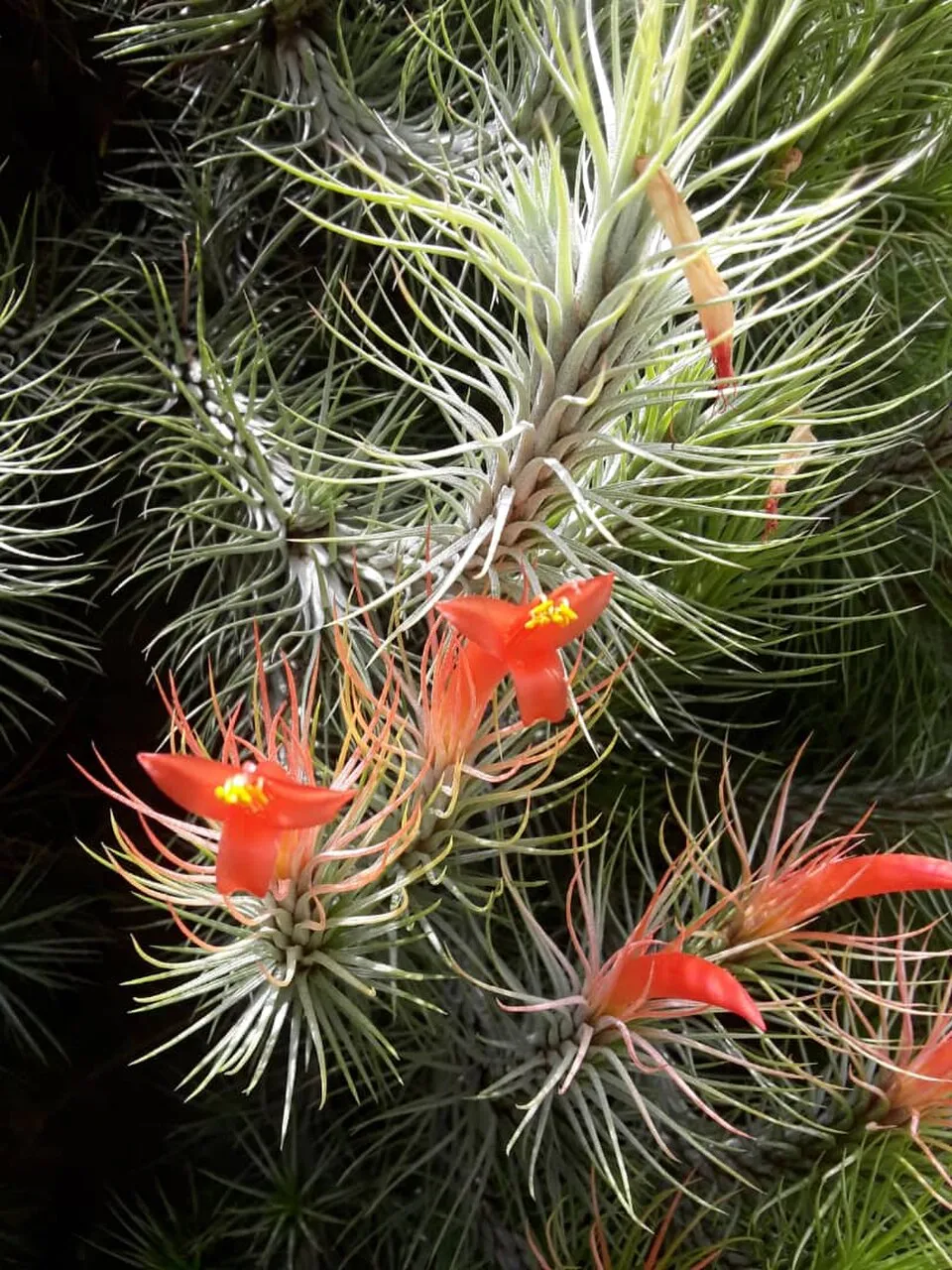
Tillandsia funckiana, commonly known as Funck's air plant, is an extraordinary epiphytic member of the Bromeliaceae family, celebrated for its unique morphology and striking ornamental value. This species typically forms a compact, upright to pendant rosette, with individual stems capable of elongating significantly, reaching up to 15 to 20 inches (38 to 51 cm) or more. Its most defining characteristic is its narrow, cylindrical, and densely packed leaves, which are distinctly recurved, creating a somewhat 'fuzzy' or wiry aesthetic.
These leaves, approximately 1 to 2 inches (2.5 to 5 cm) long, are covered with specialized, silvery-green to glaucous trichomes. These trichomes are vital for the plant's survival, functioning as highly efficient absorption structures for atmospheric moisture and dissolved nutrients, a hallmark adaptation for air plants. Unlike most terrestrial flora, Tillandsia funckiana possesses vestigial or entirely absent true roots, utilizing its trichome-covered foliage to thrive.
During its bloom cycle, Funck's air plant produces a spectacular inflorescence. A vibrant, often pendulous spike emerges from the center of the rosette, sometimes extending over 12 inches (30 cm), adorned with brilliant red or orange bracts. These colorful bracts provide a dramatic visual contrast to the tubular, often blue to purple flowers, which effectively attract a diverse range of aerial pollinators in its native habitat.
Tillandsia funckiana is indigenous to the humid, tropical mountainous regions of Venezuela, particularly thriving in cloud forests and high-altitude environments. It is frequently found clinging epiphytically to tree branches or occasionally saxicolously to rocks. Its remarkable ability to flourish in environments with minimal or no soil underscores its advanced evolutionary adaptations within the diverse Bromeliaceae family, a group renowned for its unique growth habits and often vibrant floral displays.
Trusted Scientific References
1. Authoritative external sources for Tillandsia funckiana
1.1 Wikipedia — Tillandsia funckiana
1.2 Kew POWO (Plants of the World Online)
1.3 PubMed — peer-reviewed research
1.4 NCBI Taxonomy Browser
1.5 GBIF — Global Biodiversity
1.1.Tillandsia Funckiana — Key Features
- ✓ <strong>Epiphytic Growth Habit</strong> — Thrives without soil, anchoring to surfaces.
- ✓ <strong>Trichome</strong> — Covered Leaves — Specialized cells for water and nutrient absorption.
- ✓ <strong>Distinctive Morphology</strong> — Slender, recurved, cylindrical leaves with a 'fuzzy' appearance.
- ✓ <strong>Vibrant Inflorescence</strong> — Produces striking red bracts and blue/purple tubular flowers.
- ✓ <strong>Low Maintenance</strong> — Requires minimal care compared to many houseplants.
- ✓ <strong>Air Purification Properties</strong> — Helps filter airborne contaminants.
- ✓ <strong>Humidity Contribution</strong> — Naturally increases ambient humidity.
- ✓ <strong>Pet</strong> — Friendly — Non-toxic to cats and dogs.
- ✓ <strong>Ornamental Value</strong> — Highly prized for its unique aesthetic in home decor.
- ✓ <strong>Native to Cloud Forests</strong> — Adapted to high-altitude, humid environments.
1.2.Tillandsia Funckiana — Quick Summary
- ✓ Tillandsia funckiana is an epiphytic air plant from Venezuela.
- ✓ Features slender, recurved, trichome-covered leaves and vibrant red/purple blooms.
- ✓ Absorbs moisture and nutrients through specialized leaf trichomes.
- ✓ Offers benefits like air purification, humidity regulation, and stress reduction.
- ✓ Requires bright, indirect light, weekly soaking, and good air circulation.
- ✓ Generally non-toxic to pets and humans, with low maintenance needs.
2.Tillandsia Funckiana — Scientific Identity
3.Tillandsia Funckiana — Quick Facts
4.Tillandsia Funckiana — Appearance & Identification
5.Tillandsia Funckiana — Native Habitat
6.Tillandsia Funckiana — Water Requirements
- ✓ Light — Provide bright, indirect light; avoid direct, intense sunlight which can scorch leaves.
- ✓ Watering — Soak the entire plant in dechlorinated water for 20-30 minutes once a week; mist occasionally between soakings.
- ✓ Air Circulation — Ensure good airflow to prevent rot; do not keep in enclosed, stagnant environments.
- ✓ Temperature — Maintain temperatures between 60-80°F (15-27°C); protect from frost.
- ✓ Humidity — Prefers moderate to high humidity; consider a humidifier or regular misting in dry climates.
- ✓ Fertilization — Use a Tillandsia-specific fertilizer at ¼ strength once a month during growing seasons.
- ✓ Mounting — Attach to non-treated wood, cork, or rocks using plant-safe adhesive or wire; avoid burying in soil.
- ✓ Pruning — Remove dry, brown, or dead leaves and spent flower stalks for aesthetic and health reasons.
Reviewed by the Flora Medical Global Botanical Review Panel
Multi-disciplinary editorial group · Botany · Ethnobotany · Herbal-medicine literature
Who reviewed this: This page was checked by the Flora Medical Global Botanical Review Panel — an in-house editorial group of botany graduates, ethnobotany researchers, and horticulture practitioners who collectively maintain our 7,000+ plant encyclopedia. Meet the team.
Our 4-step verification process
1. Taxonomic verification
Scientific names and synonyms cross-checked against Kew POWO, World Flora Online, and The Plant List.
2. Phytochemical & medicinal cross-reference
Active compounds, traditional uses, and reported activities are cross-referenced with PubMed, USDA Dr. Duke's database, and peer-reviewed ethnobotanical literature.
3. Conservation & distribution check
Distribution, ecology, and conservation status confirmed against GBIF occurrence records and the IUCN Red List.
4. Editorial & safety review
Every entry passes an editorial pass for clarity, originality, and safety notices (toxicity, contraindications, dosage caveats) before publication.
Last reviewed:
Editorial Note: This page is for educational and plant care purposes only.
Written by: Flora Medical Global Editorial Team
Reviewed by: Flora Medical Global Botanical Review Panel
Last Updated: June 15, 2026







Tillandsia Funckiana — Comments & Community Reviews
Rate this plant