

Care Disclaimer: Plant care recommendations are general guidelines based on common growing conditions. Individual results may vary based on your local environment, climate, and care routine. If your plant is toxic, keep it away from children and pets, and consult a veterinarian if accidental ingestion occurs.
1.Tillandsia Stricta — Overview
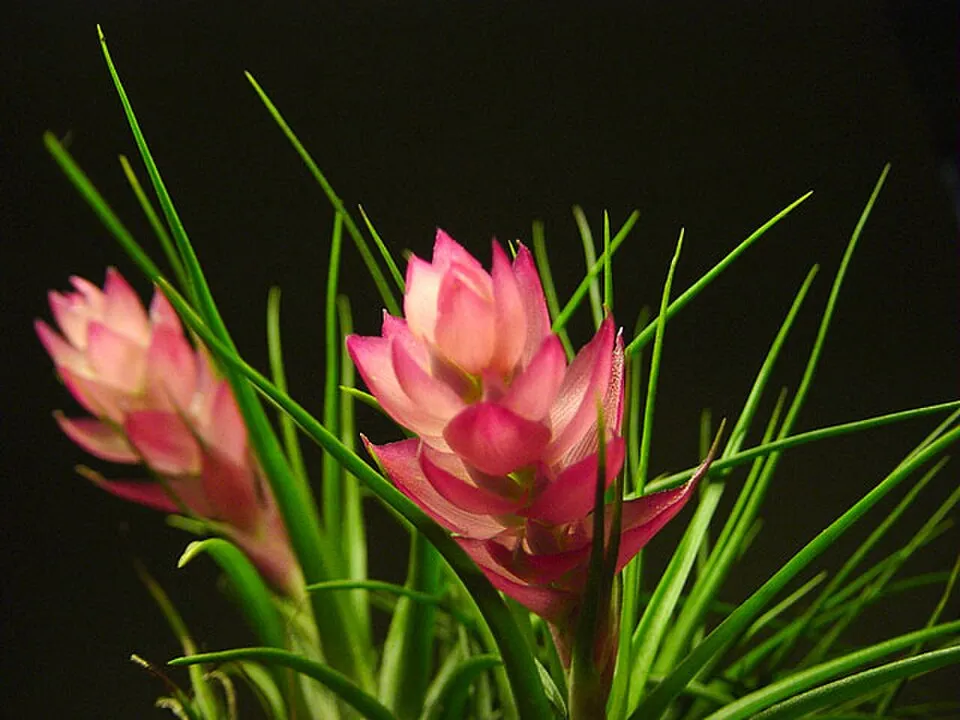
Tillandsia stricta, a captivating member of the Bromeliaceae family, is a perennial epiphytic bromeliad indigenous to the humid tropical and subtropical regions of South America, primarily spanning Brazil, Colombia, and Venezuela. This unique air plant thrives by affixing itself to tree branches or rocky substrates, absorbing all its moisture and nutrients directly from the atmosphere through specialized foliar structures. Its morphology is characterized by a dense rosette of narrow, elongated leaves, typically a vibrant green, which can transition to striking reddish or purplish hues when exposed to intense sunlight.
These leaves, which can extend up to 15 cm (6 inches) in length, are covered in microscopic, scale-like trichomes that are crucial for efficient water and nutrient absorption, a hallmark adaptation for its epiphytic lifestyle. The plant produces a prominent, erect flowering spike, often reaching 30 cm (12 inches) in height, adorned with vibrant, tubular flowers ranging from purple to blue. The inflorescence is frequently subtended by brightly colored bracts, significantly enhancing its ornamental appeal.
Tillandsia stricta's remarkable adaptability allows it to flourish in environments with fluctuating water availability, making it a resilient species in its natural habitat and a popular choice for indoor cultivation where humidity can be managed. Its ability to live independently of soil, relying solely on its atmospheric uptake mechanisms, underscores its evolutionary success within the diverse Tillandsia genus.
Trusted Scientific References
1. Authoritative external sources for Tillandsia stricta
1.1 Wikipedia — Tillandsia stricta
1.2 Kew POWO (Plants of the World Online)
1.3 PubMed — peer-reviewed research
1.4 NCBI Taxonomy Browser
1.5 GBIF — Global Biodiversity
1.6Tillandsia Stricta should be interpreted through verified botanical identity, practical care, and responsible safety language. This recovery note adds the missing context needed for a complete profile: match light to the plant's habit, use well-drained soil, water according to season, and avoid unsupported medicinal or edible claims. For publishing, the plant can be presented as a source-backed indoor plant with clear care guidance, common problem diagnosis, and conservative safety wording.
1.1.Tillandsia Stricta — Key Features
- ✓ <strong>Epiphytic Growth Habit</strong> — Thrives without soil, clinging to trees or rocks in its natural habitat.
- ✓ <strong>Specialized Trichomes</strong> — Leaves are covered with absorbent trichomes essential for water and nutrient uptake from the air.
- ✓ <strong>Striking Foliage</strong> — Features green leaves that can turn reddish-purple under bright light, forming an attractive rosette.
- ✓ <strong>Vibrant Inflorescence</strong> — Produces a tall spike with beautiful purple-to-blue tubular flowers and colorful bracts.
- ✓ <strong>Native to South America</strong> — Naturally distributed across Brazil, Colombia, and Venezuela in humid tropical zones.
- ✓ <strong>Adaptable and Resilient</strong> — Highly tolerant to periods of drought due to its efficient water absorption mechanisms.
- ✓ <strong>Rich in Bioactive Compounds</strong> — Contains flavonoids, triterpenes, and saponins, contributing to its medicinal potential.
- ✓ <strong>Traditional Herbal Remedy</strong> — Ethnobotanically recognized for various uses within the wider Tillandsia genus, including respiratory and anti-inflammatory support.
- ✓ <strong>Popular Ornamental Plant</strong> — Widely cultivated indoors and in greenhouses for its aesthetic appeal and low maintenance.
- ✓ <strong>Air Purification Potential</strong> — As an air plant, it may subtly contribute to improving indoor air quality, though not its primary medicinal benefit.
1.2.Tillandsia Stricta — Quick Summary
- ✓ Epiphytic Bromeliad — Tillandsia stricta is a unique air plant from South America, absorbing nutrients from the air.
- ✓ Traditional Medicinal Uses — Historically used for respiratory ailments, inflammation, and digestive issues within the Tillandsia genus.
- ✓ Rich Phytochemistry — Contains beneficial compounds like flavonoids, triterpenes, and saponins with antioxidant and anti-inflammatory potential.
- ✓ Ornamental Appeal — Valued for its striking rosette leaves and vibrant purple-blue flowers with colorful bracts.
- ✓ Easy Indoor Cultivation — Thrives with bright, indirect light, regular misting, and good air circulation, making it popular for homes.
- ✓ Cautious Use — Requires professional consultation before medicinal use, especially for pregnant individuals or those on medication.
2.Tillandsia Stricta — Scientific Identity
3.Tillandsia Stricta — Quick Facts
4.Tillandsia Stricta — Appearance & Identification
5.Tillandsia Stricta — Native Habitat
6.Tillandsia Stricta — Water Requirements
- ✓ Mounting — Tillandsia stricta thrives when mounted on inert structures such as driftwood, cork bark, or decorative rocks, mimicking its natural epiphytic habitat.
- ✓ Light Requirements — Provide bright, indirect light; direct, harsh sunlight can scorch the leaves, while insufficient light will hinder growth and flowering.
- ✓ Watering — Mist the entire plant thoroughly 2-3 times per week, ensuring water reaches all leaf surfaces. Additionally, soak the plant in filtered or rainwater for 20-30 minutes every 1-2 weeks.
- ✓ Air Circulation — Good air movement is crucial to prevent fungal growth and ensure the plant dries completely within a few hours after watering, preventing rot.
- ✓ Humidity — Maintain moderate to high humidity levels, ideally above 50%, especially in drier indoor environments, which can be achieved through misting or a humidity tray.
- ✓ Temperature — Keep temperatures between 15-30°C (60-85°F), avoiding extreme cold or sudden temperature fluctuations.
- ✓ Fertilization — Fertilize sparingly with a bromeliad-specific or orchid fertilizer diluted to ¼ strength, applied during soaking or misting once a month during active growing seasons.
- ✓ Propagation — Tillandsia stricta can be propagated from offsets (pups) that emerge from the base of the mother plant after flowering; remove when they are about one-third to half the size of the mother plant.
Reviewed by the Flora Medical Global Botanical Review Panel
Multi-disciplinary editorial group · Botany · Ethnobotany · Herbal-medicine literature
Who reviewed this: This page was checked by the Flora Medical Global Botanical Review Panel — an in-house editorial group of botany graduates, ethnobotany researchers, and horticulture practitioners who collectively maintain our 7,000+ plant encyclopedia. Meet the team.
Our 4-step verification process
1. Taxonomic verification
Scientific names and synonyms cross-checked against Kew POWO, World Flora Online, and The Plant List.
2. Phytochemical & medicinal cross-reference
Active compounds, traditional uses, and reported activities are cross-referenced with PubMed, USDA Dr. Duke's database, and peer-reviewed ethnobotanical literature.
3. Conservation & distribution check
Distribution, ecology, and conservation status confirmed against GBIF occurrence records and the IUCN Red List.
4. Editorial & safety review
Every entry passes an editorial pass for clarity, originality, and safety notices (toxicity, contraindications, dosage caveats) before publication.
Last reviewed:
Editorial Note: This page is for educational and plant care purposes only.
Written by: Flora Medical Global Editorial Team
Reviewed by: Flora Medical Global Botanical Review Panel
Last Updated: June 15, 2026







Tillandsia Stricta — Comments & Community Reviews
Rate this plant