

Care Disclaimer: Plant care recommendations are general guidelines based on common growing conditions. Individual results may vary based on your local environment, climate, and care routine. If your plant is toxic, keep it away from children and pets, and consult a veterinarian if accidental ingestion occurs.
1.Titanopsis Calcarea — Overview
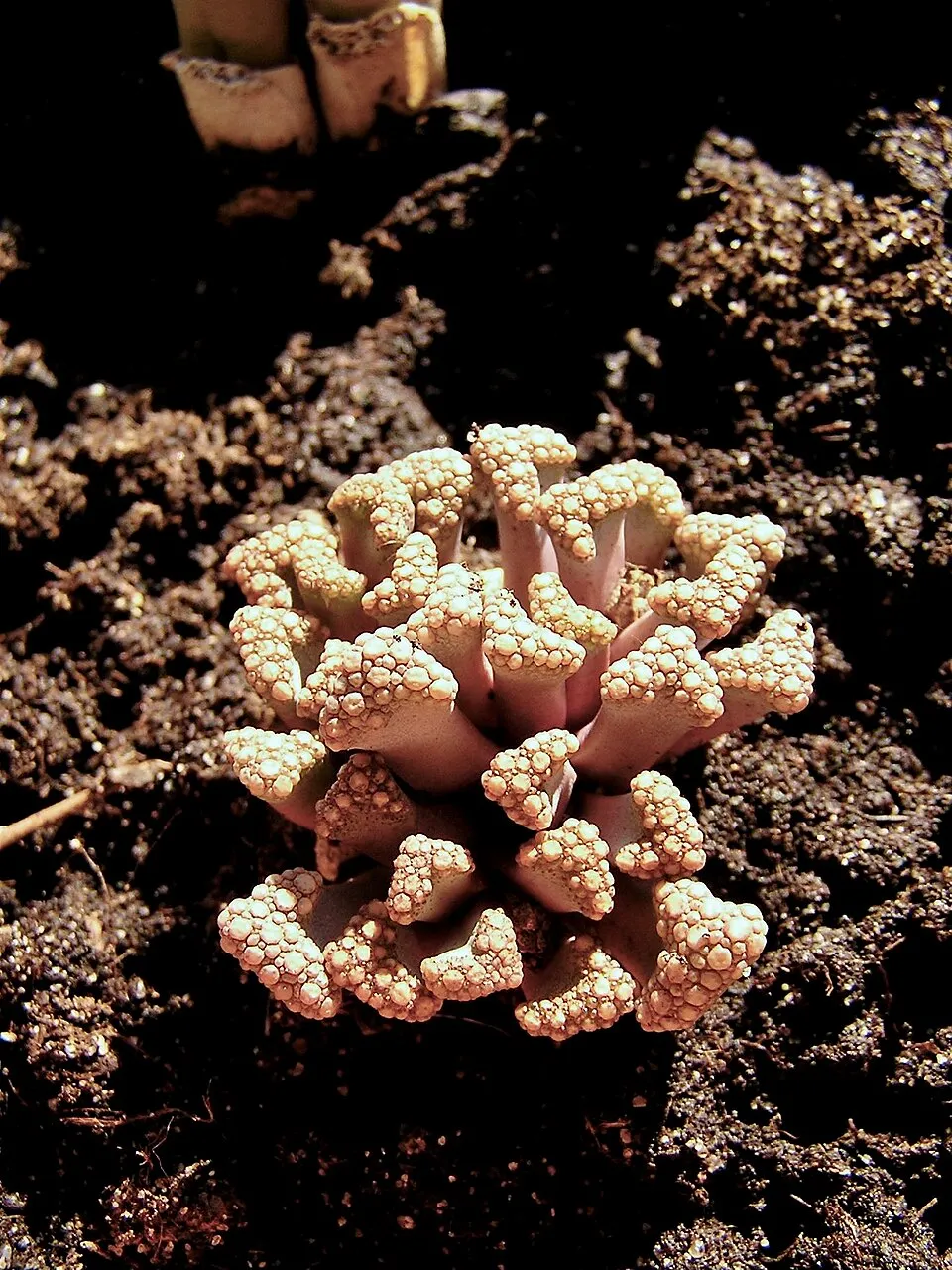
Titanopsis calcarea, commonly known as the 'Concrete Leaf' or 'Living Stone' succulent, is a captivating species within the Aizoaceae family. Native to the arid and semi-arid regions of South Africa, particularly the Northern Cape Province, it has evolved remarkable adaptations to thrive in harsh, rocky, and sandy environments. This perennial succulent forms dense, low-growing mats of rosettes, each comprising numerous fleshy, grayish-green leaves.
The leaves are uniquely textured, covered in distinct warty protuberances and a fine, dust-like coating of calcium deposits, which not only gives them a striking resemblance to pebbles or concrete but also helps to reflect intense sunlight and reduce transpirational water loss. When exposed to strong sunlight, the leaf tips may develop a reddish or purplish tinge, enhancing their camouflage. From late summer into autumn, Titanopsis calcarea produces small, solitary, daisy-like yellow flowers that emerge from the center of the rosettes, attracting local pollinators such as bees.
Its unique morphology, minimal water requirements, and low-maintenance nature make it a highly sought-after ornamental plant for succulent collectors, rock gardens, and container cultivation, offering both aesthetic appeal and a testament to botanical resilience.
Trusted Scientific References
1. Authoritative external sources for Titanopsis calcarea
1.1 Wikipedia — Titanopsis calcarea
1.2 Kew POWO (Plants of the World Online)
1.3 PubMed — peer-reviewed research
1.4 NCBI Taxonomy Browser
1.5 GBIF — Global Biodiversity
1.6Titanopsis Calcarea should be interpreted through verified botanical identity, practical care, and responsible safety language. This recovery note adds the missing context needed for a complete profile: match light to the plant's habit, use well-drained soil, water according to season, and avoid unsupported medicinal or edible claims. For publishing, the plant can be presented as a source-backed indoor plant with clear care guidance, common problem diagnosis, and conservative safety wording.
1.1.Titanopsis Calcarea — Key Features
- ✓ <strong>Botanical Name</strong> — Titanopsis calcarea.
- ✓ <strong>Common Names</strong> — Concrete Leaf, Living Stone Plant.
- ✓ <strong>Family</strong> — Aizoaceae (Ice Plant Family).
- ✓ <strong>Native Region</strong> — South Africa, particularly the Northern Cape.
- ✓ <strong>Growth Habit</strong> — Low-growing, mat-forming succulent rosettes.
- ✓ <strong>Leaf Morphology</strong> — Fleshy, grayish-green, warty texture mimicking pebbles or concrete.
- ✓ <strong>Flowering</strong> — Produces small, yellow, daisy-like flowers in late summer to autumn.
- ✓ <strong>Drought Tolerance</strong> — Highly adapted to arid environments with extreme water conservation.
- ✓ <strong>Traditional Uses</strong> — Topical applications for dermatological issues and wound care.
- ✓ <strong>Ornamental Value</strong> — Popular collector's succulent for rock gardens and indoor containers.
1.2.Titanopsis Calcarea — Quick Summary
- ✓ Drought-tolerant succulent native to South Africa, known for its unique 'living stone' appearance and textured leaves.
- ✓ Traditionally used topically in Southern African communities for wound healing, eczema, insect bites, and skin irritations.
- ✓ Contains potential anti-inflammatory, antiseptic, and antimicrobial compounds, though research is emerging.
- ✓ Valued ornamentally for its aesthetic appeal, resilience symbolism, and indirect wellness benefits in indoor environments.
- ✓ Requires minimal water and excellent drainage; sensitive to frost and overwatering.
- ✓ Primarily for external use; internal consumption is not recommended due to lack of safety data.
2.Titanopsis Calcarea — Scientific Identity
3.Titanopsis Calcarea — Quick Facts
4.Titanopsis Calcarea — Appearance & Identification
5.Titanopsis Calcarea — Native Habitat
6.Titanopsis Calcarea — Water Requirements
- ✓ Soil Requirements — Thrives in extremely well-draining, gritty soil, ideally a succulent mix comprising pumice, perlite, coarse sand, and a minimal amount of organic matter.
- ✓ Light Exposure — Prefers full sun to bright, indirect light; strong light encourages compact growth and enhances the distinctive leaf coloration and texture.
- ✓ Watering — Water sparingly and deeply during its active growing season, allowing the soil to dry out completely between waterings to prevent root rot.
- ✓ Temperature and Humidity — Tolerates high temperatures but is highly susceptible to frost; ideal temperatures are between 18-28°C (65-82°F); low humidity is preferred.
- ✓ Fertilization — Requires very little fertilization; a highly diluted, low-nitrogen succulent fertilizer can be applied once or twice during its active growth period.
- ✓ Propagation — Primarily propagated from seeds, which can be slow and challenging, or by carefully dividing established clumps during repotting.
- ✓ Container Growing — An excellent choice for containers due to its compact size and specific drainage needs, making it suitable for indoor cultivation in bright locations.
Reviewed by the Flora Medical Global Botanical Review Panel
Multi-disciplinary editorial group · Botany · Ethnobotany · Herbal-medicine literature
Who reviewed this: This page was checked by the Flora Medical Global Botanical Review Panel — an in-house editorial group of botany graduates, ethnobotany researchers, and horticulture practitioners who collectively maintain our 7,000+ plant encyclopedia. Meet the team.
Our 4-step verification process
1. Taxonomic verification
Scientific names and synonyms cross-checked against Kew POWO, World Flora Online, and The Plant List.
2. Phytochemical & medicinal cross-reference
Active compounds, traditional uses, and reported activities are cross-referenced with PubMed, USDA Dr. Duke's database, and peer-reviewed ethnobotanical literature.
3. Conservation & distribution check
Distribution, ecology, and conservation status confirmed against GBIF occurrence records and the IUCN Red List.
4. Editorial & safety review
Every entry passes an editorial pass for clarity, originality, and safety notices (toxicity, contraindications, dosage caveats) before publication.
Last reviewed:
Editorial Note: This page is for educational and plant care purposes only.
Written by: Flora Medical Global Editorial Team
Reviewed by: Flora Medical Global Botanical Review Panel
Last Updated: June 15, 2026







Titanopsis Calcarea — Comments & Community Reviews
Rate this plant