
Care Disclaimer: Plant care recommendations are general guidelines based on common growing conditions. Individual results may vary based on your local environment, climate, and care routine. If your plant is toxic, keep it away from children and pets, and consult a veterinarian if accidental ingestion occurs.
1.Travelers Palm — Overview
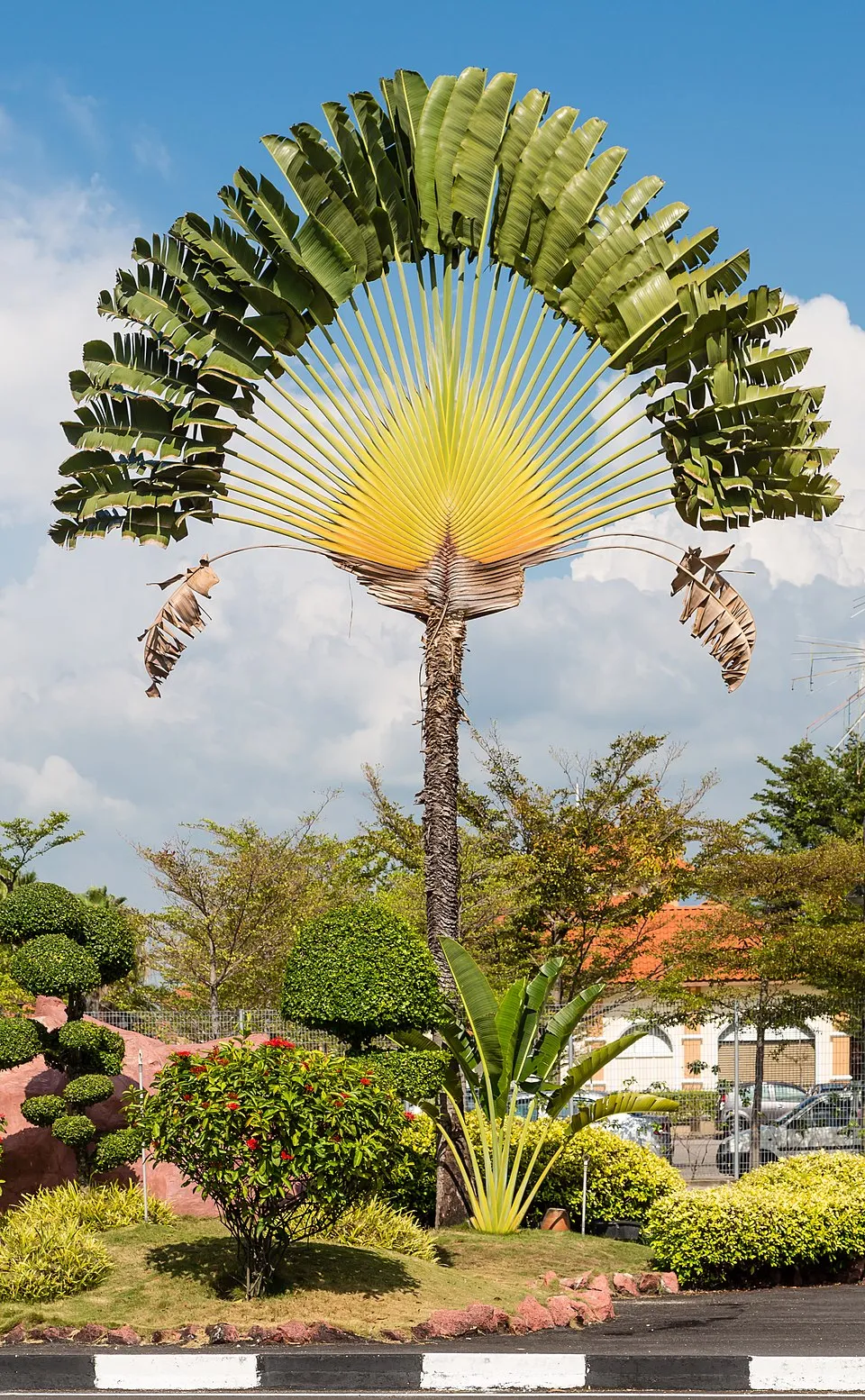
Ravenala madagascariensis, commonly known as the Travelers Palm or Travelers Tree, is an emblematic evergreen arborescent monocot native exclusively to the island of Madagascar. Despite its popular moniker and palm-like appearance, it is not a true palm but belongs to the Strelitziaceae family, sharing kinship with the vibrant bird-of-paradise flowers. Its most striking feature is the dramatic arrangement of colossal, paddle-shaped leaves, which can reach lengths of 3 to 4 meters, fanning out symmetrically in a single plane atop a robust, often unbranched trunk.
This trunk, typically growing 10 to 12 meters high, is characterized by distinct rings, the remnants of fallen leaves, lending it a rough, greyish texture. The impressive distichous array of leaves often aligns itself along an east-west axis, a characteristic that reputedly earned it the 'Travelers Palm' name, as it could serve as a rudimentary compass for those navigating its native landscapes. Crucially, the fused bases of these massive leaf petioles form natural cup-like structures capable of collecting and storing substantial amounts of rainwater, a vital resource for both the plant and various endemic fauna.
The Travelers Palm develops an extensive fibrous root system, providing strong anchorage in its preferred tropical habitats, thriving in open, sunny locations with consistently moist, well-drained soil, frequently found along riverbanks or within rainforest clearings. The plant's inflorescences are encased in large, boat-shaped bracts (spathes) emerging from the leaf axils, bearing numerous white to creamy-yellow tubular flowers, primarily pollinated by lemurs and bats in Madagascar. Post-pollination, woody, capsular fruits develop, splitting open to reveal distinctive, iridescent blue seeds.
Trusted Scientific References
1. Authoritative external sources for Ravenala madagascariensis
1.1 Wikipedia — Ravenala madagascariensis
1.2 Kew POWO (Plants of the World Online)
1.3 PubMed — peer-reviewed research
1.4 NCBI Taxonomy Browser
1.5 GBIF — Global Biodiversity
1.1.Travelers Palm — Key Features
- ✓ <strong>Endemic to Madagascar,</strong> — Endemic to Madagascar, a national symbol of the island.
- ✓ <strong>Strikingly symmetrical, fan</strong> — shaped crown of colossal leaves.
- ✓ <strong>Leaf bases form</strong> — Leaf bases form natural reservoirs, collecting significant amounts of rainwater.
- ✓ <strong>Produces unique, vibrant</strong> — Produces unique, vibrant iridescent blue seeds within woody capsules.
- ✓ <strong>Closely related to the Bird</strong> — of-Paradise flower (Strelitzia).
- ✓ <strong>A popular ornamental</strong> — A popular ornamental plant in tropical and subtropical landscapes worldwide.
- ✓ <strong>Heart of the</strong> — Heart of the plant and young leaves are traditionally consumed as food.
- ✓ <strong>Various plant parts</strong> — Various plant parts are utilized in traditional construction and crafts.
- ✓ <strong>Pollination primarily carried</strong> — Pollination primarily carried out by lemurs and bats in its native habitat.
- ✓ <strong>Possesses a robust,</strong> — Possesses a robust, unbranched trunk marked by distinctive leaf scars.
1.2.Travelers Palm — Quick Summary
- ✓ Iconic arborescent monocot from Madagascar, not a true palm.
- ✓ Large, fan-shaped leaves collect rainwater, inspiring its 'Travelers Tree' name.
- ✓ Traditionally used for diabetes, kidney issues, stomachaches, and as food.
- ✓ Rich in flavonoids, triterpenes, and fatty acids with documented bioactivities.
- ✓ Scientific studies support its antioxidant, antidiabetic, hypolipidemic, and renoprotective properties.
- ✓ Water collected in leaf bases is generally unsafe for direct human consumption due to contamination.
2.Travelers Palm — Scientific Identity
3.Travelers Palm — Quick Facts
4.Travelers Palm — Appearance & Identification
5.Travelers Palm — Native Habitat
6.Travelers Palm — Water Requirements
- ✓ Climate Preference — Thrives in tropical to subtropical climates, requiring high humidity and warm temperatures year-round, sensitive to frost.
- ✓ Sunlight Requirements — Prefers full sun exposure for optimal growth, though young plants can tolerate partial shade.
- ✓ Soil and Drainage — Needs well-drained, fertile soil rich in organic matter, with consistent moisture but not waterlogging.
- ✓ Watering Regime — Requires regular and ample watering, especially during dry periods, to mimic its natural rainforest habitat.
- ✓ Propagation — Primarily propagated by seeds, which should be fresh and pre-soaked, or by suckers that emerge from the base of mature plants.
- ✓ Space and Growth — Due to its large size and expansive fan-like canopy, it requires significant space, making it suitable for large gardens or landscapes.
- ✓ Container Growing — Young plants can be grown in large containers, but will eventually outgrow them and require transplanting to the ground.
- ✓ Invasive Potential — In some regions outside its native range, such as Mauritius, it can be considered an invasive species, requiring careful management.
Reviewed by the Flora Medical Global Botanical Review Panel
Multi-disciplinary editorial group · Botany · Ethnobotany · Herbal-medicine literature
Who reviewed this: This page was checked by the Flora Medical Global Botanical Review Panel — an in-house editorial group of botany graduates, ethnobotany researchers, and horticulture practitioners who collectively maintain our 7,000+ plant encyclopedia. Meet the team.
Our 4-step verification process
1. Taxonomic verification
Scientific names and synonyms cross-checked against Kew POWO, World Flora Online, and The Plant List.
2. Phytochemical & medicinal cross-reference
Active compounds, traditional uses, and reported activities are cross-referenced with PubMed, USDA Dr. Duke's database, and peer-reviewed ethnobotanical literature.
3. Conservation & distribution check
Distribution, ecology, and conservation status confirmed against GBIF occurrence records and the IUCN Red List.
4. Editorial & safety review
Every entry passes an editorial pass for clarity, originality, and safety notices (toxicity, contraindications, dosage caveats) before publication.
Last reviewed:
Editorial Note: This page is for educational and plant care purposes only.
Written by: Flora Medical Global Editorial Team
Reviewed by: Flora Medical Global Botanical Review Panel
Last Updated: June 15, 2026







Travelers Palm — Comments & Community Reviews
Rate this plant