


Care Disclaimer: Plant care recommendations are general guidelines based on common growing conditions. Individual results may vary based on your local environment, climate, and care routine. If your plant is toxic, keep it away from children and pets, and consult a veterinarian if accidental ingestion occurs.
1.Utricularia — Overview
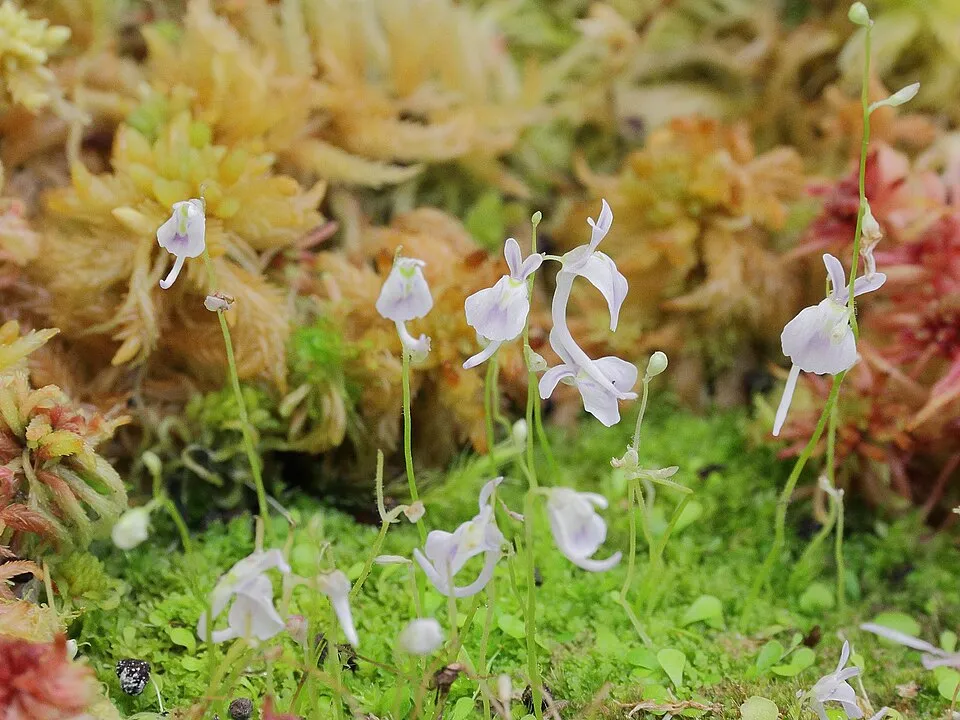
Utricularia sandersonii, commonly known as Sanderson's bladderwort, is a captivating perennial herbaceous carnivorous plant belonging to the family Lentibulariaceae. This unique species thrives in specific, nutrient-poor, and consistently waterlogged environments, such as shallow swamps, bogs, and marshy areas, where it frequently forms extensive, vibrant green mats. Native to the Southern African regions including South Africa, Namibia, and Botswana, U. sandersonii has evolved remarkable adaptations to its aquatic and semi-aquatic habitats.
Morphologically, the plant is distinguished by its highly specialized bladder-like traps, which are transparent and appear as tiny bubbles submerged in water. These ingenious structures function as rapid-fire suction traps, capturing minute aquatic invertebrates like protozoa and small insect larvae to supplement its nutrient intake from the impoverished soil. Its leaves are finely dissected, giving them a delicate, feathery appearance, typically displaying a bright green hue that contrasts beautifully with its watery surroundings. While flowering is not constant, when it occurs, the plant produces charming, bright yellow, sometimes white-tinged, bilabiate flowers that emerge gracefully above the water or substrate on tall, slender stalks, attracting specific pollinators.
U. sandersonii exhibits notable resilience, adapting well to fluctuations in water levels and various environmental changes, making it a fascinating subject for botanical study and a unique addition to specialized indoor aquariums or terrariums, provided its specific care requirements are met.
Trusted Scientific References
1. Authoritative external sources for Utricularia sandersonii
1.1 Wikipedia — Utricularia sandersonii
1.2 Kew POWO (Plants of the World Online)
1.3 PubMed — peer-reviewed research
1.4 NCBI Taxonomy Browser
1.5 GBIF — Global Biodiversity
1.6Utricularia should be interpreted through verified botanical identity, practical care, and responsible safety language. This recovery note adds the missing context needed for a complete profile: match light to the plant's habit, use well-drained soil, water according to season, and avoid unsupported medicinal or edible claims. For publishing, the plant can be presented as a source-backed indoor plant with clear care guidance, common problem diagnosis, and conservative safety wording.
1.1.Utricularia — Key Features
- ✓ <strong>Species Name</strong> — Utricularia sandersonii (Sanderson's Bladderwort).
- ✓ <strong>Family</strong> — Lentibulariaceae (Bladderwort Family).
- ✓ <strong>Plant Type</strong> — Carnivorous herbaceous perennial.
- ✓ <strong>Habitat</strong> — Aquatic to semi-aquatic, nutrient-poor bogs and swamps.
- ✓ <strong>Carnivorous Mechanism</strong> — Distinctive, fast-acting bladder traps for capturing micro-invertebrates.
- ✓ <strong>Flowers</strong> — Small, bilabiate, bright yellow flowers borne on slender stalks.
- ✓ <strong>Leaves</strong> — Finely dissected, feathery, typically bright green.
- ✓ <strong>Traditional Use</strong> — Genus Utricularia used as diuretic, anti-inflammatory, and for skin ailments.
- ✓ <strong>Cultivation</strong> — Requires specialized care: consistently wet, low-nutrient, acidic conditions.
- ✓ <strong>Distribution</strong> — Native to South Africa, Namibia, and Botswana.
1.2.Utricularia — Quick Summary
- ✓ Utricularia sandersonii is a carnivorous perennial known as Sanderson's bladderwort.
- ✓ It thrives in nutrient-poor, wet habitats across Southern Africa, using unique bladder traps.
- ✓ The genus Utricularia is traditionally valued for diuretic, anti-inflammatory, and skin-supporting properties.
- ✓ Phytochemically, it contains flavonoids, phenolic acids, and iridoids, though species-specific data is limited.
- ✓ Cultivation requires specific conditions: acidic soil, distilled water, high humidity, and bright indirect light.
- ✓ Medicinal use should always be approached with caution and under professional guidance due to limited research.
2.Utricularia — Scientific Identity
3.Utricularia — Quick Facts
4.Utricularia — Appearance & Identification
5.Utricularia — Native Habitat
6.Utricularia — Water Requirements
- ✓ Substrate Preparation — Use a highly acidic, nutrient-poor growing medium, typically a mix of peat moss and perlite or sand, avoiding standard potting soil.
- ✓ Water Quality — Employ only distilled water, rainwater, or reverse osmosis water to maintain low mineral content and prevent nutrient burn.
- ✓ Consistent Moisture — Keep the substrate consistently saturated or allow for a shallow tray of water beneath the pot, mimicking its boggy natural habitat.
- ✓ Humidity Levels — Ensure high ambient humidity, ideally above 70%, which is crucial for the plant's health; terrariums are often ideal.
- ✓ Lighting Requirements — Provide bright, indirect light; a south-facing window with filtered light or LED grow lights are suitable, but avoid harsh direct sun.
- ✓ Temperature Range — Maintain moderate temperatures, preferably between 18-28°C (65-82°F), and protect from extreme heat or cold.
- ✓ Feeding Practices — As a carnivorous plant, it captures its own prey; supplemental feeding is generally unnecessary and can even harm the delicate traps.
- ✓ Propagation Techniques — Easily propagated by dividing its rhizomes or stolons, or by taking stem cuttings and placing them in water or moist substrate.
Reviewed by the Flora Medical Global Botanical Review Panel
Multi-disciplinary editorial group · Botany · Ethnobotany · Herbal-medicine literature
Who reviewed this: This page was checked by the Flora Medical Global Botanical Review Panel — an in-house editorial group of botany graduates, ethnobotany researchers, and horticulture practitioners who collectively maintain our 7,000+ plant encyclopedia. Meet the team.
Our 4-step verification process
1. Taxonomic verification
Scientific names and synonyms cross-checked against Kew POWO, World Flora Online, and The Plant List.
2. Phytochemical & medicinal cross-reference
Active compounds, traditional uses, and reported activities are cross-referenced with PubMed, USDA Dr. Duke's database, and peer-reviewed ethnobotanical literature.
3. Conservation & distribution check
Distribution, ecology, and conservation status confirmed against GBIF occurrence records and the IUCN Red List.
4. Editorial & safety review
Every entry passes an editorial pass for clarity, originality, and safety notices (toxicity, contraindications, dosage caveats) before publication.
Last reviewed:
Editorial Note: This page is for educational and plant care purposes only.
Written by: Flora Medical Global Editorial Team
Reviewed by: Flora Medical Global Botanical Review Panel
Last Updated: June 15, 2026







Utricularia — Comments & Community Reviews
Rate this plant