
Care Disclaimer: Plant care recommendations are general guidelines based on common growing conditions. Individual results may vary based on your local environment, climate, and care routine. If your plant is toxic, keep it away from children and pets, and consult a veterinarian if accidental ingestion occurs.
1.Vanda Orchid — Overview
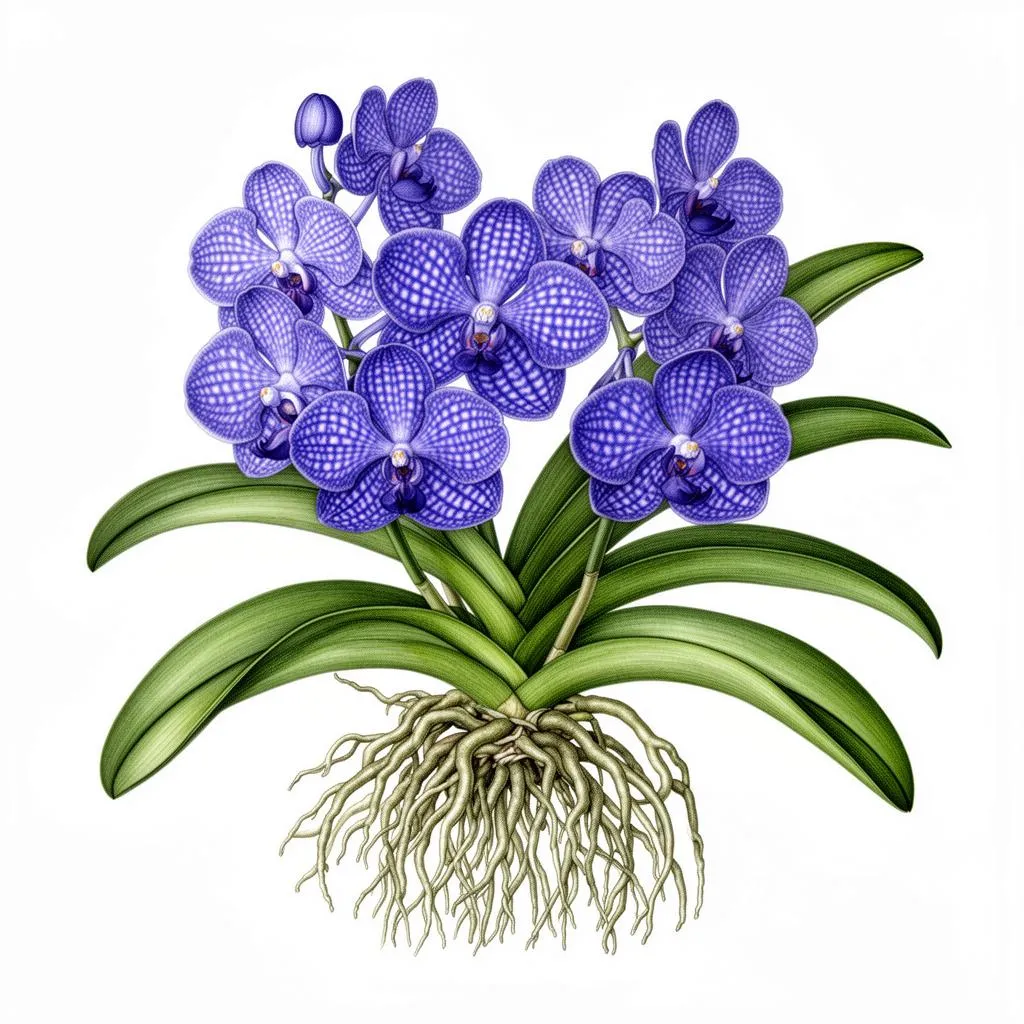
Vanda coerulea, widely recognized as the Blue Orchid or Autumn Lady's Slipper, is an exquisite epiphytic orchid species that thrives in the humid mountain forests of Northeast India, Myanmar, Thailand, and southwestern China. This captivating plant was first documented by William Griffith in 1837 and formally described by John Lindley in 1847, swiftly gaining global admiration for its unparalleled vibrant blue-purple flowers. Its native habitat is characterized by consistent high humidity, moderate temperatures, and ample filtered light, where it typically grows on the branches of large host trees at elevations ranging from 800 to 1700 meters. Vanda coerulea establishes a non-parasitic, symbiotic relationship with its arboreal hosts, using them purely for physical support.
Taxonomically, it belongs to the extensive Orchidaceae family, specifically within the subtribe Aeridinae. The species is distinguished by its monopodial growth habit, meaning it grows vertically from a single stem, continuously producing new leaves and inflorescences. Its roots are notably thick, silvery-gray, and extensively developed, encased in a spongy velamen layer designed for efficient absorption of moisture and atmospheric nutrients. The leaves are strap-like, leathery, and deeply channeled, arranged in two opposing rows along the stem.
The most arresting feature is its inflorescence—a long, often erect or arching spike that bears between 5 to 20 large, flat, intensely tessellated blue-purple flowers, each spanning 5 to 10 cm. The intricate, mosaic-like pattern of darker veins, known as tessellation, is a defining characteristic, particularly prominent on its sepals and petals. Flowering typically graces the plant from late summer into autumn. While not a primary herb in mainstream Ayurvedic or Traditional Chinese Medicine, local indigenous communities in its native range have historically utilized extracts of Vanda coerulea for various traditional purposes.
Trusted Scientific References
1. Authoritative external sources for Vanda coerulea
1.1 Wikipedia — Vanda coerulea
1.2 Kew POWO (Plants of the World Online)
1.3 PubMed — peer-reviewed research
1.4 NCBI Taxonomy Browser
1.5 GBIF — Global Biodiversity
1.1.Vanda Orchid — Key Features
- ✓ <strong>Striking blue</strong> — purple, tessellated flowers, a hallmark of the species.
- ✓ <strong>Epiphytic growth habit,</strong> — Epiphytic growth habit, naturally occurring on trees in tropical mountain forests.
- ✓ <strong>Monopodial growth with</strong> — Monopodial growth with a single stem producing leaves and flower spikes.
- ✓ <strong>Distinctive thick, silvery</strong> — gray aerial roots covered with a moisture-absorbing velamen.
- ✓ <strong>Indigenous communities in</strong> — Indigenous communities in its native range utilize it for various traditional medicinal purposes.
- ✓ <strong>Noted for its potential anti</strong> — aging effects on dermal fibroblasts, a specific research finding.
- ✓ <strong>Contains a diverse</strong> — Contains a diverse array of bioactive compounds, including phenolics and eucomic acid derivatives.
- ✓ <strong>Demands specific environmental</strong> — Demands specific environmental conditions for successful cultivation, including high humidity.
- ✓ <strong>Commonly known as</strong> — Commonly known as the Blue Orchid or the Autumn Lady's Slipper.
- ✓ <strong>Exhibits potential antioxidant, anti</strong> — inflammatory, and wound healing activities across the genus.
1.2.Vanda Orchid — Quick Summary
- ✓ Vanda coerulea is an epiphytic orchid known for its stunning blue-purple flowers.
- ✓ Traditionally used in indigenous medicine for anti-aging, wound healing, and anti-inflammatory purposes.
- ✓ Rich in phenolic compounds, eucomic acid derivatives, and anthocyanins.
- ✓ Requires specific cultivation conditions including high humidity and bright, indirect light.
- ✓ Offers potential benefits for skin health, digestive issues, and rheumatic pain.
- ✓ Research often focuses on the broader Vanda genus, with specific V. coerulea studies on skin senescence.
2.Vanda Orchid — Scientific Identity
3.Vanda Orchid — Quick Facts
4.Vanda Orchid — Appearance & Identification
5.Vanda Orchid — Native Habitat
6.Vanda Orchid — Water Requirements
- ✓ Light — Provide bright, indirect light for 6-8 hours daily; direct midday sun can scorch the leaves.
- ✓ Humidity — Maintain high humidity levels, ideally between 70-80%, using humidifiers or by grouping plants.
- ✓ Temperature — Optimal temperatures range from 65-85°F (18-29°C) during the day, with a desirable 10-15°F drop at night.
- ✓ Watering — Water thoroughly when the thick roots turn silvery-gray and feel dry, typically every 1-3 days depending on environmental factors.
- ✓ Potting Medium — Best grown bare root in hanging baskets to allow excellent air circulation, or in very coarse, well-draining media like large bark chips or charcoal.
- ✓ Air Circulation — Essential for preventing fungal and bacterial diseases, particularly around the roots and leaves.
- ✓ Fertilization — Fertilize weekly during active growth with a highly diluted orchid-specific fertilizer, reducing frequency during dormancy.
- ✓ Repotting — Repot sparingly, usually every 2-3 years, only when the medium breaks down or the plant outgrows its container, disturbing roots minimally.
Reviewed by the Flora Medical Global Botanical Review Panel
Multi-disciplinary editorial group · Botany · Ethnobotany · Herbal-medicine literature
Who reviewed this: This page was checked by the Flora Medical Global Botanical Review Panel — an in-house editorial group of botany graduates, ethnobotany researchers, and horticulture practitioners who collectively maintain our 7,000+ plant encyclopedia. Meet the team.
Our 4-step verification process
1. Taxonomic verification
Scientific names and synonyms cross-checked against Kew POWO, World Flora Online, and The Plant List.
2. Phytochemical & medicinal cross-reference
Active compounds, traditional uses, and reported activities are cross-referenced with PubMed, USDA Dr. Duke's database, and peer-reviewed ethnobotanical literature.
3. Conservation & distribution check
Distribution, ecology, and conservation status confirmed against GBIF occurrence records and the IUCN Red List.
4. Editorial & safety review
Every entry passes an editorial pass for clarity, originality, and safety notices (toxicity, contraindications, dosage caveats) before publication.
Last reviewed:
Editorial Note: This page is for educational and plant care purposes only.
Written by: Flora Medical Global Editorial Team
Reviewed by: Flora Medical Global Botanical Review Panel
Last Updated: June 15, 2026







Vanda Orchid — Comments & Community Reviews
Rate this plant