
Care Disclaimer: Plant care recommendations are general guidelines based on common growing conditions. Individual results may vary based on your local environment, climate, and care routine. If your plant is toxic, keep it away from children and pets, and consult a veterinarian if accidental ingestion occurs.
1.Welwitschia Mirabilis — Overview
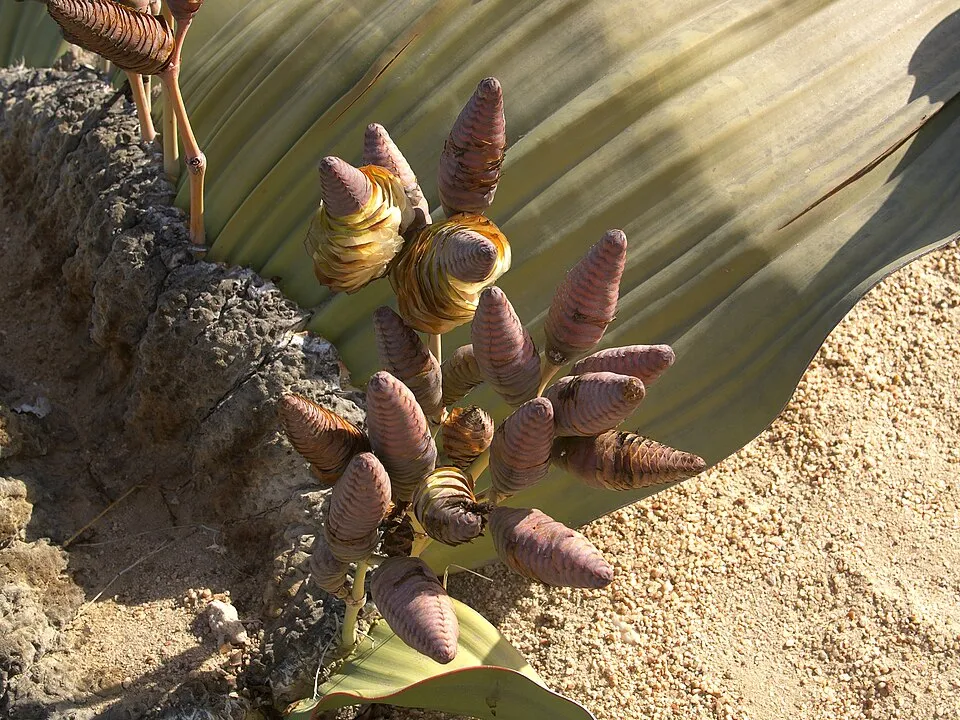
Welwitschia mirabilis, a truly singular and ancient gymnosperm, is an iconic plant endemic to the hyper-arid Namib Desert, spanning parts of Angola and Namibia. This fascinating species is celebrated for its extraordinary longevity, with individual plants often exceeding 1,000 years, and some specimens estimated to be over 1,500 to 2,000 years old. Its most distinctive morphological feature is the presence of only two massive, strap-like leaves that emerge from a robust, woody, often cork-textured stem.
These leaves grow continuously from their basal meristem throughout the plant's entire life, gradually splitting and fraying at the edges to create a dramatic, almost alien-like appearance that can cover a significant ground area. The stem itself is stout and subterranean for much of its life, with only the crown and leaves visible above the sandy, gravelly soils where it thrives. Welwitschia is a dioecious plant, meaning it has separate male and female individuals, each producing cone-like structures: males bear pollen cones, while females develop seed cones.
As a member of the Gnetophyta division, it holds a unique evolutionary position, often referred to as a 'living fossil' due to its ancient lineage and relatively unchanged form over millions of years, offering profound insights into plant evolution.
Trusted Scientific References
1. Authoritative external sources for Welwitschia mirabilis
1.1 Wikipedia — Welwitschia mirabilis
1.2 Kew POWO (Plants of the World Online)
1.3 PubMed — peer-reviewed research
1.4 NCBI Taxonomy Browser
1.5 GBIF — Global Biodiversity
1.6Welwitschia Mirabilis should be interpreted through verified botanical identity, practical care, and responsible safety language. This recovery note adds the missing context needed for a complete profile: match light to the plant's habit, use well-drained soil, water according to season, and avoid unsupported medicinal or edible claims. For publishing, the plant can be presented as a source-backed indoor plant with clear care guidance, common problem diagnosis, and conservative safety wording.
1.1.Welwitschia Mirabilis — Key Features
- ✓ <strong>Extreme Longevity</strong> — Individuals can live for over 1,500 years, making it one of the longest-living plants.
- ✓ <strong>Two Indefinite Leaves</strong> — Produces only two cotyledonary leaves that grow continuously throughout its entire lifespan.
- ✓ <strong>Deep Taproot System</strong> — Possesses an extensive root network that can reach deep underground water sources.
- ✓ <strong>Dioecious Reproduction</strong> — Features separate male and female plants, each bearing distinct cone-like structures.
- ✓ <strong>Namib Desert Endemic</strong> — Found exclusively in the hyper-arid coastal regions of Angola and Namibia.
- ✓ <strong>Gnetophyta Classification</strong> — A unique member of the Gnetophyta division, considered a 'living fossil'.
- ✓ <strong>Remarkable Drought Resistance</strong> — Highly adapted to survive extreme aridity, high temperatures, and fog-water absorption.
- ✓ <strong>Unique Morphology</strong> — Its sprawling, tattered leaves and woody stem give it a prehistoric, alien appearance.
- ✓ <strong>Slow Growth Rate</strong> — Develops very slowly, adding to its ancient and enduring character.
- ✓ <strong>Ecological Keystone</strong> — Provides crucial microhabitats and shelter for various desert organisms.
1.2.Welwitschia Mirabilis — Quick Summary
- ✓ Welwitschia mirabilis is an ancient, iconic gymnosperm unique to the Namib Desert.
- ✓ It boasts extreme longevity, with individuals living for over a millennium.
- ✓ Characterized by only two continuously growing, strap-like leaves and a deep taproot.
- ✓ A master of drought resistance, exquisitely adapted to hyper-arid environments.
- ✓ Primarily valued as an ornamental specimen, ecological keystone, and research subject.
- ✓ Holds no established traditional or modern medicinal uses for human health.
2.Welwitschia Mirabilis — Scientific Identity
3.Welwitschia Mirabilis — Quick Facts
4.Welwitschia Mirabilis — Appearance & Identification
5.Welwitschia Mirabilis — Native Habitat
6.Welwitschia Mirabilis — Water Requirements
- ✓ Arid Soil Mimicry — Requires extremely well-draining, coarse, sandy, or gravelly soil with minimal organic matter to replicate its natural desert substrate.
- ✓ Infrequent Deep Watering — Highly drought-adapted, it needs minimal watering, allowing the soil to dry out completely between waterings to prevent root rot.
- ✓ Full Sun Exposure — Thrives in intense, direct sunlight for the majority of the day, essential for optimal photosynthesis and robust development.
- ✓ Temperature Management — Prefers hot daytime temperatures but can tolerate cooler nights; protection from frost (below 5°C) is critical, especially for young plants.
- ✓ Deep Planter Requirement — Due to its extensive and deep taproot system, it necessitates a very deep pot or a purpose-built rock garden with ample vertical space.
- ✓ Seed Propagation — Primarily grown from seeds, which can be challenging to germinate and require specific conditions, including warmth and consistent, but not excessive, moisture.
- ✓ Slow Growth and Patience — Welwitschia is known for its exceptionally slow growth rate, requiring significant patience and long-term commitment from cultivators.
- ✓ Low Humidity Preference — High atmospheric humidity can predispose the plant to fungal infections; it prefers dry air conditions characteristic of its native habitat.
Reviewed by the Flora Medical Global Botanical Review Panel
Multi-disciplinary editorial group · Botany · Ethnobotany · Herbal-medicine literature
Who reviewed this: This page was checked by the Flora Medical Global Botanical Review Panel — an in-house editorial group of botany graduates, ethnobotany researchers, and horticulture practitioners who collectively maintain our 7,000+ plant encyclopedia. Meet the team.
Our 4-step verification process
1. Taxonomic verification
Scientific names and synonyms cross-checked against Kew POWO, World Flora Online, and The Plant List.
2. Phytochemical & medicinal cross-reference
Active compounds, traditional uses, and reported activities are cross-referenced with PubMed, USDA Dr. Duke's database, and peer-reviewed ethnobotanical literature.
3. Conservation & distribution check
Distribution, ecology, and conservation status confirmed against GBIF occurrence records and the IUCN Red List.
4. Editorial & safety review
Every entry passes an editorial pass for clarity, originality, and safety notices (toxicity, contraindications, dosage caveats) before publication.
Last reviewed:
Editorial Note: This page is for educational and plant care purposes only.
Written by: Flora Medical Global Editorial Team
Reviewed by: Flora Medical Global Botanical Review Panel
Last Updated: June 15, 2026







Welwitschia Mirabilis — Comments & Community Reviews
Rate this plant