
Medical Disclaimer: This content is for educational purposes only. It is not medical advice. Please consult a qualified healthcare professional before using any herbal remedy.
Safety Overview
1.Acacia Gum — Essential Profile
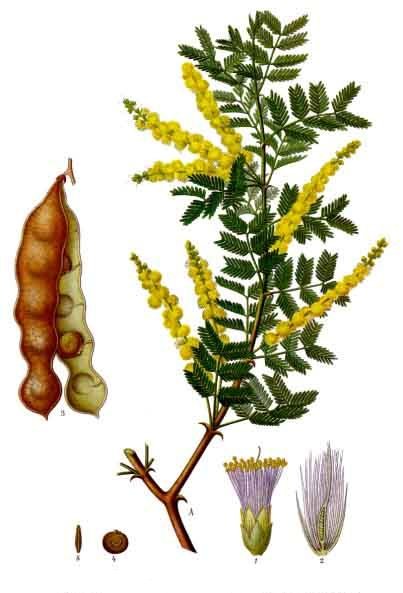
Acacia senegal, widely recognized as Acacia gum or gum arabic, is a resilient deciduous tree belonging to the Fabaceae family, specifically within the Mimosoideae subfamily. This species is a hallmark of the semi-desert regions across Sub-Saharan Africa, particularly thriving in the challenging ecological conditions of the Sahel belt. Its remarkable drought tolerance allows it to flourish in arid and semi-arid environments. Morphologically, Acacia senegal typically reaches heights of 6 to 15 meters, characterized by a gnarled, often multi-stemmed trunk that supports a distinctive, flat-topped crown. The bark presents a pale grey to yellowish-brown hue, frequently developing fissures or papery flakes in older specimens, contributing to its rugged appearance.
A defining feature of the plant is its sharp, dark thorns, arranged in triplets, which serve as an effective natural defense against herbivores. The tree’s leaves are intricately delicate and feathery, structured as bipinnately compound with numerous small leaflets. These leaflets exhibit nyctinastic movement, folding up at night or during intense heat, a crucial adaptation for moisture conservation. During severe drought, Acacia senegal sheds its leaves entirely to further minimize water loss through transpiration. Its fragrant flowers are small, ranging from pale yellow to creamy white, and appear in slender, axillary spikes, providing vital nectar and pollen for various pollinators.
The fruit consists of a flat, papery pod that matures to a light brown color, encapsulating several seeds. An extensive root system, including a deep taproot, efficiently accesses subterranean water, complemented by lateral roots that absorb surface moisture. Historically, Acacia senegal has held immense economic importance in nations like Sudan, Mauritania, and Senegal, where its hardened sap, known as gum arabic, was a prized commodity in ancient trade routes and utilized by Egyptians for diverse applications, including mummification, pigment binding, and early medicinal practices.
Trusted Scientific References
1. Authoritative external sources for Acacia senegal
1.1 Wikipedia — Acacia senegal
1.2 Kew POWO (Plants of the World Online)
1.3 PubMed — peer-reviewed research
1.4 NCBI Taxonomy Browser
1.5 GBIF — Global Biodiversity
1.1.Acacia Gum — Distinguishing Points
- ✓Botanical Origin — Derived from the sap exudate of the Acacia senegal tree, native to Sub-Saharan Africa.
- ✓Soluble Dietary Fiber — Classified as a highly soluble fiber, contributing to its prebiotic and digestive health benefits.
- ✓Complex Polysaccharide — Composed mainly of arabin, a calcium salt of arabic acid, with a complex branched structure.
- ✓Emulsifying Agent — Renowned for its excellent emulsifying and stabilizing properties in food and pharmaceutical industries.
- ✓Demulcent Action — Provides a soothing effect on mucous membranes, useful for irritation and inflammation.
- ✓Prebiotic Effect — Promotes the growth of beneficial gut bacteria, supporting a healthy microbiome.
- ✓Drought — Tolerant Species — The tree itself is highly adapted to arid and semi-arid environments.
- ✓Historical Significance — Utilized since ancient Egyptian times for various purposes, including medicine and craftsmanship.
- ✓Nontoxic Orally — Generally recognized as safe for oral consumption within established guidelines.
- ✓Versatile Applications — Found in food, pharmaceuticals, cosmetics, and traditional medicinal preparations.
1.2.Acacia Gum — In Brief
- ✓Acacia senegal, or gum arabic, is a drought-tolerant tree from Africa's Sahel region.
- ✓Its hardened sap is a versatile natural gum with ancient historical and economic importance.
- ✓Medicinally, it's valued for demulcent, prebiotic, anti-inflammatory, and antioxidant properties.
- ✓Primarily used orally as a soluble fiber for gut health and topically for skin conditions.
- ✓Generally considered safe for oral consumption, but caution is advised during pregnancy and lactation.
- ✓Known for its complex polysaccharide structure, primarily arabin, and arabinogalactan proteins.
2.Acacia Gum — Botanical Identity
3.Acacia Gum — Vital Statistics
4.Acacia Gum — Botanical Description
5.Acacia Gum — Origin & Spread
6.Acacia Gum — Folk Medicine Applications
Historically significant in North Africa and the Middle East for food, medicine, and as an ingredient in inks and paints. Essential to the economy of many Sahelian countries, known as 'white gold.'
7.Acacia Gum — Phytochemistry
- ✓Polysaccharides — The primary component is arabin, which is the calcium, magnesium, and potassium salt of arabic acid, a complex branched polysaccharide.
- ✓Arabinogalactan Proteins — These are glycoproteins within the gum, contributing to its emulsifying and stabilizing properties, and demonstrating antioxidant and immunomodulatory activities.
- ✓D-Galactose Units — The core backbone of the gum's polysaccharide structure is composed of D-galactose residues.
- ✓Uronic Acids — D-Glucuronic acid units are found in the side chains of the polysaccharide, contributing to the gum's acidic nature and charge.
- ✓Neutral Sugars — L-Rhamnose and L-Arabinose are common terminal units on the side chains, adding to the structural complexity and functional properties of the gum.
- ✓Mineral Salts — Contains various essential electrolytes, including calcium, magnesium, and potassium, which are integral to its natural composition and properties.
- ✓Peroxidase Enzyme — A naturally occurring enzyme in the gum, which, if not inactivated by heat, can catalyze the oxidation of certain pharmaceutical products.
- ✓Fiber — Classified as a soluble dietary fiber, contributing to its prebiotic and bulk-forming effects in the digestive system.
8.Acacia Gum — Evidence-Based Benefits
- ✓Demulcent Properties — Acacia gum forms a protective, soothing layer over irritated mucous membranes, offering relief for coughs, sore throats, and gastrointestinal discomfort.
- ✓Anti-inflammatory Action — Research suggests Acacia senegal may modulate inflammatory pathways, potentially benefiting conditions like rheumatoid arthritis by reducing inflammatory markers.
- ✓Antioxidant Support — The plant's arabinogalactans exhibit significant antioxidant activity, helping to neutralize free radicals and reduce oxidative stress in the body.
- ✓Gut Health Promotion — As a prebiotic fiber, acacia gum supports the growth of beneficial gut bacteria (bifidogenic effect), contributing to a healthy microbiome and improved digestive function.
- ✓Gastrointestinal Protection — Animal studies indicate a protective effect against chemically induced gastrointestinal insults, supporting gut lining integrity.
- ✓Potential Blood Glucose Modulation — Some clinical data suggest Acacia gum may help improve certain metabolic parameters, including BMI and systolic blood pressure, in individuals with type 2 diabetes.
- ✓Lipid-Lowering Effects — Evidence points to a potential role in binding fatty acids and improving high-density lipoprotein (HDL) levels, contributing to better cardiovascular health.
- ✓Wound Healing and Dermatological Use — Traditionally applied topically, it acts as an emollient and astringent, supporting skin repair and reducing inflammation in skin disorders and wounds.
- ✓Antimicrobial Potential — In vitro and animal studies show some antimicrobial activity, particularly in reducing parasitemia in malaria models, though high concentrations are often required.
- ✓Oral Health Benefits — Its antibacterial properties have been studied for potential use in periodontal disease, contributing to better gum health.
8.1.Acacia Gum — Therapeutic Indications
9.Acacia Gum — Safety & Side Effects
9.1.Acacia Gum — Possible Adverse Reactions
- ✓Allergic Reactions — Sensitive individuals may experience allergic responses, including skin rashes, itching, or respiratory symptoms.
- ✓Gastrointestinal Discomfort — Early morning nausea, mild diarrhea, and bloating have been reported, especially at higher doses or upon initial consumption.
- ✓Unfavorable Mouth Sensation — Some users may experience an unusual or unpleasant sensation in the mouth after ingesting acacia gum.
- ✓Flatulence — As a fermentable fiber, it can lead to increased gas production in the gut, particularly during the initial phases of use.
- ✓Reduced Absorption — Theoretically, very high doses might interfere with the absorption of certain minerals or medications, though not well-documented.
- ✓Intravenous Use — Historically, intravenous administration caused severe renal and liver damage and allergic reactions; this route is now abandoned.
9.2.Acacia Gum — Clinical Safety Notes
- ✓Generally Recognized As Safe (GRAS) — Acacia gum is deemed safe for ingestion by regulatory bodies when used as a food additive.
- ✓Oral Nontoxicity — It is essentially nontoxic when consumed orally within recommended dosages.
- ✓Pregnancy and Lactation — Avoid use due to insufficient information regarding safety and efficacy in pregnant and breastfeeding individuals.
- ✓Contraindications — No specific contraindications have been definitively identified, apart from known hypersensitivity or allergy to acacia gum.
- ✓Drug Interactions — No well-documented drug interactions have been reported, making it generally safe to use alongside most medications.
- ✓Allergic Potential — While generally safe, individuals with known allergies to other plant gums or members of the Fabaceae family should exercise caution.
- ✓Dosage Adherence — Adhering to recommended dosages is important to minimize potential gastrointestinal discomfort.
10.Acacia Gum — Preparation Methods
- ✓Oral Powder/Granules — Acacia gum is commonly consumed as a soluble powder mixed into water, juices, or food for its prebiotic and demulcent effects.
- ✓Food Additive — Widely used in the food industry as an emulsifier, stabilizer, and thickener in beverages, confectionery, and processed foods.
- ✓Pharmaceutical Excipient — Employed in pharmaceutical formulations as a binder, emulsifying agent, suspending agent, and demulcent in various medications.
- ✓Traditional Infusions — In traditional medicine, the gum may be dissolved in warm water to create soothing drinks for sore throats, coughs, and digestive upset.
- ✓Topical Applications — Historically, it has been incorporated into poultices and creams for wound healing, skin irritation, and as an emollient.
- ✓Daily Dosing — Clinical trials often utilize doses of 30 grams orally per day, typically divided, for various indications over several weeks to months.
- ✓Emulsion Stabilization — Its unique chemical structure makes it highly effective at stabilizing oil-in-water emulsions, preventing separation of ingredients.
11.Acacia Gum — How to Grow
- ✓Climate and Soil — Thrives in arid and semi-arid regions, preferring poor, sandy, well-drained soils with low fertility.
- ✓Propagation — Primarily propagated from seeds, which may require scarification to break dormancy, or occasionally from cuttings.
- ✓Planting — Young seedlings are typically planted at the onset of the rainy season to establish themselves, requiring minimal initial care.
- ✓Water Requirements — Highly drought-tolerant once established, requiring little to no irrigation in its native habitat, relying on deep taproots.
- ✓Harvesting — Gum is traditionally harvested by tapping the trees during the dry season, when the bark naturally splits, exuding sap that hardens into 'tears'.
- ✓Sustainable Practices — Modern commercial harvesting involves semi-mechanical tapping and collection, ensuring the long-term health and productivity of the trees.
- ✓Growth Cycle — Trees typically begin producing gum after 3-5 years and continue to yield for many decades under favorable conditions.
Reviewed by the Flora Medical Global Botanical Review Panel
Multi-disciplinary editorial group · Botany · Ethnobotany · Herbal-medicine literature
Who reviewed this: This page was checked by the Flora Medical Global Botanical Review Panel — an in-house editorial group of botany graduates, ethnobotany researchers, and horticulture practitioners who collectively maintain our 7,000+ plant encyclopedia. Meet the team.
Our 4-step verification process
1. Taxonomic verification
Scientific names and synonyms cross-checked against Kew POWO, World Flora Online, and The Plant List.
2. Phytochemical & medicinal cross-reference
Active compounds, traditional uses, and reported activities are cross-referenced with PubMed, USDA Dr. Duke's database, and peer-reviewed ethnobotanical literature.
3. Conservation & distribution check
Distribution, ecology, and conservation status confirmed against GBIF occurrence records and the IUCN Red List.
4. Editorial & safety review
Every entry passes an editorial pass for clarity, originality, and safety notices (toxicity, contraindications, dosage caveats) before publication.
Last reviewed:
Important medical disclaimer: This content is for educational and research purposes only. It is not medical advice and is not a substitute for consultation with a licensed healthcare provider. Do not use any herb to self-treat a medical condition without professional guidance.
Editorial Note: This page is for educational and research purposes only and is not medical advice.
Written by: Flora Medical Global Editorial Team
Reviewed by: Flora Medical Global Botanical Review Panel
Last Updated: June 16, 2026





Acacia Gum — Comments & Community Reviews
Rate this plant