
Medical Disclaimer: This content is for educational purposes only. It is not medical advice. Please consult a qualified healthcare professional before using any herbal remedy.
Safety Overview
1.Agrimony — Botanical Snapshot
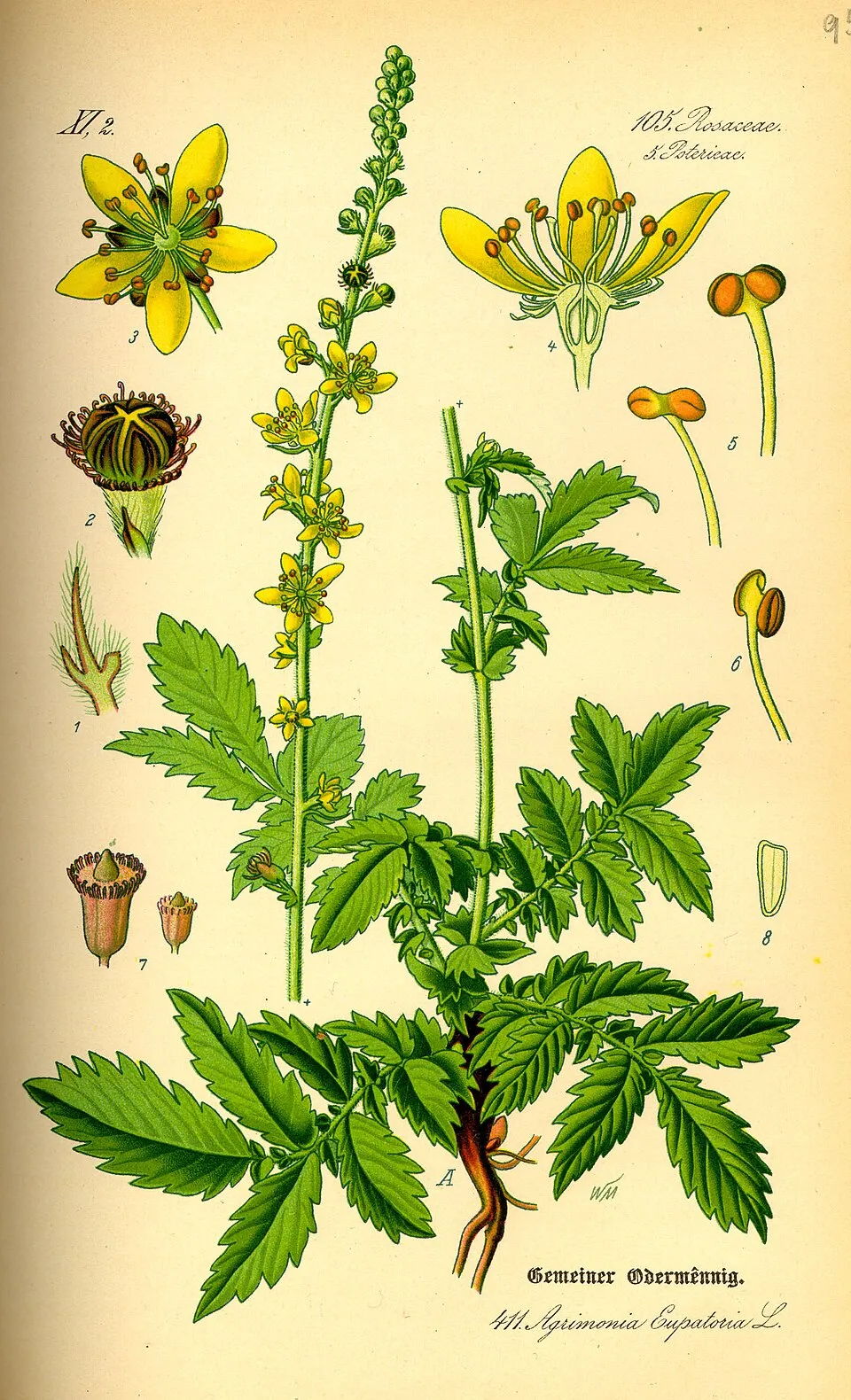
Agrimony, scientifically classified as Agrimonia eupatoria, is a distinguished perennial herbaceous plant belonging to the expansive Rosaceae family. It typically attains a height of 30 to 100 cm, characterized by its slender, robust, and erect stems that are densely covered with fine, soft hairs. The foliage of Agrimony is notably distinctive, featuring deeply serrated, pinnately compound leaves arranged alternately along the stem, contributing to its unique textural appearance.
Its most captivating botanical feature is the striking tall spires adorned with numerous small, five-petaled, bright yellow flowers, which create a vibrant display from early summer through to early autumn, typically June to September. Following this floral period, the plant produces small, burr-like fruits equipped with hooked bristles, a clever adaptation that facilitates seed dispersal by readily attaching to animal fur and clothing.
Indigenous to the temperate zones of the Northern Hemisphere, Agrimonia eupatoria thrives in a variety of open and semi-open habitats. It is commonly found flourishing in sun-drenched meadows, along the edges of hedgerows, in clearings within woodlands, and on disturbed ground across Europe, Asia, and North America. Its historical significance in herbal medicine is profound, with its use documented since antiquity in revered texts such as Anglo-Saxon leech books and the writings of Pliny the Elder, underscoring its long-standing therapeutic application.
In traditional European herbalism, Agrimony has been historically lauded as a potent 'liver tonic' and a beneficial 'throat herb.' It was customarily employed to alleviate a range of conditions, including various digestive disorders, inflammatory responses, and skin ailments. During the medieval period, it gained widespread popularity as 'Egrimony Tea,' celebrated for its purported wound-healing and detoxifying capabilities. This plant embodies a remarkable continuity, bridging ancient medicinal wisdom with contemporary pharmacological investigation, as ongoing research continues to validate its traditional efficacy and unravel its complex phytochemical profile.
Trusted Scientific References
1. Authoritative external sources for Agrimonia eupatoria
1.1 Wikipedia — Agrimonia eupatoria
1.2 Kew POWO (Plants of the World Online)
1.3 PubMed — peer-reviewed research
1.4 NCBI Taxonomy Browser
1.5 GBIF — Global Biodiversity
1.1.Agrimony — Distinguishing Points
- ✓Perennial herbaceous plant — Perennial herbaceous plant with erect, hairy stems.
- ✓Distinctive deeply serrated, — Distinctive deeply serrated, pinnately compound leaves.
- ✓Tall spires of small, five — petaled yellow flowers blooming in summer.
- ✓Produces burr — like fruits for seed dispersal.
- ✓Abundant in tannins, — Abundant in tannins, flavonoids, and phenolic acids.
- ✓Strong astringent and anti — inflammatory properties.
- ✓Traditional 'liver tonic' — Traditional 'liver tonic' and 'throat herb' in European herbalism.
- ✓Supports digestive health, — Supports digestive health, wound healing, and oral hygiene.
- ✓Possesses antioxidant and — Possesses antioxidant and potential antiviral activities.
- ✓Historically used for — Historically used for skin conditions, diarrhea, and indigestion.
1.2.Agrimony — Concise Overview
- ✓Agrimony (Agrimonia eupatoria) is a perennial herb known for its historical use in European herbal medicine.
- ✓Rich in tannins and flavonoids, it exhibits significant anti-inflammatory, antioxidant, and astringent properties.
- ✓Traditionally valued as a 'liver tonic' and 'throat herb,' it supports digestive health, skin healing, and oral hygiene.
- ✓Modern research explores its potential for blood sugar modulation and antiviral effects.
- ✓Key applications include treating diarrhea, sore throats, liver issues, and minor skin conditions.
- ✓Caution is advised for pregnant individuals, those on diabetes medication, and prior to surgery.
2.Agrimony — Nomenclature & Classification
3.Agrimony — Fact Sheet
4.Agrimony — Physical Description
5.Agrimony — Origin & Spread
6.Agrimony — Heritage Uses
7.Agrimony — Phytochemistry
- ✓Tannins — Predominantly hydrolysable tannins, including agrimoniin, which are responsible for its astringent, anti-inflammatory, and antioxidant properties, particularly beneficial for mucosal tissues.
- ✓Flavonoids — Key compounds such as quercetin, luteolin, apigenin, and their glycosides like isoquercitrin, contribute to the plant's significant antioxidant, anti-inflammatory, and vasorelaxant activities.
- ✓Phenolic Acids — Derivatives like caffeic acid, ellagic acid, and chlorogenic acid are present, further enhancing the plant's antioxidant capacity and contributing to its protective effects.
- ✓Triterpenes — Compounds such as ursolic acid and related saponins are found, which may contribute to its anti-inflammatory and hepatoprotective actions.
- ✓Volatile Oils — Contains a small percentage of essential oils, which contribute to the plant's characteristic aroma and may possess mild antimicrobial properties.
- ✓Coumarins — Certain isocoumarin derivatives have been identified, with some studies suggesting hepatoprotective activity.
- ✓Polysaccharides — Mucilaginous compounds that can offer demulcent effects, soothing irritated mucous membranes in the digestive and respiratory tracts.
- ✓Phytosterols — Plant sterols like beta-sitosterol are present, which can have anti-inflammatory and cholesterol-lowering potential.
- ✓Vitamins and Minerals — Contains trace amounts of vitamins (e.g., Vitamin K, Vitamin C) and minerals (e.g., silica, iron), supporting general nutritional benefits.
8.Agrimony — Pharmacological Findings
- ✓Anti-Inflammatory — Agrimony exhibits significant anti-inflammatory properties, primarily attributed to its rich content of tannins and flavonoids, which work to reduce inflammation in various tissues and mucous membranes.
- ✓Antioxidant Activity — The presence of potent flavonoids like quercetin, luteolin, and isoquercitrin, along with other phenolic compounds, provides robust antioxidant effects, protecting cells from oxidative stress and free radical damage.
- ✓Astringent Effects — High concentrations of tannins contribute to Agrimony's powerful astringent action, making it valuable for toning tissues, reducing secretions, and aiding in conditions like diarrhea and excessive bleeding.
- ✓Digestive Support — Traditionally used to soothe gastrointestinal upset, Agrimony's astringent and anti-inflammatory compounds can help alleviate symptoms of indigestion, mild diarrhea, and irritable bowel syndrome (IBS).
- ✓Liver Health — Revered as a 'liver tonic,' Agrimony is traditionally believed to support liver function and bile flow, with some modern studies suggesting potential hepatoprotective effects and improvements in liver enzyme levels.
- ✓Wound Healing — Its astringent and anti-inflammatory properties make it effective for topical applications to promote the healing of minor wounds, cuts, and skin irritations by tightening tissues and reducing infection risk.
- ✓Throat and Oral Health — As a 'throat herb,' infusions or gargles of Agrimony are traditionally employed to soothe sore throats, laryngitis, and mouth inflammations due to its soothing and astringent actions.
- ✓Blood Sugar Modulation — Research indicates Agrimony may possess properties that help in modulating blood sugar levels, showing potential for supportive use in metabolic health, though more human studies are needed.
- ✓Antiviral Potential — Some studies suggest Agrimony may have antiviral effects, potentially inhibiting the replication of certain viruses, contributing to its traditional use in various infectious conditions.
- ✓Kidney and Urinary Tract Support — Traditionally, Agrimony has been used to support kidney function and address minor urinary tract issues, likely due to its mild diuretic and astringent properties.
8.1.Agrimony — Reported Uses
9.Agrimony — Safety & Side Effects
9.1.Agrimony — Possible Adverse Reactions
- ✓Stomach Irritation — Large amounts of Agrimony, particularly due to its tannin content, may cause stomach upset or irritation.
- ✓Liver Damage — Excessive or prolonged use of high doses of Agrimony may potentially lead to liver damage, especially in sensitive individuals.
- ✓Photosensitivity — Topical application or internal use of Agrimony may increase skin sensitivity to sunlight, raising the risk of sunburn.
- ✓Blood Sugar Drop — Agrimony can lower blood sugar levels, posing a risk of hypoglycemia, particularly in individuals taking antidiabetes medications.
- ✓Allergic Reactions — Although rare, individuals may experience allergic reactions, including skin rashes or gastrointestinal discomfort.
- ✓Menstrual Cycle Effects — There is a theoretical concern that Agrimony might affect the menstrual cycle, leading to avoidance during pregnancy.
9.2.Agrimony — Safety Profile
- ✓Pregnancy — Agrimony is considered possibly unsafe during pregnancy due to potential effects on the menstrual cycle; avoid use.
- ✓Breast-feeding — Insufficient reliable information exists regarding its safety during breast-feeding; it is best to avoid use.
- ✓Surgery — Discontinue Agrimony at least two weeks before any scheduled surgery due to its potential to affect blood sugar levels and interfere with surgical control.
- ✓Diabetes Medications — Use with caution and monitor blood sugar closely if taking antidiabetes drugs, as Agrimony may enhance their blood sugar-lowering effects.
- ✓Liver Conditions — Individuals with pre-existing liver conditions should use Agrimony with extreme caution and under medical supervision due to the risk of liver damage with large doses.
- ✓Photosensitivity — Be mindful of increased sun sensitivity, especially when using Agrimony topically or consuming it regularly; use sun protection.
- ✓Dosage — Adhere to recommended dosages; large or prolonged use may increase the risk of adverse effects like stomach irritation and liver issues.
10.Agrimony — Preparations & Uses
- ✓Herbal Infusion (Tea) — Steep 1-2 teaspoons of dried Agrimony herb in a cup of hot water for 10-15 minutes; strain and drink up to three times daily for digestive or throat issues.
- ✓Tincture — Take 2-4 ml of Agrimony tincture, 2-3 times per day, diluted in water, as directed by a healthcare professional.
- ✓Decoction — For stronger preparations, simmer 1-2 tablespoons of dried root or herb in water for 15-20 minutes; strain and consume.
- ✓Topical Compress — Prepare a strong infusion or decoction, soak a clean cloth, and apply to skin irritations, minor wounds, or bruises.
- ✓Gargle/Mouthwash — Use a cooled Agrimony infusion as a gargle for sore throats, laryngitis, or as a mouthwash for oral inflammations.
- ✓Herbal Bath — Add a strong Agrimony infusion to bathwater to soothe widespread skin irritations or for its general tonic effects.
- ✓Capsules/Extracts — Standardized extracts are available in capsule form; follow manufacturer's dosage instructions or consult a practitioner.
11.Agrimony — Garden Cultivation
- ✓Site Selection — Agrimony thrives in full sun to partial shade, preferring well-drained soil with moderate fertility.
- ✓Soil Preparation — Prepare the soil by incorporating organic matter to improve drainage and nutrient content; a pH range of 6.0-7.0 is ideal.
- ✓Propagation — Can be propagated from seeds sown directly in spring or autumn, or by dividing established clumps in early spring.
- ✓Sowing Depth — Sow seeds shallowly, about 0.5 cm deep, as they require light for germination; keep moist until seedlings emerge.
- ✓Watering — Requires moderate watering; established plants are relatively drought-tolerant but benefit from consistent moisture during dry periods.
- ✓Spacing — Space plants approximately 30-45 cm apart to allow for proper air circulation and growth.
- ✓Pest and Disease Management — Generally resistant to most pests and diseases, but ensure good air circulation to prevent fungal issues in humid conditions.
- ✓Harvesting — Harvest flowering tops and leaves when the plant is in full bloom, typically from June to September, for optimal medicinal potency.
Reviewed by the Flora Medical Global Botanical Review Panel
Multi-disciplinary editorial group · Botany · Ethnobotany · Herbal-medicine literature
Who reviewed this: This page was checked by the Flora Medical Global Botanical Review Panel — an in-house editorial group of botany graduates, ethnobotany researchers, and horticulture practitioners who collectively maintain our 7,000+ plant encyclopedia. Meet the team.
Our 4-step verification process
1. Taxonomic verification
Scientific names and synonyms cross-checked against Kew POWO, World Flora Online, and The Plant List.
2. Phytochemical & medicinal cross-reference
Active compounds, traditional uses, and reported activities are cross-referenced with PubMed, USDA Dr. Duke's database, and peer-reviewed ethnobotanical literature.
3. Conservation & distribution check
Distribution, ecology, and conservation status confirmed against GBIF occurrence records and the IUCN Red List.
4. Editorial & safety review
Every entry passes an editorial pass for clarity, originality, and safety notices (toxicity, contraindications, dosage caveats) before publication.
Last reviewed:
Important medical disclaimer: This content is for educational and research purposes only. It is not medical advice and is not a substitute for consultation with a licensed healthcare provider. Do not use any herb to self-treat a medical condition without professional guidance.
Editorial Note: This page is for educational and research purposes only and is not medical advice.
Written by: Flora Medical Global Editorial Team
Reviewed by: Flora Medical Global Botanical Review Panel
Last Updated: June 16, 2026





Agrimony — Comments & Community Reviews
Rate this plant