
Medical Disclaimer: This content is for educational purposes only. It is not medical advice. Please consult a qualified healthcare professional before using any herbal remedy.
Safety Overview
1.Arnica — Essential Profile
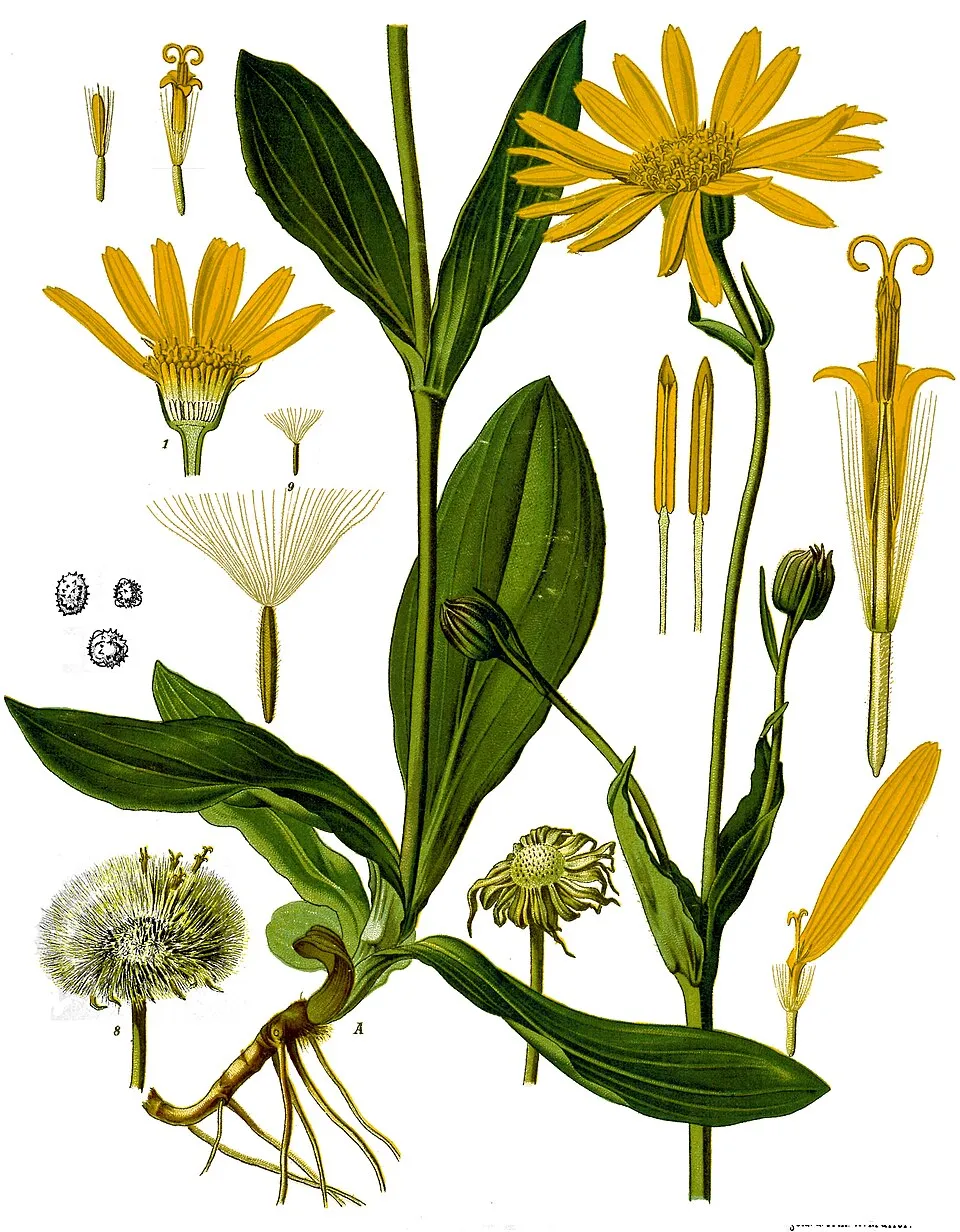
Arnica montana, commonly known as Arnica, Leopard's Bane, or Mountain Tobacco, is a charismatic perennial herbaceous plant belonging to the Asteraceae family. This robust species is indigenous to the subalpine and alpine regions of Europe and Siberia, flourishing in acidic, well-drained soils of mountain meadows, heaths, and open woodlands. Its distinctive morphology includes an upright, often hairy stem that typically reaches heights of 20 to 60 cm.
The leaves are arranged in a basal rosette, with additional opposite leaves ascending the stem; they are lanceolate to ovate, soft, and covered in fine hairs, which is thought to be the origin of its name from the Greek 'Arnakis,' meaning lamb's skin. The plant's most striking feature is its vibrant yellow-orange flowers, which bloom in mid-summer. These large, solitary, or few-flowered capitula consist of numerous bright golden-yellow ray and disc florets, making them highly recognizable.
Below ground, Arnica montana possesses a creeping rhizome that contributes to its perennial nature. Historically, this plant has been a cornerstone of traditional European herbal medicine since the 16th century, primarily valued for its external applications in treating various forms of trauma. Due to habitat loss and over-harvesting in its native range, Arnica montana is now a protected species in several European countries, underscoring the importance of sustainable cultivation and wild harvesting practices.
Trusted Scientific References
1. Authoritative external sources for Arnica montana
1.1 Wikipedia — Arnica montana
1.2 Kew POWO (Plants of the World Online)
1.3 PubMed — peer-reviewed research
1.4 NCBI Taxonomy Browser
1.5 GBIF — Global Biodiversity
1.6Arnica should be interpreted through verified botanical identity, practical care, and responsible safety language. This recovery note adds the missing context needed for a complete profile: match light to the plant's habit, use well-drained soil, water according to season, and avoid unsupported medicinal or edible claims. For publishing, the plant can be presented as a source-backed medicinal plant with clear care guidance, common problem diagnosis, and conservative safety wording.
1.1.Arnica — Notable Characteristics
- ✓Botanical Classification — A member of the Asteraceae (daisy) family, known for its composite flowers.
- ✓Alpine Habitat — Thrives in subalpine meadows and acid soils of mountainous regions in Europe.
- ✓Distinctive Flowers — Features bright yellow-orange capitula with prominent ray and disc florets.
- ✓Primary Traditional Use — Revered since the 16th century in European folk medicine for external trauma.
- ✓Key Active Compounds — Rich in sesquiterpene lactones, particularly helenalin, driving its medicinal actions.
- ✓Potent Anti — inflammatory — Inhibits NF-κB, a crucial pathway in inflammatory responses, reducing swelling and pain.
- ✓External Application Focus — Predominantly used topically in creams, gels, and ointments for musculoskeletal injuries.
- ✓Internal Toxicity Warning — Undiluted ingestion is highly dangerous, posing risks of cardiac and gastrointestinal distress.
- ✓Homeopathic Significance — Widely employed in highly diluted forms for internal use in trauma and shock.
- ✓Conservation Status — Protected in several regions due to habitat destruction and over-collection.
1.2.Arnica — In Brief
- ✓Arnica montana is a perennial herb from the Asteraceae family, native to European alpine regions.
- ✓Primarily used topically for bruises, sprains, muscle pain, and inflammation.
- ✓Contains potent sesquiterpene lactones, like helenalin, responsible for its anti-inflammatory effects.
- ✓Ingesting undiluted Arnica is highly toxic and can cause serious cardiac and gastrointestinal issues.
- ✓Homeopathic dilutions are used internally for trauma, including concussions, under professional guidance.
- ✓Faces conservation challenges due to habitat loss and over-harvesting in its native range.
2.Arnica — Scientific Identity
3.Arnica — Vital Statistics
4.Arnica — Botanical Description
5.Arnica — Ecological Habitat
6.Arnica — Heritage Uses
7.Arnica — Key Phytochemicals
- ✓Sesquiterpene Lactones — Key compounds include helenalin and dihydrohelenalin, found predominantly in the flowers. These are responsible for Arnica's potent anti-inflammatory and analgesic effects through the inhibition of nuclear factor kappa B (NF-κB).
- ✓Flavonoids — Quercetin, kaempferol, and their glycosides are present, contributing antioxidant and additional anti-inflammatory properties, helping to stabilize capillaries.
- ✓Essential Oils — Comprising thymol, thymol methyl ether, and derivatives, these provide antiseptic and local analgesic effects, contributing to the plant's characteristic aroma.
- ✓Phenolic Acids — Caffeic acid and chlorogenic acid derivatives are found, offering antioxidant activity and supporting the plant's overall therapeutic profile.
- ✓Coumarins — Minor amounts of coumarins like umbelliferone and scopoletin may be present, which can have mild anti-inflammatory and anticoagulant properties.
- ✓Carotenoids — Responsible for the vibrant yellow-orange color of the flowers, these compounds also possess antioxidant benefits.
- ✓Triterpenes — Ursolic acid and lupeol are examples of triterpenes that may contribute to the plant's anti-inflammatory and protective effects.
- ✓Polysaccharides — These complex carbohydrates can play a role in modulating immune responses and supporting general cellular health.
8.Arnica — Evidence-Based Benefits
- ✓Bruise Reduction — Arnica montana is renowned for its ability to significantly reduce the appearance and discomfort of bruises by promoting localized blood circulation and aiding in the reabsorption of extravasated blood.
- ✓Sprain and Strain Relief — Topically applied Arnica preparations help alleviate pain, swelling, and inflammation associated with sprains, muscle strains, and other soft tissue injuries.
- ✓Muscle Soreness Management — It is widely used by athletes and individuals experiencing muscle soreness or stiffness following intense physical exertion, facilitating faster recovery.
- ✓Post-Traumatic Edema Reduction — Arnica's anti-inflammatory compounds, particularly sesquiterpene lactones, effectively diminish swelling (edema) that occurs after physical trauma.
- ✓Anti-Inflammatory Action — The primary active constituents, such as helenalin, exhibit potent anti-inflammatory effects by inhibiting key inflammatory pathways like NF-κB.
- ✓Pain Management — By reducing inflammation and swelling, Arnica helps to mitigate localized pain, making it a valuable natural analgesic for musculoskeletal discomfort.
- ✓Post-Surgical Recovery Aid — Studies suggest that topical and homeopathic Arnica can help reduce pain and bruising following surgical procedures, including dental surgeries and carpal tunnel release.
- ✓Antioxidant Support — Certain compounds within Arnica montana possess antioxidant properties, helping to protect cells from oxidative stress and supporting overall tissue healing.
- ✓Homeopathic Concussion Support — In highly diluted homeopathic forms, Arnica is traditionally used for head trauma, including concussions, to address associated bruising, swelling, and shock-like states.
- ✓Joint Pain Alleviation — For conditions like osteoarthritis or general joint discomfort, topical Arnica can offer symptomatic relief by targeting localized inflammation and pain.
8.1.Arnica — Indications & Uses
9.Arnica — Cautions & Contraindications
9.1.Arnica — Caution Notes
- ✓Allergic Contact Dermatitis — Individuals sensitive to plants in the Asteraceae family (e.g., ragweed, marigolds) may experience skin rashes, itching, or swelling upon topical application.
- ✓Skin Irritation — Undiluted or highly concentrated topical Arnica can cause irritation, redness, or blistering, especially on sensitive skin or with prolonged use.
- ✓Internal Toxicity — Ingestion of undiluted Arnica preparations can lead to severe side effects including gastroenteritis, vomiting, abdominal pain, and cardiac arrhythmias, potentially fatal.
- ✓Open Wound Complications — Application to broken skin or open wounds can cause irritation, inflammation, and potentially lead to systemic absorption of toxic compounds.
- ✓Oral Cavity Irritation — Even diluted forms, if used in the mouth for extended periods, can cause inflammation or irritation of the mucous membranes.
- ✓Sweet’s Syndrome — In rare cases, severe skin reactions like Sweet’s syndrome have been reported following topical Arnica application.
- ✓Platelet Inhibition — Helenalin, a key constituent, can inhibit platelet function, theoretically increasing the risk of bleeding, especially if absorbed systemically.
9.2.Arnica — Safety Profile
- ✓External Use Only for Undiluted Forms — Concentrated Arnica preparations (tinctures, oils, creams) must only be applied externally to intact skin.
- ✓Avoid Broken Skin — Never apply Arnica to open wounds, cuts, abraded skin, or mucous membranes due to the risk of systemic toxicity and severe irritation.
- ✓Patch Test — Always perform a patch test on a small skin area before widespread use to check for allergic reactions or sensitivities.
- ✓Pregnancy and Lactation — Avoid use during pregnancy and breastfeeding due to insufficient safety data and the potential for uterine stimulation or transfer of toxic compounds.
- ✓Children and Infants — Use with extreme caution in children; only highly diluted homeopathic preparations are considered safe for internal use under professional guidance.
- ✓Allergic Reactions — Contraindicated for individuals with known allergies to Arnica or other plants in the Asteraceae/Compositae family.
- ✓Drug Interactions — Use with caution in individuals taking anticoagulant medications (blood thinners) due to theoretical risks of increased bleeding, though systemic absorption from topical use is generally low.
10.Arnica — Usage Guide
- ✓Topical Creams and Gels — Apply a thin layer of Arnica cream or gel to the affected area, such as bruises, sprains, or sore muscles, 2-4 times daily.
- ✓Ointments and Salves — Use Arnica-infused ointments for localized pain and inflammation, ensuring the skin is intact and unbroken.
- ✓Compresses — Prepare a diluted Arnica tincture or strong tea for use as a cold compress on swollen or bruised areas, avoiding direct contact with open wounds.
- ✓Homeopathic Pellets/Tablets — For internal use, highly diluted homeopathic Arnica pellets or tablets are taken orally or sublingually, following specific dosage instructions for conditions like trauma, shock, or post-surgical recovery.
- ✓Tinctures (External Only) — Dilute Arnica tincture with water before applying topically, as it is highly concentrated and potent.
- ✓Massage Oils — Infuse Arnica flowers in a carrier oil (e.g., olive or almond oil) to create a therapeutic massage oil for muscle stiffness and pain.
- ✓Baths — Add a diluted Arnica preparation to bathwater for a soothing soak, beneficial for general muscle aches and body soreness, ensuring no broken skin.
11.Arnica — Garden Cultivation
- ✓Site Selection — Choose a location with full sun to partial shade, mimicking its native subalpine habitat, and ensure good air circulation.
- ✓Soil Requirements — Arnica thrives in acidic (pH 5.0-6.5), well-drained, sandy-loam soils that are rich in organic matter.
- ✓Propagation — Can be propagated from seeds sown in autumn or early spring, or more reliably through division of rhizomes in early spring or after flowering.
- ✓Watering — Requires consistent moisture, especially during dry periods, but avoid waterlogging which can lead to root rot.
- ✓Fertilization — Generally prefers nutrient-poor soils; excessive fertilization can reduce medicinal compound concentration. A light application of compost in spring is usually sufficient.
- ✓Pest and Disease Control — Arnica is relatively resistant to pests and diseases, but watch for slugs and snails, and ensure good drainage to prevent fungal issues.
- ✓Harvesting — Flowers are typically harvested in mid-summer when fully open, usually in July or August, while rhizomes can be harvested in autumn after the growing season.
Reviewed by the Flora Medical Global Botanical Review Panel
Multi-disciplinary editorial group · Botany · Ethnobotany · Herbal-medicine literature
Who reviewed this: This page was checked by the Flora Medical Global Botanical Review Panel — an in-house editorial group of botany graduates, ethnobotany researchers, and horticulture practitioners who collectively maintain our 7,000+ plant encyclopedia. Meet the team.
Our 4-step verification process
1. Taxonomic verification
Scientific names and synonyms cross-checked against Kew POWO, World Flora Online, and The Plant List.
2. Phytochemical & medicinal cross-reference
Active compounds, traditional uses, and reported activities are cross-referenced with PubMed, USDA Dr. Duke's database, and peer-reviewed ethnobotanical literature.
3. Conservation & distribution check
Distribution, ecology, and conservation status confirmed against GBIF occurrence records and the IUCN Red List.
4. Editorial & safety review
Every entry passes an editorial pass for clarity, originality, and safety notices (toxicity, contraindications, dosage caveats) before publication.
Last reviewed:
Important medical disclaimer: This content is for educational and research purposes only. It is not medical advice and is not a substitute for consultation with a licensed healthcare provider. Do not use any herb to self-treat a medical condition without professional guidance.
Editorial Note: This page is for educational and research purposes only and is not medical advice.
Written by: Flora Medical Global Editorial Team
Reviewed by: Flora Medical Global Botanical Review Panel
Last Updated: June 16, 2026





Arnica — Comments & Community Reviews
Rate this plant