


Medical Disclaimer: This content is for educational purposes only. It is not medical advice. Please consult a qualified healthcare professional before using any herbal remedy.
Safety Overview
1.Banyan — Plant Snapshot
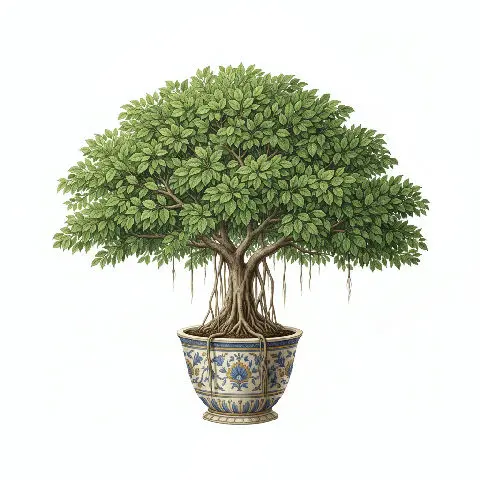
Ficus benghalensis, widely known as the Banyan tree, is a monumental member of the Moraceae family, deeply rooted in the cultural and ecological landscape of the Indian subcontinent. This majestic species is distinguished by its unique growth habit, initiating often as an epiphyte on host trees before developing an extensive network of aerial prop roots. These roots descend from its branches, eventually reaching the soil to thicken into secondary woody trunks, allowing a single Banyan to spread laterally over immense areas, sometimes covering several acres.
Its name, 'Banyan,' is historically linked to Indian traders who used its vast shade as a marketplace. Ecologically, the Banyan plays a crucial role in preventing soil erosion, supporting diverse ecosystems, and providing vital shelter. Botanically, it features large, leathery, elliptic to oval leaves, typically 10–20 cm long, with prominent venation.
The fruits are small, sessile, fig-like syconia, produced in axillary pairs, ripening from green to red, serving as a key food source for local fauna. The tree's smooth, greyish bark contrasts with its dense, dark green foliage. Beyond its botanical and ecological significance, the Banyan holds profound spiritual importance in Hinduism, symbolizing longevity, fertility, and wisdom, and is frequently associated with revered deities.
Trusted Scientific References
1. Authoritative external sources for Ficus benghalensis
1.1 Wikipedia — Ficus benghalensis
1.2 Kew POWO (Plants of the World Online)
1.3 PubMed — peer-reviewed research
1.4 NCBI Taxonomy Browser
1.5 GBIF — Global Biodiversity
1.6Banyan should be interpreted through verified botanical identity, practical care, and responsible safety language. This recovery note adds the missing context needed for a complete profile: match light to the plant's habit, use well-drained soil, water according to season, and avoid unsupported medicinal or edible claims. For publishing, the plant can be presented as a source-backed medicinal plant with clear care guidance, common problem diagnosis, and conservative safety wording.
1.1.Banyan — Defining Traits
- ✓Expansive canopy supported — Expansive canopy supported by unique aerial prop roots.
- ✓Deeply revered in — Deeply revered in Hinduism, symbolizing longevity and wisdom.
- ✓Native to the — Native to the Indian subcontinent, thriving in tropical climates.
- ✓Known for significant astringent, anti — inflammatory, and hypoglycemic properties.
- ✓Traditional uses span — Traditional uses span wound healing, diabetes, and gynecological issues.
- ✓Features large, leathery leaves and characteristic fig — like fruits (syconia).
- ✓Latex, bark, leaves, — Latex, bark, leaves, and fruits are the primary parts used medicinally.
- ✓Ecologically vital, providing — Ecologically vital, providing shade and supporting biodiversity.
- ✓Often starts life — Often starts life as an epiphyte, eventually forming a massive tree.
- ✓Classified within the — Classified within the Moraceae family, related to other fig species.
1.2.Banyan — Quick Summary
- ✓Iconic Indian tree with vast canopy, revered culturally.
- ✓Renowned in Ayurveda for diverse medicinal properties.
- ✓Key benefits include anti-diabetic, wound healing, and astringent actions.
- ✓Used traditionally for skin, digestive, and gynecological ailments.
- ✓Bark, leaves, latex, and fruits are primary medicinal parts.
- ✓Requires caution for pregnant women and those on specific medications.
2.Banyan — Systematic Position
3.Banyan — Quick Facts
4.Banyan — Morphological Account
5.Banyan — Geographic Distribution
6.Banyan — Cultural & Traditional Roles
7.Banyan — Secondary Metabolites
- ✓Phytosterols — Including beta-sitosterol, known for their anti-inflammatory, hypocholesterolemic, and antioxidant properties.
- ✓Triterpenoids — Such as Friedelin, found in the leaves, contributing to anti-inflammatory and hepatoprotective activities.
- ✓Glucosides — Bengalinoside is a notable glucoside present in the bark, potentially responsible for some of its medicinal effects.
- ✓Flavonoid Glycosides — Leucocyanidin and Leucopelargonidin are found in the bark, offering significant antioxidant and anti-inflammatory benefits.
- ✓Phenolic Compounds — A diverse group of compounds contributing to the plant's antioxidant, antimicrobial, and astringent properties.
- ✓Tannins — Abundant in the bark and leaves, responsible for the strong astringent taste and effects, useful in wound healing and digestive issues.
- ✓Esters of Alpha-Tatraxasterol — Identified in the heartwood, their specific pharmacological actions are under investigation.
- ✓Liglic Acid — Also found in the heartwood, contributing to the plant's complex phytochemistry.
- ✓Latex Constituents — The milky latex contains various enzymes, resins, and rubber components, which contribute to its wound-healing and antimicrobial properties.
- ✓Saponins — Present in some parts, which may contribute to cholesterol-lowering and immune-modulating effects.
8.Banyan — Modern Studies
- ✓Wound Healing — The latex and bark extract of Ficus benghalensis possess antiseptic and astringent properties, promoting faster wound contraction and tissue regeneration, often applied topically.
- ✓Anti-diabetic Action — Decoctions from the bark and fruits have demonstrated hypoglycemic effects, aiding in the management of blood sugar levels in traditional and preliminary modern studies.
- ✓Anti-inflammatory Support — Various parts of the Banyan tree, including leaves and bark, exhibit anti-inflammatory compounds that can help reduce swelling and discomfort.
- ✓Digestive Health — Its astringent properties make Banyan effective in treating diarrhea and dysentery by reducing excessive fluid secretion and firming stools.
- ✓Gynecological Aid — Bark decoctions are traditionally used to address vaginal diseases and to strengthen uterine muscles, particularly during pregnancy, though caution is advised.
- ✓Oral Health — The milky latex is applied to dental caries and gum issues, leveraging its antimicrobial and astringent actions to alleviate pain and infection.
- ✓Skin Conditions — Topical application of Banyan latex and bark paste is beneficial for various skin ailments, including herpes, wounds, and improving skin complexion.
- ✓Antioxidant Protection — Rich in flavonoids and other phenolic compounds, Ficus benghalensis offers significant antioxidant activity, protecting cells from oxidative stress.
- ✓Hypotensive Effects — Preliminary research suggests that Banyan extracts may contribute to lowering blood pressure, supporting cardiovascular health.
- ✓Cholesterol Management — Studies indicate potential hypocholesterolemic effects, helping to regulate lipid profiles and reduce cholesterol levels.
- ✓Eye Health — The latex can be applied externally for conjunctivitis due to its soothing and antiseptic properties, though professional guidance is critical.
- ✓Premature Ejaculation — In traditional medicine, the latex of the Banyan tree is used to address issues of premature ejaculation.
8.1.Banyan — Indications & Uses
9.Banyan — Precautions & Warnings
9.1.Banyan — Caution Notes
- ✓Constipation Risk — The strong astringent properties of Banyan may lead to or worsen constipation in susceptible individuals, especially with high doses.
- ✓Allergic Reactions — Sensitive individuals may experience skin irritation or allergic reactions upon direct contact with the latex.
- ✓Gastrointestinal Discomfort — High oral doses of Banyan preparations might cause mild stomach upset or indigestion.
- ✓Drug Interactions — Potential interactions with blood-sugar-lowering medications or anticoagulants due to its hypoglycemic and unknown blood-thinning effects.
- ✓Eye Irritation — Direct, undiluted application of Banyan latex to the eyes can cause severe irritation and should be avoided.
- ✓Heavy Metal Contamination — As with any plant-derived product, there is a risk of heavy metal accumulation if sourced from polluted environments.
- ✓Photosensitivity — Some individuals might experience increased skin sensitivity to sunlight after topical application of certain Banyan extracts.
9.2.Banyan — Toxicity Assessment
- ✓Professional Consultation — Always consult a healthcare professional before using Banyan, especially if pregnant, breastfeeding, or on other medications.
- ✓Pregnancy and Lactation — Limited safety data necessitates caution; avoid use unless specifically advised and monitored by a qualified practitioner.
- ✓Children — Use in children should be under strict medical supervision due to insufficient research on pediatric safety.
- ✓Dosage Adherence — Follow recommended dosages precisely to minimize potential adverse effects; self-medication is not advised.
- ✓Allergic History — Individuals with known allergies to Ficus species or latex should avoid contact with Banyan preparations.
- ✓Source Purity — Ensure Banyan products are sourced from reputable suppliers to avoid contamination or adulteration.
- ✓Monitoring — Individuals with diabetes or on blood pressure medication should monitor their blood glucose and blood pressure levels closely if using Banyan.
10.Banyan — Preparation & Dosage
- ✓Bark Decoction — Prepare a decoction by boiling dried bark pieces in water; commonly used internally for diabetes management or externally for washes.
- ✓Leaf Bud Infusion — Tender leaf buds are infused in hot water to create a cold infusion, traditionally consumed for excessive sweating or nausea.
- ✓Milky Latex Application — The fresh latex is directly applied topically to wounds, skin diseases, dental caries, or as eye drops (with extreme caution and dilution).
- ✓Fruit Consumption — Ripe Banyan fruits can be consumed fresh or processed, historically used as part of dietary remedies for diabetes.
- ✓Aerial Root Paste — A paste made from the aerial roots is applied externally for its firming properties, such as for breast firmness.
- ✓Powdered Bark/Leaves — Dried bark or leaves are ground into a fine powder, which can be mixed with honey or water for internal consumption or applied as a poultice.
- ✓Ghee Preparations — Leaf buds or bark extracts are sometimes processed with ghee and mixed with honey for specific Ayurvedic formulations to treat conditions like diarrhea.
- ✓Topical Washes — Decoctions of bark or leaves are used as antiseptic washes for skin lesions, ulcers, and vaginal infections.
11.Banyan — Growing Guide
- ✓Propagation — Banyan can be readily propagated from seeds, stem cuttings, or by planting its established aerial prop roots directly into moist soil.
- ✓Climate — Thrives in tropical and subtropical climates, requiring warm temperatures and high humidity for optimal growth.
- ✓Soil Requirements — Prefers well-drained, fertile soil, but can tolerate a range of soil types, including sandy and loamy soils.
- ✓Light Exposure — Requires full sun exposure to develop its characteristic expansive canopy and robust root system.
- ✓Watering — Young plants need regular watering; mature trees are drought-tolerant but benefit from occasional deep watering during dry spells.
- ✓Space — Due to its massive size and spreading habit, it requires ample space, making it unsuitable for small gardens or confined urban areas.
- ✓Support — Young trees may need initial staking to establish a strong central trunk before aerial roots provide natural support.
- ✓Pest Management — Generally robust, but susceptible to common fig pests like mealybugs and scale insects, which can be managed with organic pesticides.
Reviewed by the Flora Medical Global Botanical Review Panel
Multi-disciplinary editorial group · Botany · Ethnobotany · Herbal-medicine literature
Who reviewed this: This page was checked by the Flora Medical Global Botanical Review Panel — an in-house editorial group of botany graduates, ethnobotany researchers, and horticulture practitioners who collectively maintain our 7,000+ plant encyclopedia. Meet the team.
Our 4-step verification process
1. Taxonomic verification
Scientific names and synonyms cross-checked against Kew POWO, World Flora Online, and The Plant List.
2. Phytochemical & medicinal cross-reference
Active compounds, traditional uses, and reported activities are cross-referenced with PubMed, USDA Dr. Duke's database, and peer-reviewed ethnobotanical literature.
3. Conservation & distribution check
Distribution, ecology, and conservation status confirmed against GBIF occurrence records and the IUCN Red List.
4. Editorial & safety review
Every entry passes an editorial pass for clarity, originality, and safety notices (toxicity, contraindications, dosage caveats) before publication.
Last reviewed:
Important medical disclaimer: This content is for educational and research purposes only. It is not medical advice and is not a substitute for consultation with a licensed healthcare provider. Do not use any herb to self-treat a medical condition without professional guidance.
Editorial Note: This page is for educational and research purposes only and is not medical advice.
Written by: Flora Medical Global Editorial Team
Reviewed by: Flora Medical Global Botanical Review Panel
Last Updated: June 16, 2026





Banyan — Comments & Community Reviews
Rate this plant