


Medical Disclaimer: This content is for educational purposes only. It is not medical advice. Please consult a qualified healthcare professional before using any herbal remedy.
Safety Overview
1.Bharangi (Turk Turban Moon) — At a Glance
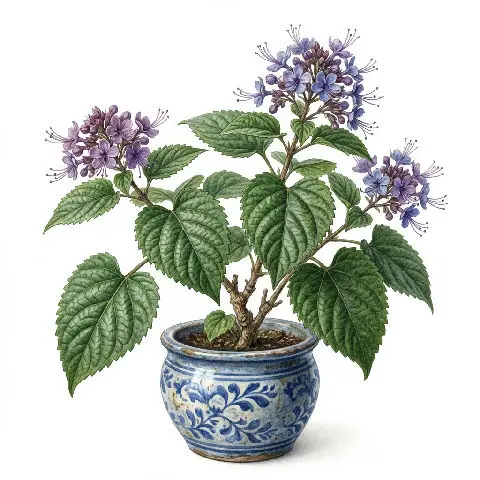
Bharangi, known scientifically as Clerodendrum serratum, is a significant medicinal plant belonging to the Lamiaceae family, a reclassification from its earlier placement in Verbenaceae. This deciduous woody shrub, commonly called Turk Turban Moon, Blue Glory, or Beetle Killer, typically grows between 0.6 to 2.4 meters (2-8 ft) tall. It thrives in marshy or damp environments, indicating a preference for moist soil conditions, and is widely distributed across Southeast Asia, with a notable presence throughout India. Morphologically, Clerodendrum serratum is characterized by its robust, bluntly quadrangular stems that support large, opposite leaves.
These leaves are elliptic, measuring approximately 7-20 cm (3-8 inches) in length, featuring acute apices and stout petioles, often presenting a somewhat dry or rough texture, which contributes to its Sanskrit synonym 'Kharashaka'. During the summer, the plant produces numerous, slightly fragrant flowers arranged in terminal panicles. These visually striking blossoms exhibit hues from bluish to dark purple, with distinctively twisted pedicels. The Sanskrit names 'Padma' (lotus-like flower) and 'Angaravalli' (appearing like red hot coal when in bloom) likely allude to the beauty or intensity of its floral display.
Following the rainy season, the flowers develop into small, drupaceous fruits that ripen to a deep purple-black color, often appearing in clusters. While the root of Bharangi is primarily utilized in traditional medicine, its leaves also hold therapeutic value.
Trusted Scientific References
1. Authoritative external sources for Clerodendrum serratum
1.1 Wikipedia — Clerodendrum serratum
1.2 Kew POWO (Plants of the World Online)
1.3 PubMed — peer-reviewed research
1.4 NCBI Taxonomy Browser
1.5 GBIF — Global Biodiversity
1.6Bharangi (Turk Turban Moon) should be interpreted through verified botanical identity, practical care, and responsible safety language. This recovery note adds the missing context needed for a complete profile: match light to the plant's habit, use well-drained soil, water according to season, and avoid unsupported medicinal or edible claims. For publishing, the plant can be presented as a source-backed medicinal plant with clear care guidance, common problem diagnosis, and conservative safety wording.
1.1.Bharangi (Turk Turban Moon) — Distinguishing Points
- ✓Traditional Ayurvedic Powerhouse — Revered for millennia in Indian healing systems.
- ✓Multi — faceted Respiratory Aid — Addresses asthma, cough, rhinitis, and mucus congestion.
- ✓Anti — inflammatory & Antipyretic — Effective against inflammation and fever.
- ✓Digestive Enhancer — Improves appetite and overall digestive strength.
- ✓Antimicrobial Properties — Aids in combating infections and parasitic infestations.
- ✓Unique Botanical Morphology — Features bluntly quadrangular stems and distinctive blue-purple flowers.
- ✓Rich Phytochemical Profile — Contains beneficial flavonoids, diterpenoids, and triterpenoids.
- ✓Versatile Applications — Utilized as powder, decoction, paste, and in complex formulations.
- ✓Native to Southeast Asia — Thrives in moist, tropical environments.
- ✓Kapha and Vata Balancer — Addresses imbalances of these specific Ayurvedic doshas.
1.2.Bharangi (Turk Turban Moon) — In Brief
- ✓Potent Ayurvedic herb for respiratory and inflammatory conditions.
- ✓Balances Kapha and Vata Doshas with pungent and bitter tastes.
- ✓Key constituents include Hispidulin, Scutellarein, and Uncinatone.
- ✓Primarily uses roots, also leaves, for internal and external applications.
- ✓Caution advised during pregnancy due to uterine stimulant properties.
- ✓Found extensively across India in damp, marshy environments.
2.Bharangi (Turk Turban Moon) — Botanical Identity
3.Bharangi (Turk Turban Moon) — Vital Statistics
4.Bharangi (Turk Turban Moon) — Botanical Features
5.Bharangi (Turk Turban Moon) — Native Range & Habitat
6.Bharangi (Turk Turban Moon) — Folk Medicine Applications
7.Bharangi (Turk Turban Moon) — Key Phytochemicals
- ✓Flavonoids — Key compounds include Hispidulin, Scutellarein, and their glycosides like 7-O-glucuronides, known for potent antioxidant, anti-inflammatory, and antiallergic activities.
- ✓Diterpenoids — Uncinatone is a significant diterpenoid identified, contributing to the plant's anti-inflammatory and potential anticarcinogenic properties.
- ✓Triterpenoids — Compounds like pectolinaigenin are present, often associated with anti-inflammatory and hepatoprotective effects.
- ✓Phenolic Acids — Various phenolic acids contribute to the overall antioxidant capacity, protecting cells from oxidative stress.
- ✓Saponins — These compounds contribute to the plant's expectorant properties, aiding in the removal of mucus from the respiratory tract.
- ✓Alkaloids — While less characterized, some alkaloidal content may contribute to its diverse pharmacological actions, including nervine effects.
- ✓Steroids — Plant steroids are often found, playing roles in anti-inflammatory and hormonal modulation within the body.
- ✓Glycosides — A range of glycosides, including those derived from flavonoids, enhance solubility and bioavailability of active constituents, contributing to therapeutic effects.
- ✓Volatile Oils — Trace amounts of volatile compounds might be present, contributing to the plant's aroma and potentially exhibiting antimicrobial properties.
8.Bharangi (Turk Turban Moon) — Evidence-Based Benefits
- ✓Respiratory Health Support — Bharangi is highly valued in Ayurveda for its bronchodilatory and expectorant properties, making it effective in managing asthma, chronic coughs, and other respiratory disorders by clearing congested airways.
- ✓Mucolytic Action — It acts as a potent mucolytic agent, helping to break down thick mucus and facilitate its expulsion from the lungs and respiratory passages, thereby relieving congestion.
- ✓Anti-inflammatory Effects — The plant exhibits significant anti-inflammatory activity, which is beneficial in alleviating symptoms associated with various inflammatory conditions, including joint pain and generalized swelling.
- ✓Antipyretic Properties — Traditionally used to reduce fever (Jwarahara), Bharangi helps in lowering elevated body temperature and managing febrile states.
- ✓Digestive Stimulant — It functions as a Deepani, improving digestive strength and stimulating appetite, which aids in better nutrient absorption and overall gastrointestinal function.
- ✓Antimicrobial and Anthelmintic — Bharangi possesses Krimighna properties, indicating its ability to combat microbial infections and parasitic worm infestations within the body.
- ✓Wound Healing — Applied externally, the leaf paste is known to promote the healing of wounds and abscesses (Vranashophahara) by drawing out pus and accelerating tissue repair.
- ✓Alleviates Allergic Rhinitis — Its traditional use extends to managing seasonal allergies and rhinitis (Peenasa hara), reducing nasal congestion and inflammation.
- ✓Gout Management — Bharangi is indicated in Vatarakta (gout), suggesting its role in balancing Vata dosha and reducing inflammation and pain associated with the condition.
- ✓Blood Purifier — It acts as a Rakta Shodhaka, helping to purify the blood and improve overall circulatory health, which can benefit skin conditions and generalized edema.
- ✓Diuretic Action — The plant stimulates kidney function, increasing urine production and aiding in conditions like dysuria (Mootrakrichra), promoting detoxification.
8.1.Bharangi (Turk Turban Moon) — Indications & Uses
9.Bharangi (Turk Turban Moon) — Safety & Side Effects
9.1.Bharangi (Turk Turban Moon) — Possible Adverse Reactions
- ✓Gastric Discomfort — Due to its pungent and bitter taste, high doses may cause mild stomach upset or acidity in sensitive individuals.
- ✓Uterine Stimulation — As a known uterine stimulant, it should be used with caution and under medical supervision during pregnancy.
- ✓Hypotension Risk — Its potential to calm the nervous system and affect circulation might theoretically lower blood pressure in susceptible individuals.
- ✓Drug Interactions — May interact with certain conventional medications, particularly those for blood pressure, inflammation, or respiratory conditions; professional advice is recommended.
- ✓Allergic Reactions — Though rare, individuals sensitive to Lamiaceae family plants may experience allergic responses like skin rashes or digestive upset.
- ✓Dryness — The Rooksha (dryness) quality may exacerbate conditions of extreme dryness or constipation if not balanced with appropriate anupana (adjuvants).
- ✓Over-Stimulation — Excessive intake may lead to over-stimulation of excretory functions, potentially causing increased urination or bowel movements.
9.2.Bharangi (Turk Turban Moon) — Toxicity Assessment
- ✓Pregnancy and Lactation — Contraindicated during pregnancy due to uterine stimulating properties; use during lactation should be under strict medical guidance.
- ✓Children — Administer to children only under the supervision of a qualified healthcare practitioner, with adjusted dosages.
- ✓Pre-existing Conditions — Individuals with chronic health conditions, especially cardiovascular issues or severe gastrointestinal sensitivity, should consult a doctor before use.
- ✓Medication Interactions — Exercise caution if taking anticoagulant, anti-hypertensive, or other prescription medications, as interactions are possible.
- ✓Dosage Adherence — Always adhere to recommended dosages; excessive intake can increase the risk of adverse effects.
- ✓Allergic Sensitivity — Discontinue use if any signs of allergic reaction, such as skin rash or difficulty breathing, occur.
- ✓Professional Consultation — It is highly recommended to consult a qualified Ayurvedic physician or medical herbalist before incorporating Bharangi into a therapeutic regimen.
10.Bharangi (Turk Turban Moon) — Preparation Methods
- ✓Herbal Powder (Churna) — The dried root is processed into a fine powder, typically taken in doses of 3-6 grams per day, divided, often mixed with honey or warm water.
- ✓Decoction (Kwath) — Roots or leaves can be boiled in water to prepare a potent decoction, used for respiratory ailments and inflammatory conditions.
- ✓Leaf Paste for Topical Application — Fresh leaves are crushed to form a paste, applied externally to wounds, boils, and abscesses to draw out pus and aid healing.
- ✓Ayurvedic Formulations — Incorporated into complex Ayurvedic preparations like Bharngi Guda for respiratory issues, Pushkaramoolasava, and Vasavaleha for cough and asthma.
- ✓Medicated Ghee (Ghrita) — Used in formulations like Amritaprasha Ghrita, which is beneficial for bleeding disorders, cough, and certain gynecological conditions.
- ✓Lozenges (Gutika) — Found in preparations like Khadiradi Gutika, designed to be slowly chewed for throat infections and cough relief.
- ✓Root Juice Combination — Fresh root juice, sometimes combined with ginger juice, is traditionally administered to help prevent and manage asthma attacks.
- ✓External Poultice — Beyond paste, a warm poultice of Bharangi leaves can be applied to swollen glands or inflammatory swellings for symptomatic relief.
11.Bharangi (Turk Turban Moon) — Cultivation & Care
- ✓Habitat Mimicry — Best grown in conditions mimicking its natural habitat, requiring moist, well-drained soil and partial to full sunlight.
- ✓Soil Preference — Thrives in rich, loamy soils with good organic content, maintaining consistent moisture without becoming waterlogged.
- ✓Propagation — Can be propagated effectively from seeds, stem cuttings, or root suckers, with stem cuttings being a common method for faster establishment.
- ✓Watering — Requires regular watering, especially during dry periods, to keep the soil consistently damp, reflecting its marshy habitat preference.
- ✓Climate — Prefers warm, humid climates typical of tropical and subtropical regions of Southeast Asia and India, intolerant to frost.
- ✓Pest and Disease Management — Generally robust, but monitoring for common garden pests and fungal diseases in humid conditions is advisable.
- ✓Harvesting Roots — Roots are typically harvested in autumn, around October, after the plant has reached at least 1.5 years of age for optimal maturity and constituent concentration.
- ✓Harvesting Leaves — Leaves are best collected during the summer months, often in June or July, when their medicinal properties are considered most potent.
Reviewed by the Flora Medical Global Botanical Review Panel
Multi-disciplinary editorial group · Botany · Ethnobotany · Herbal-medicine literature
Who reviewed this: This page was checked by the Flora Medical Global Botanical Review Panel — an in-house editorial group of botany graduates, ethnobotany researchers, and horticulture practitioners who collectively maintain our 7,000+ plant encyclopedia. Meet the team.
Our 4-step verification process
1. Taxonomic verification
Scientific names and synonyms cross-checked against Kew POWO, World Flora Online, and The Plant List.
2. Phytochemical & medicinal cross-reference
Active compounds, traditional uses, and reported activities are cross-referenced with PubMed, USDA Dr. Duke's database, and peer-reviewed ethnobotanical literature.
3. Conservation & distribution check
Distribution, ecology, and conservation status confirmed against GBIF occurrence records and the IUCN Red List.
4. Editorial & safety review
Every entry passes an editorial pass for clarity, originality, and safety notices (toxicity, contraindications, dosage caveats) before publication.
Last reviewed:
Important medical disclaimer: This content is for educational and research purposes only. It is not medical advice and is not a substitute for consultation with a licensed healthcare provider. Do not use any herb to self-treat a medical condition without professional guidance.
Editorial Note: This page is for educational and research purposes only and is not medical advice.
Written by: Flora Medical Global Editorial Team
Reviewed by: Flora Medical Global Botanical Review Panel
Last Updated: June 16, 2026





Bharangi (Turk Turban Moon) — Comments & Community Reviews
Rate this plant