


Medical Disclaimer: This content is for educational purposes only. It is not medical advice. Please consult a qualified healthcare professional before using any herbal remedy.
Safety Overview
1.Birthwort — Essential Profile
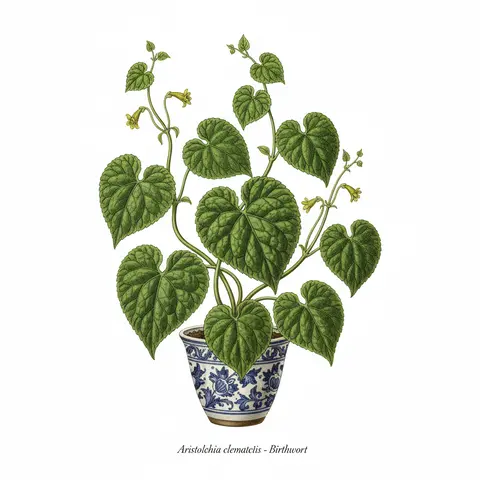
Birthwort (Aristolochia clematitis) is a distinctive perennial herbaceous plant belonging to the Aristolochiaceae family, a group renowned for its unique and often intricate floral structures. Native to a wide expanse across Europe and Western Asia, its remarkable adaptability has led to its naturalization in various temperate zones globally, including parts of North America where it can be found along roadsides and in disturbed habitats. This species thrives particularly well in environments characterized by ample moisture and partial to full shade, frequently colonizing woodlands, forest edges, and the banks of streams. Morphologically, Aristolochia clematitis is easily identified by its cordate, or heart-shaped, leaves, which are typically petiolate and can attain a length of up to 15 cm, presenting a lush, vibrant green foliage.
The plant's most striking feature is its flowers, which emerge in late spring to early summer. These are tubular and possess a highly specialized, five-lobed perianth that remarkably resembles a pitcher or a meerschaum pipe, a characteristic shared with other members of the genus. The color palette of the flowers ranges from pale yellow to greenish-brown, often adorned with intricate patterns of purple or brown markings, serving as a visual and olfactory lure for specific insect pollinators, primarily flies, which become temporarily trapped to ensure pollination. The robust root system is rhizomatous, allowing for efficient vegetative spread and the formation of dense stands in favorable conditions.
Taxonomically, Aristolochia clematitis is classified within the order Piperales, a basal angiosperm lineage, highlighting its ancient evolutionary history. While historically significant in various folk medicine traditions across Europe, the entire plant, from root to leaf, is laden with a complex array of phytochemicals, with the most significant and notorious group being the aristolochic acids. These compounds, once linked to its purported medicinal efficacy, are now unequivocally recognized for their severe nephrotoxic and carcinogenic properties, leading to widespread regulatory bans.
Trusted Scientific References
1. Authoritative external sources for Aristolochia clematitis
1.1 Wikipedia — Aristolochia clematitis
1.2 Kew POWO (Plants of the World Online)
1.3 PubMed — peer-reviewed research
1.4 NCBI Taxonomy Browser
1.5 GBIF — Global Biodiversity
1.1.Birthwort — Notable Characteristics
- ✓Distinctive pitcher — shaped flowers with intricate markings.
- ✓Cordate (heart — shaped) leaves, typically petiolate.
- ✓Native to Europe — Native to Europe and Western Asia, naturalized globally.
- ✓Contains potent and — Contains potent and highly toxic aristolochic acids.
- ✓Historically used in — Historically used in various European folk medicine traditions.
- ✓Unequivocally recognized as — Unequivocally recognized as nephrotoxic and carcinogenic.
- ✓Perennial herbaceous plant — Perennial herbaceous plant with a rhizomatous root system.
- ✓Thrives in moist, — Thrives in moist, shaded environments, often along stream banks.
- ✓Pollinated by flies — Pollinated by flies due to specialized floral structure.
- ✓Subject to widespread — Subject to widespread regulatory bans for medicinal use.
1.2.Birthwort — Concise Overview
- ✓Birthwort (Aristolochia clematitis) is a European perennial with distinctive pitcher-shaped flowers.
- ✓Historically used in folk medicine for a range of ailments, including labor induction and wound healing.
- ✓Contains highly toxic aristolochic acids, known for severe nephrotoxic and carcinogenic effects.
- ✓Internal consumption is strictly contraindicated and globally banned due to irreversible organ damage and cancer risk.
- ✓Even external application should be avoided due to potential systemic absorption and local irritation.
2.Birthwort — Scientific Identity
3.Birthwort — Vital Statistics
4.Birthwort — Botanical Description
5.Birthwort — Native Range & Habitat
6.Birthwort — Folk Medicine Applications
7.Birthwort — Key Phytochemicals
- ✓Aristolochic Acids (AAs) — The most prominent and dangerous group, including Aristolochic Acid I (AA-I) and Aristolochic Acid II (AA-II). These nitrophenanthrene carboxylic acids are responsible for the plant's severe nephrotoxic, carcinogenic, and mutagenic properties, despite historical claims of immunostimulant and anti-tumor activity.
- ✓Aristolactams — These are nitrogen-containing secondary metabolites, often derived from aristolochic acids. Examples like Aristolactam I are found throughout the plant and contribute to its overall toxicity as metabolites with similar adverse effects.
- ✓Flavonoids — A diverse group of polyphenolic compounds common in plants, often associated with antioxidant properties. While present, their potential benefits are entirely overshadowed by the toxicity of aristolochic acids in Birthwort.
- ✓Lignans — Another class of plant secondary metabolites, these are dimeric phenylpropanoids. Their presence in Aristolochia clematitis is likely, but their specific roles or beneficial activities are not relevant given the plant's extreme toxicity.
- ✓Alkaloids (other) — While aristolactams are a type of alkaloid, other alkaloidal compounds may be present in minor quantities, though their specific structures and activities are not well-documented or significant compared to AAs.
- ✓Essential Oils — Small amounts of volatile organic compounds may contribute to the plant's aroma, though not a primary constituent for its reputed effects or toxicity.
- ✓Tannins — Astringent polyphenols that might be present, traditionally associated with wound healing and anti-inflammatory effects, but again, completely overshadowed by the plant's primary toxic compounds.
8.Birthwort — Pharmacological Findings
- ✓Historically used as an Abortifacient — Traditionally believed to induce abortion by stimulating uterine contractions, a dangerous and contraindicated application.
- ✓Traditionally used as an Anti-inflammatory — Folk medicine employed it to reduce inflammation, though modern science notes its severe toxicity.
- ✓Historically used as an Antispasmodic — Believed to relax muscular spasms and cramps in traditional European herbalism.
- ✓Traditionally used as a Diaphoretic — Applied to induce perspiration, aiding in fever reduction in historical contexts.
- ✓Historically used as an Emmenagogue — Utilized to promote or increase menstrual flow, closely linked to its abortifacient properties.
- ✓Traditionally used as a Febrifuge — Employed in folk remedies to reduce fevers and alleviate associated symptoms.
- ✓Historically used as an Oxytocic — Applied to hasten parturition and stimulate uterine contractions, especially during childbirth, due to its potent uterine effects.
- ✓Traditionally used as a Stimulant — Believed to excite or quicken physiological processes, acting as a general tonic in some historical practices.
- ✓Historically used for Wound Healing — Externally applied to speed the healing of slow-healing cuts and sores, possibly by stimulating white blood cell activity.
- ✓Traditionally used for Eczema — Applied topically to treat chronic skin conditions like eczema, aiming to reduce redness and itching.
- ✓Historically used for Infected Nails — Employed externally in the treatment of infected toe and fingernails due to its purported antimicrobial properties.
8.1.Birthwort — Conditions Traditionally Used For
9.Birthwort — Cautions & Contraindications
9.1.Birthwort — Possible Adverse Reactions
- ✓Nephrotoxicity — Aristolochic acids are potent kidney toxins, causing irreversible kidney damage, including end-stage renal failure.
- ✓Carcinogenicity — Strongly linked to various cancers, particularly urothelial carcinoma (cancers of the urinary tract and kidney pelvis), even with minimal exposure.
- ✓Mutagenicity — Induces genetic mutations, contributing to its carcinogenic potential.
- ✓Uterine Bleeding — Can cause severe uterine hemorrhage, particularly when used as an abortifacient or emmenagogue.
- ✓Gastrointestinal Distress — Nausea, vomiting, and abdominal pain may occur upon ingestion.
- ✓Allergic Reactions — Topical application can lead to skin irritation, rashes, or other allergic responses in sensitive individuals.
9.2.Birthwort — Safety Overview
- ✓Absolute Contraindication for Internal Use — Due to severe nephrotoxic and carcinogenic effects, internal consumption of Birthwort is strictly prohibited.
- ✓Pregnancy and Lactation — Absolutely contraindicated in pregnant and lactating women due to its abortifacient properties and risk of harm to the fetus or infant.
- ✓Pre-existing Kidney Disease — Individuals with any kidney impairment are at extremely high risk of exacerbated damage.
- ✓Cancer Patients — Should never be used by individuals with a history of cancer or those undergoing cancer treatment due to its carcinogenic properties.
- ✓Topical Use Caution — Even external application carries risks of systemic absorption and localized irritation; not recommended without explicit medical supervision.
- ✓Regulatory Bans — Birthwort and other Aristolochia species containing aristolochic acids are globally banned from use in herbal products and dietary supplements.
- ✓Professional Guidance — Any consideration for use, even historical or external, requires extreme caution and should only be under the strictest, informed professional supervision, acknowledging the inherent dangers.
10.Birthwort — Usage Guide
- ✓Traditional Uterine Stimulant — Historically, the juice from stems was used to induce childbirth or as an abortifacient, a practice now recognized as extremely dangerous and contraindicated.
- ✓Traditional Anti-inflammatory Poultice — The flowering herb or root was traditionally applied externally as a poultice to reduce inflammation.
- ✓External Application for Wounds — Historically used topically on slow-healing cuts and sores, aimed at promoting healing and preventing infection.
- ✓Topical Treatment for Skin Conditions — Applied externally for conditions like eczema and infected nails, despite the risks of systemic absorption.
- ✓Infusions for Fevers — Traditional herbalists prepared infusions from the plant to act as a diaphoretic and febrifuge, for internal consumption, which is now considered highly toxic.
- ✓Decoctions for Menstrual Issues — Historically, decoctions were consumed to regulate menstrual flow or as an emmenagogue, a practice with severe health risks due to aristolochic acid content.
- ✓Caution for All Uses — Due to the unequivocal nephrotoxic and carcinogenic properties, Aristolochia clematitis is not recommended for any medicinal use, internal or external.
11.Birthwort — Garden Cultivation
- ✓Soil Preference — Thrives in well-drained loamy soil, rich in organic matter, tolerating mildly acid, neutral, and mildly alkaline pH levels.
- ✓Light Requirements — Prefers semi-shade to full shade conditions (light woodland), though it can tolerate full sun if moisture is consistent.
- ✓Moisture Needs — Requires consistently moist soil conditions; sensitive to drought.
- ✓Hardiness Zone — Hardy in USDA zones 5-9 and UK zone 6, indicating tolerance to temperate climates.
- ✓Growth Habit — Perennial herbaceous plant growing up to 0.7 meters (2ft 4in) tall, with a spreading, invasive rhizomatous root system.
- ✓Pollination — Flowers are hermaphrodite and are primarily pollinated by flies, attracted by the unique, often malodorous, pitcher-shaped flowers.
- ✓Historical Cultivation — Formerly cultivated across Europe as a medicinal plant, prior to the full understanding of its severe toxicity.
Reviewed by the Flora Medical Global Botanical Review Panel
Multi-disciplinary editorial group · Botany · Ethnobotany · Herbal-medicine literature
Who reviewed this: This page was checked by the Flora Medical Global Botanical Review Panel — an in-house editorial group of botany graduates, ethnobotany researchers, and horticulture practitioners who collectively maintain our 7,000+ plant encyclopedia. Meet the team.
Our 4-step verification process
1. Taxonomic verification
Scientific names and synonyms cross-checked against Kew POWO, World Flora Online, and The Plant List.
2. Phytochemical & medicinal cross-reference
Active compounds, traditional uses, and reported activities are cross-referenced with PubMed, USDA Dr. Duke's database, and peer-reviewed ethnobotanical literature.
3. Conservation & distribution check
Distribution, ecology, and conservation status confirmed against GBIF occurrence records and the IUCN Red List.
4. Editorial & safety review
Every entry passes an editorial pass for clarity, originality, and safety notices (toxicity, contraindications, dosage caveats) before publication.
Last reviewed:
Important medical disclaimer: This content is for educational and research purposes only. It is not medical advice and is not a substitute for consultation with a licensed healthcare provider. Do not use any herb to self-treat a medical condition without professional guidance.
Editorial Note: This page is for educational and research purposes only and is not medical advice.
Written by: Flora Medical Global Editorial Team
Reviewed by: Flora Medical Global Botanical Review Panel
Last Updated: June 16, 2026





Birthwort — Comments & Community Reviews
Rate this plant