
Medical Disclaimer: This content is for educational purposes only. It is not medical advice. Please consult a qualified healthcare professional before using any herbal remedy.
Safety Overview
1.Burdock — Introduction & Highlights
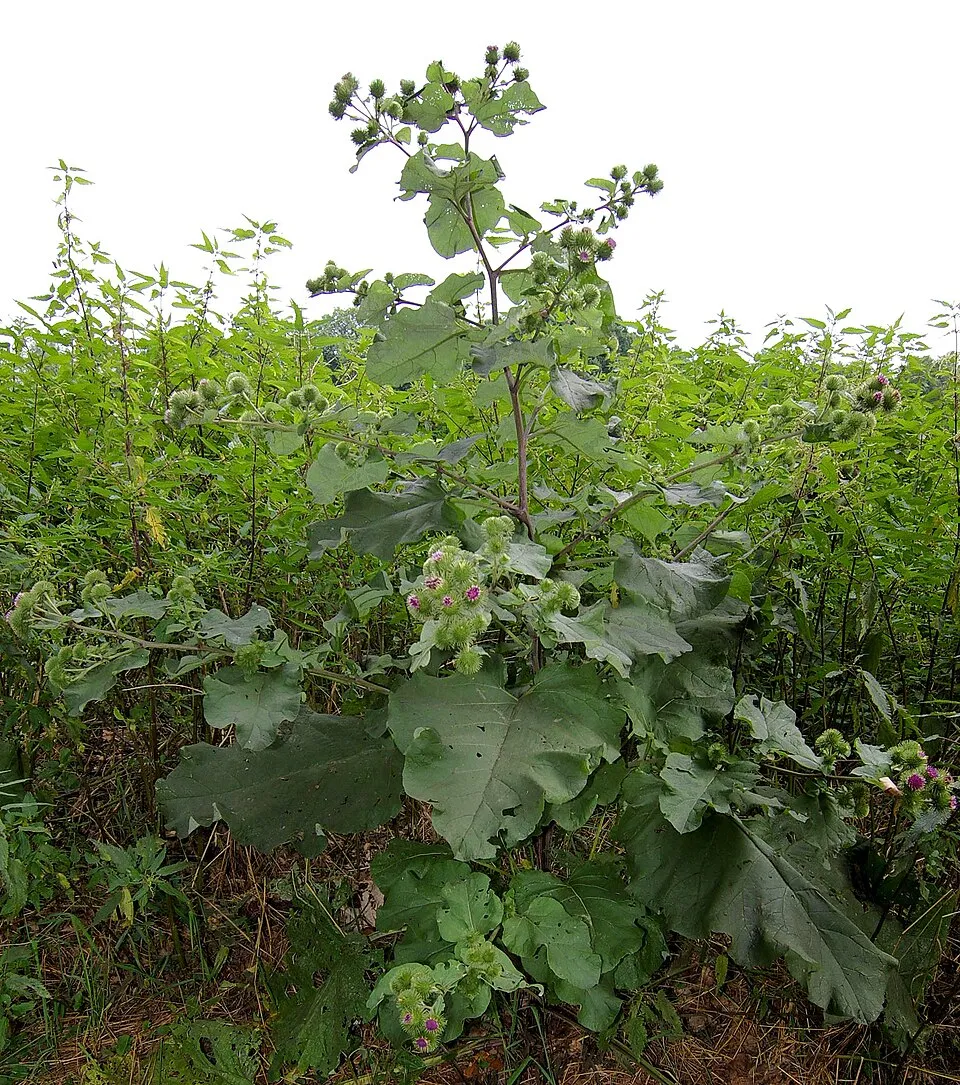
Arctium lappa, universally recognized as greater burdock, gobō, or niúban, is a robust biennial herbaceous plant thriving in the Asteraceae family. This resilient species is characterized by a remarkably deep taproot, often extending up to one meter into the soil, which is the primary part harvested for its extensive therapeutic attributes. The foliage of Arctium lappa is distinctive, featuring large, cordate (heart-shaped) leaves that can reach impressive lengths of up to 70 cm. These leaves possess a coarse texture, displaying a vibrant dark green on their upper surface and a noticeably paler underside.
In its second year of growth, the plant develops an erect, branched stem capable of reaching heights of two meters, adorned with numerous purple, thistle-like flowers. These flowers mature into characteristic burrs, well-known for their tenacious ability to cling to fabrics and animal fur, a natural design that famously inspired the invention of Velcro. Native to the temperate regions of Europe and Asia, burdock has successfully naturalized across North America, flourishing in disturbed environments such as fields, along roadsides, and in neglected waste areas. Its historical significance is profound, with centuries of documented use in both traditional Chinese medicine (TCM) and European folk medicine.
Medieval apothecaries highly valued burdock for its reputed blood-purifying properties and its application in treating diverse skin conditions like eczema and psoriasis. In TCM, where it is known as Niúbángǝn, records dating back to the Song Dynasty (960-1279 AD) highlight its efficacy in clearing heat and expelling toxins from the body, particularly benefiting dermal health and enhancing systemic detoxification processes. Beyond its medicinal applications, burdock holds significant cultural importance, especially in Japan and Korea, where its young roots are esteemed as a nutritious vegetable, gobō. Prized for their earthy flavor and fibrous texture, these roots are commonly prepared through stir-frying, pickling, or as an ingredient in soups and stews, deeply embedding burdock into the culinary traditions of these regions.
Trusted Scientific References
1. Authoritative external sources for Arctium lappa
1.1 Wikipedia — Arctium lappa
1.2 Kew POWO (Plants of the World Online)
1.3 PubMed — peer-reviewed research
1.4 NCBI Taxonomy Browser
1.5 GBIF — Global Biodiversity
1.1.Burdock — Standout Qualities
- ✓Deep, fleshy taproot — Deep, fleshy taproot reaching up to 1 meter.
- ✓Large, heart — shaped leaves with a coarse texture.
- ✓Produces distinctive purple, thistle — like flowers.
- ✓Mature flowers develop — Mature flowers develop into burrs that inspired Velcro.
- ✓Biennial herbaceous plant — Biennial herbaceous plant from the Asteraceae family.
- ✓Native to Europe — Native to Europe and Asia, naturalized globally.
- ✓Historically utilized in — Historically utilized in traditional Chinese medicine (Niúbángǝn) and European folk medicine.
- ✓Young roots are — Young roots are consumed as a nutritious vegetable (gobō) in Asian cultures.
- ✓Recognized for its alterative, depurative, and anti — inflammatory properties.
- ✓Contains significant levels — Contains significant levels of inulin, lignans, and phenolic compounds.
1.2.Burdock — Quick Summary
- ✓Traditional alterative and depurative herb, renowned for 'blood purification'.
- ✓Key for dermatological conditions like eczema, psoriasis, and acne.
- ✓Rich in inulin, lignans (arctiin, arctigenin), and phenolic acids.
- ✓Used culinarily as gobō in East Asian cuisine, especially Japan.
- ✓Exhibits anti-inflammatory, antioxidant, diuretic, and lymphatic stimulant actions.
- ✓Caution advised for pregnant/lactating individuals, diabetics, and those on anticoagulants or with Asteraceae allergies.
2.Burdock — Taxonomic Classification
3.Burdock — Reference Facts
4.Burdock — Plant Morphology
5.Burdock — Habitat & Distribution
6.Burdock — Cultural & Traditional Roles
7.Burdock — Bioactive Constituents
- ✓Sesquiterpene Lactones — Key compounds include arctigenin and arctiin, known for their significant anti-inflammatory, antiviral, and potential anti-cancer properties.
- ✓Inulin — A fructan polysaccharide, this prebiotic fiber constitutes a substantial portion of the root, supporting gut microbiome health and aiding blood sugar regulation.
- ✓Phenolic Acids — Primarily caffeic acid and chlorogenic acid, these compounds are potent antioxidants and contribute to burdock's anti-inflammatory and hepatoprotective actions.
- ✓Lignans — Arctigenin and its glycoside arctiin are prominent lignans, exhibiting phytoestrogenic, anti-tumor, and immune-modulating activities.
- ✓Flavonoids — Compounds like quercetin and luteolin are present, contributing to the plant's overall antioxidant and anti-inflammatory profile.
- ✓Polyacetylenes — Unique to Asteraceae, these compounds such as arctinone and arctinal possess notable antimicrobial, antifungal, and cytotoxic activities.
- ✓Mucilage — Comprising various polysaccharides, mucilage provides demulcent and soothing properties, particularly beneficial for digestive and skin irritation.
- ✓Volatile Oils — Present in smaller quantities, these contribute to the plant's characteristic aroma and may offer minor antiseptic or carminative effects.
- ✓Tannins — Provide astringent properties, contributing to its traditional use in skin conditions and as a general tonic.
- ✓Plant Sterols — Including beta-sitosterol, which may contribute to cholesterol-lowering and anti-inflammatory effects.
8.Burdock — Research Insights
- ✓Anti-inflammatory — Burdock root exhibits significant anti-inflammatory properties, attributed to compounds like arctigenin and phenolic acids, which modulate inflammatory pathways.
- ✓Detoxifying/Depurative — Acts as a potent blood purifier, aiding the body's natural elimination of metabolic waste and toxins through the liver and kidneys.
- ✓Dermatological Support — Highly valued for treating various skin conditions such as eczema, psoriasis, acne, and seborrhoeic dermatitis by clearing 'toxic heat' from the skin.
- ✓Lymphatic System Stimulant — Promotes healthy lymphatic flow, essential for immune function, fluid balance, and the efficient removal of cellular waste products.
- ✓Digestive Aid — Its bitter principles stimulate digestive secretions, while the mucilaginous fiber (inulin) supports gut health and can relieve constipation, particularly from the seeds.
- ✓Diuretic Action — Encourages increased urine production, facilitating the excretion of excess fluids and waste, contributing to its overall depurative effects.
- ✓Antioxidant Properties — Rich in phenolic acids and flavonoids, burdock helps neutralize free radicals, protecting cells from oxidative stress and damage.
- ✓Antimicrobial Activity — Contains polyacetylenes and other compounds that demonstrate inhibitory effects against certain bacteria and fungi, offering protective benefits.
- ✓Hepatoprotective Effects — Supports liver function, aiding in the processing and elimination of toxins, which is crucial for overall detoxification and skin health.
- ✓Hypoglycemic Potential — The high inulin content may help regulate blood sugar levels by slowing glucose absorption and acting as a prebiotic to improve gut flora.
- ✓Immunomodulatory Effects — Contributes to immune system balance, potentially enhancing the body's defense mechanisms against infections.
8.1.Burdock — Reported Uses
9.Burdock — Precautions & Warnings
9.1.Burdock — Warnings
- ✓Detoxification flare-ups — Initial use may temporarily worsen skin conditions as toxins are mobilized for elimination.
- ✓Allergic reactions — Individuals sensitive to the Asteraceae family (ragweed, chrysanthemums) may experience allergic responses.
- ✓Gastrointestinal upset — Some users may experience mild bloating, gas, or stomach discomfort, especially with high doses.
- ✓Diuretic effect — Excessive consumption can lead to increased urination and potential electrolyte imbalances.
- ✓Hypoglycemia — May lower blood sugar levels, posing a risk for individuals with diabetes or those on hypoglycemic medications.
- ✓Hypotension — Could potentially contribute to lower blood pressure, interacting with antihypertensive drugs.
- ✓Contamination risk — Wild-harvested roots must be carefully identified to avoid confusion with toxic look-alike plants like deadly nightshade.
9.2.Burdock — Clinical Safety Notes
- ✓Pregnancy and Lactation — Avoid use during pregnancy and breastfeeding due to insufficient safety data and potential uterine stimulant effects.
- ✓Bleeding Disorders/Anticoagulants — Exercise caution or avoid if on anticoagulant medications (e.g., warfarin) due to potential antiplatelet activity.
- ✓Diabetes/Hypoglycemic Drugs — Monitor blood glucose levels closely if using burdock, as it may potentiate the effects of blood sugar-lowering medications.
- ✓Allergy to Asteraceae — Contraindicated for individuals with known allergies to plants in the daisy family, such as ragweed, chrysanthemums, or marigolds.
- ✓Dehydration/Diuretic Medications — Use with caution if already dehydrated or taking pharmaceutical diuretics, to prevent excessive fluid loss.
- ✓Diarrhea — Avoid use if experiencing diarrhea, as its eliminative properties may exacerbate symptoms.
- ✓Children — Consult a qualified healthcare professional before administering burdock to children due to limited safety research in pediatric populations.
10.Burdock — Application Forms
- ✓Decoction — Sliced or chopped fresh or dried burdock root (3-18g) simmered in water for 15-20 minutes, then strained and consumed as a tea, typically 1-3 times daily.
- ✓Tincture — An alcohol extract of the root, commonly prepared at a 1:5 ratio in 25% alcohol, with a typical dosage of 6-12 ml daily, divided into several doses.
- ✓Infusion — Dried burdock leaves or seeds steeped in hot water for 10-15 minutes can be used as a milder tea, primarily for their diuretic or mild laxative effects.
- ✓Culinary Use — Young burdock roots (gobō) are prepared as a vegetable, often stir-fried, pickled, added to soups, or braised, particularly in Japanese and Korean cuisine.
- ✓Poultice/Compress — Freshly grated or powdered root mixed with a little water can be applied topically as a poultice to soothe skin irritations, boils, or minor wounds.
- ✓Powdered Root — Dried root can be ground into a powder and encapsulated, or added to smoothies and meals for a convenient way to consume its beneficial compounds.
- ✓Topical Oils/Salves — Burdock root infused in a carrier oil can be used to make salves or balms for external application to support skin health and alleviate discomfort.
11.Burdock — Growing Guide
- ✓Soil Preference — Thrives in deep, loose, well-drained, fertile loam soils to accommodate its long taproot.
- ✓Sun Exposure — Prefers full sun but can tolerate partial shade, though root development may be less robust.
- ✓Propagation — Primarily propagated from seeds, which are best direct-sown in early spring or late autumn.
- ✓Spacing — Seeds should be planted about 1 inch deep and thinned to 6-12 inches apart in rows 2-3 feet apart to allow ample root growth.
- ✓Watering — Requires consistent moisture, especially during dry periods, to ensure lush growth and prevent root hardening.
- ✓Harvesting — Roots are typically harvested in the late autumn of the first year or early spring of the second year before flowering, when they are most tender and potent.
- ✓Pests and Diseases — Generally robust, but watch for aphids, leaf miners, and powdery mildew; good air circulation helps prevent fungal issues.
- ✓Climate — Best suited for temperate climates with adequate rainfall, tolerating a range of temperatures but susceptible to severe frost.
Reviewed by the Flora Medical Global Botanical Review Panel
Multi-disciplinary editorial group · Botany · Ethnobotany · Herbal-medicine literature
Who reviewed this: This page was checked by the Flora Medical Global Botanical Review Panel — an in-house editorial group of botany graduates, ethnobotany researchers, and horticulture practitioners who collectively maintain our 7,000+ plant encyclopedia. Meet the team.
Our 4-step verification process
1. Taxonomic verification
Scientific names and synonyms cross-checked against Kew POWO, World Flora Online, and The Plant List.
2. Phytochemical & medicinal cross-reference
Active compounds, traditional uses, and reported activities are cross-referenced with PubMed, USDA Dr. Duke's database, and peer-reviewed ethnobotanical literature.
3. Conservation & distribution check
Distribution, ecology, and conservation status confirmed against GBIF occurrence records and the IUCN Red List.
4. Editorial & safety review
Every entry passes an editorial pass for clarity, originality, and safety notices (toxicity, contraindications, dosage caveats) before publication.
Last reviewed:
Important medical disclaimer: This content is for educational and research purposes only. It is not medical advice and is not a substitute for consultation with a licensed healthcare provider. Do not use any herb to self-treat a medical condition without professional guidance.
Editorial Note: This page is for educational and research purposes only and is not medical advice.
Written by: Flora Medical Global Editorial Team
Reviewed by: Flora Medical Global Botanical Review Panel
Last Updated: June 16, 2026





Burdock — Comments & Community Reviews
Rate this plant