
Medical Disclaimer: This content is for educational purposes only. It is not medical advice. Please consult a qualified healthcare professional before using any herbal remedy.
Safety Overview
1.Calabar Bean — Essential Profile
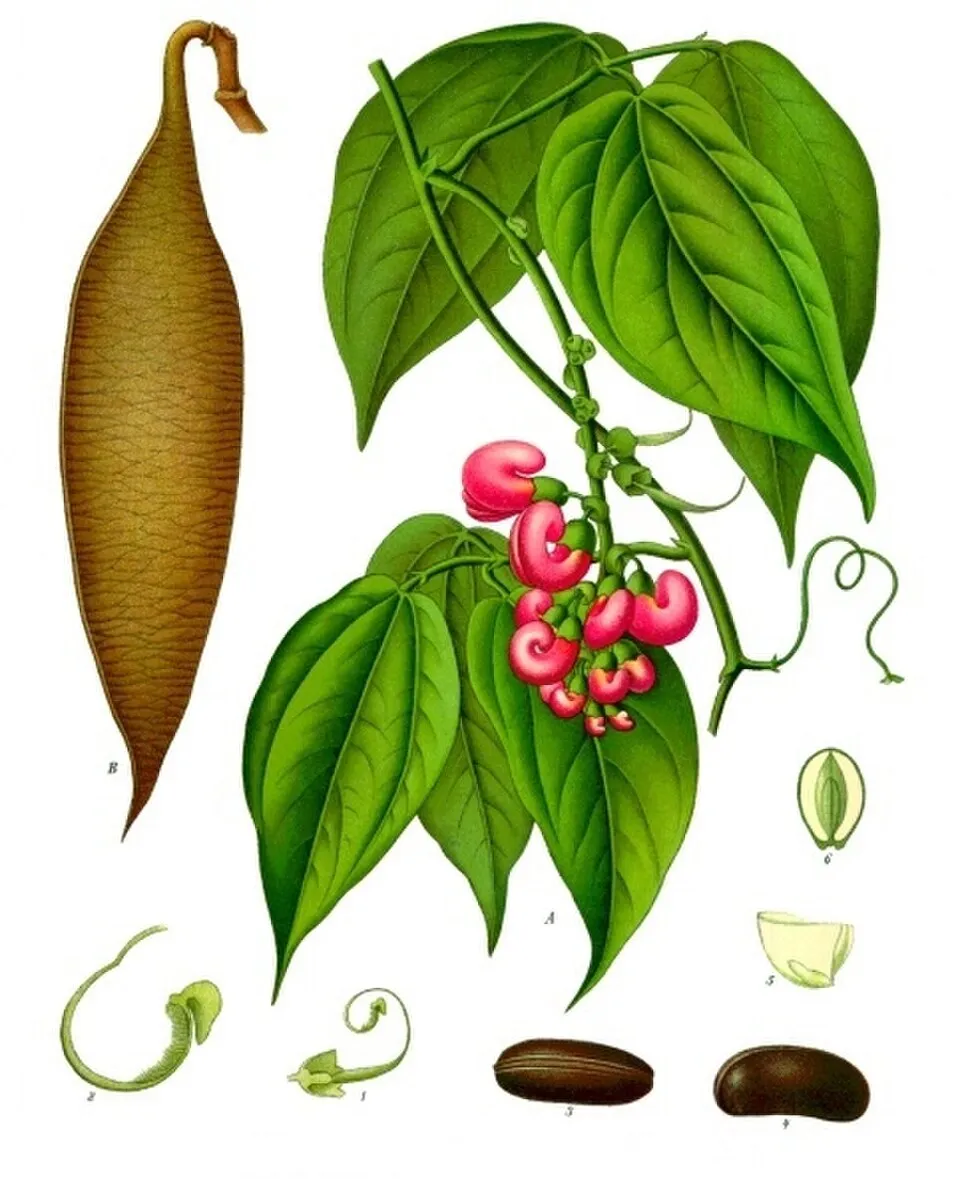
Calabar Bean, or Physostigma venenosum, is a distinctive perennial herbaceous climbing plant indigenous to the tropical rainforests and riverine areas of West Africa, notably thriving in Nigeria. This robust vine can achieve impressive heights, sometimes reaching over 15 meters, with a woody stem base that may expand up to 5 cm in diameter. Its spirally arranged leaves are ovate to broadly elliptic, measuring between 8 to 25 cm in length and 4 to 10 cm in width, characterized by a smooth, glossy deep green upper surface. The plant produces striking tubular flowers, typically creamy white to pale yellow, often tinged with purple, which bloom in showy clusters and attract various insect pollinators.
These blossoms develop into legume pods, which are elongated, measuring around 5 to 15 cm in length. Each pod typically encases two to three large, thick, and exceedingly hard seeds, colloquially known as Calabar beans. These seeds are roughly spherical to kidney-shaped, dark brown, and can measure up to 2.5 cm in diameter. Ecologically, P.
venenosum flourishes in warm, humid conditions, preferring well-drained, fertile sandy or loamy soils, and its growth is particularly abundant during the rainy season from June to September. Taxonomically, it is classified within the Fabaceae family, a large and economically important group of flowering plants.
Trusted Scientific References
1. Authoritative external sources for Physostigma venenosum
1.1 Wikipedia — Physostigma venenosum
1.2 Kew POWO (Plants of the World Online)
1.3 PubMed — peer-reviewed research
1.4 NCBI Taxonomy Browser
1.5 GBIF — Global Biodiversity
1.6Calabar Bean should be interpreted through verified botanical identity, practical care, and responsible safety language. This recovery note adds the missing context needed for a complete profile: match light to the plant's habit, use well-drained soil, water according to season, and avoid unsupported medicinal or edible claims. For publishing, the plant can be presented as a source-backed medicinal plant with clear care guidance, common problem diagnosis, and conservative safety wording.
1.1.Calabar Bean — Highlights
- ✓Potent Cholinesterase Inhibitor — Contains physostigmine, a strong acetylcholinesterase inhibitor.
- ✓Native to West Africa — Indigenous to tropical rainforests and riverbanks of countries like Nigeria.
- ✓Ordeal Bean — Historically significant for its use in 'trial by ordeal' rituals.
- ✓Distinctive Seeds — Large, hard, dark brown, kidney-shaped seeds are the primary toxic part.
- ✓Legume Family (Fabaceae) — Belongs to the pea family, characterized by its pod fruit.
- ✓Climbing Perennial Vine — A robust herbaceous climber reaching significant heights.
- ✓Pharmaceutical Source — The raw material for extracting physostigmine, a vital drug.
- ✓Extreme Toxicity — Lethal in small doses if ingested, making it unsuitable for herbal use.
- ✓Miosis Inducer — Physostigmine causes pupil constriction, useful in ophthalmology.
- ✓Antidote for Anticholinergic Poisoning — Critical in emergency medicine for reversing certain drug overdoses.
1.2.Calabar Bean — Quick Summary
- ✓Calabar Bean (Physostigma venenosum) is a highly toxic West African legume.
- ✓Contains potent indole alkaloids, primarily physostigmine, an acetylcholinesterase inhibitor.
- ✓Historically used as an 'ordeal poison' in traditional West African rituals.
- ✓Isolated physostigmine is a crucial pharmaceutical for glaucoma, anticholinergic toxicity, and was explored for Alzheimer's and myasthenia gravis.
- ✓Direct consumption of the crude bean is lethal and strictly contraindicated.
- ✓Requires extreme caution and is solely for supervised medical or pharmaceutical use.
2.Calabar Bean — Scientific Identity
3.Calabar Bean — Fact Sheet
4.Calabar Bean — Botanical Features
5.Calabar Bean — Origin & Spread
6.Calabar Bean — Traditional Uses
7.Calabar Bean — Chemical Profile
- ✓Indole Alkaloids — The most significant compounds are a group of indole alkaloids, derived from tryptophan, which are responsible for the plant's potent pharmacological effects.
- ✓Physostigmine (Eserine) — This is the principal and most pharmacologically active alkaloid, known for its potent, reversible acetylcholinesterase inhibiting activity, leading to increased acetylcholine levels.
- ✓Eseramine — A minor alkaloid structurally related to physostigmine, also contributing to the overall alkaloid profile of the Calabar Bean, though less potent.
- ✓Physovenine — Another indole alkaloid present in the seeds, sharing structural similarities with physostigmine and potentially possessing similar, albeit weaker, pharmacological actions.
- ✓Calabatine — A less studied alkaloid found in Physostigma venenosum, contributing to the complex mixture of bioactive compounds within the plant.
- ✓Geneserine — An N-oxide derivative of physostigmine, which can also be present in the plant or form upon oxidation, and possesses some anticholinesterase activity.
- ✓Rubreserine — This is an oxidative degradation product of physostigmine, appearing as a reddish compound when physostigmine is exposed to air and light, indicating alkaloid degradation.
- ✓Fatty Oils — The seeds contain a significant proportion of fatty oils, which are typical storage compounds in many legumes, though not directly responsible for the medicinal effects.
8.Calabar Bean — Pharmacological Findings
- ✓Anticholinesterase Activity — The primary active compound, physostigmine, acts as a reversible acetylcholinesterase inhibitor, preventing the breakdown of acetylcholine in the synaptic cleft and thereby enhancing cholinergic neurotransmission.
- ✓Glaucoma Management — Isolated physostigmine is historically and medically significant for its ability to reduce intraocular pressure in glaucoma by improving the outflow of aqueous humor, thus serving as a miotic agent.
- ✓Alzheimer's Disease Support — Due to its cholinesterase inhibiting properties, physostigmine was an early therapeutic agent investigated for enhancing cognitive function in Alzheimer's patients by increasing acetylcholine levels in the brain, though newer agents have largely replaced it.
- ✓Myasthenia Gravis Symptom Alleviation — By boosting acetylcholine at the neuromuscular junction, physostigmine can temporarily improve muscle strength and reduce symptoms in individuals with myasthenia gravis, a condition characterized by muscle weakness.
- ✓Anticholinergic Toxicity Reversal — Physostigmine is a crucial antidote for reversing both central and peripheral toxic effects caused by overdose of anticholinergic drugs, such as tricyclic antidepressants and atropine, due to its ability to cross the blood-brain barrier.
- ✓Nerve Agent Poisoning Protection — Research has explored physostigmine, particularly in liposomal formulations, for its potential to protect against the effects of nerve gas exposure by maintaining stable plasma concentrations and inhibiting cholinesterase.
- ✓Experimental Cognitive Enhancer — Beyond Alzheimer's, physostigmine has been studied in various experimental contexts for its general cognitive enhancing effects, particularly in memory and learning processes.
- ✓Traditional External Applications — Historically, in some traditional African practices, the seeds were reportedly used topically for certain skin conditions, albeit with extreme caution due to their inherent toxicity.
8.1.Calabar Bean — Therapeutic Indications
9.Calabar Bean — Safety Considerations
9.1.Calabar Bean — Possible Adverse Reactions
- ✓Cholinergic Crisis — Excessive stimulation of muscarinic and nicotinic receptors leading to hypersecretion, salivation, lacrimation, bronchospasm, bradycardia, nausea, vomiting, diarrhea, and muscle weakness.
- ✓Gastrointestinal Disturbances — Common adverse effects include abdominal cramps, nausea, vomiting, and diarrhea due to increased GI motility.
- ✓Central Nervous System Effects — Can cause confusion, delirium, anxiety, disorientation, hyperactivity, hallucinations, seizures, ataxia, and in severe cases, coma.
- ✓Cardiovascular Effects — May lead to bradycardia, hypotension, or paradoxically, tachycardia and tachyarrhythmia with overdose.
- ✓Respiratory Distress — Bronchospasm and increased bronchial secretions can lead to dyspnea and respiratory paralysis, a potentially lethal outcome.
- ✓Hepatic Injury — Studies in rats have shown that high doses of P. venenosum extract can cause signs of liver damage.
- ✓Ocular Effects — Miosis (pupil constriction) is a common effect, especially with topical application, and can cause blurred vision and headache.
9.2.Calabar Bean — Clinical Safety Notes
- ✓Extreme Toxicity — The Calabar Bean is profoundly toxic; ingestion of as few as 2-3 seeds can be lethal due to physostigmine content.
- ✓Contraindications for Physostigmine — Avoid in individuals with asthma, cardiovascular disease (especially bradycardia), diabetes, gangrene, urinary obstruction, and gastrointestinal obstruction.
- ✓Pregnancy and Lactation — Absolutely contraindicated during pregnancy and lactation due to documented adverse effects and potential harm to the fetus or infant.
- ✓Drug Interactions — While not extensively documented for the crude bean, physostigmine can interact with other cholinergic agents, anticholinergics, and neuromuscular blockers.
- ✓Overdose Management — In cases of physostigmine toxicity, atropine is the primary antidote, often supplemented with oximes like pralidoxime to reactivate cholinesterase.
- ✓Professional Use Only — Crude Calabar Bean or its extracts are not recommended for any self-medication or unsupervised use; its active compounds are strictly for pharmaceutical applications under medical guidance.
- ✓Hepatic Warning — Prolonged or high-dose exposure, even to extracts, may pose a risk of hepatic injury, as observed in animal studies.
10.Calabar Bean — Preparations & Uses
- ✓Extreme Caution — The crude Calabar Bean and its extracts are highly toxic and should never be ingested or used without strict medical supervision due to lethal potential.
- ✓Historical Ordeal Poison — Traditionally, the seeds were used in West African judicial rituals as an 'ordeal poison' to determine guilt or innocence, with survival indicating innocence.
- ✓Isolated Physostigmine for Glaucoma — Pharmaceutical preparations of isolated physostigmine are used topically as eye drops to treat glaucoma, reducing intraocular pressure.
- ✓Anticholinergic Overdose Antidote — Intravenous physostigmine is administered in clinical settings to reverse severe anticholinergic toxicity, under strict medical control.
- ✓Myasthenia Gravis Treatment — While largely superseded, physostigmine was historically used in formulations to manage symptoms of myasthenia gravis.
- ✓Alzheimer's Disease Research — Early research utilized physostigmine to explore cognitive enhancement in Alzheimer's, paving the way for newer cholinesterase inhibitors.
- ✓Pharmaceutical Extraction — The primary 'use' of the plant today is as a source for the extraction and purification of physostigmine for pharmaceutical applications.
- ✓No Home Use — Due to its extreme toxicity, Calabar Bean is not suitable for home remedies, herbal teas, or any form of self-medication.
11.Calabar Bean — Garden Cultivation
- ✓Climate — Thrives in warm, tropical climates with high humidity, typical of West African rainforests.
- ✓Soil Requirements — Prefers well-drained, fertile sandy or loamy soils, often found along riverbanks.
- ✓Light — Grows best in partial shade to full sun, typical of understory or clearing conditions in its native habitat.
- ✓Propagation — Primarily propagated from seeds, which can be challenging due to their hard shell and dormancy.
- ✓Support Structure — As a climbing plant, it requires a sturdy support system like trellises, fences, or other trees to grow upwards.
- ✓Watering — Requires consistent moisture, especially during its active growth and flowering periods, consistent with a rainy season.
- ✓Harvesting — Seeds ripen throughout the year but are most abundant during the rainy season, typically harvested once pods mature and dry.
Reviewed by the Flora Medical Global Botanical Review Panel
Multi-disciplinary editorial group · Botany · Ethnobotany · Herbal-medicine literature
Who reviewed this: This page was checked by the Flora Medical Global Botanical Review Panel — an in-house editorial group of botany graduates, ethnobotany researchers, and horticulture practitioners who collectively maintain our 7,000+ plant encyclopedia. Meet the team.
Our 4-step verification process
1. Taxonomic verification
Scientific names and synonyms cross-checked against Kew POWO, World Flora Online, and The Plant List.
2. Phytochemical & medicinal cross-reference
Active compounds, traditional uses, and reported activities are cross-referenced with PubMed, USDA Dr. Duke's database, and peer-reviewed ethnobotanical literature.
3. Conservation & distribution check
Distribution, ecology, and conservation status confirmed against GBIF occurrence records and the IUCN Red List.
4. Editorial & safety review
Every entry passes an editorial pass for clarity, originality, and safety notices (toxicity, contraindications, dosage caveats) before publication.
Last reviewed:
Important medical disclaimer: This content is for educational and research purposes only. It is not medical advice and is not a substitute for consultation with a licensed healthcare provider. Do not use any herb to self-treat a medical condition without professional guidance.
Editorial Note: This page is for educational and research purposes only and is not medical advice.
Written by: Flora Medical Global Editorial Team
Reviewed by: Flora Medical Global Botanical Review Panel
Last Updated: June 16, 2026





Calabar Bean — Comments & Community Reviews
Rate this plant