


Medical Disclaimer: This content is for educational purposes only. It is not medical advice. Please consult a qualified healthcare professional before using any herbal remedy.
Safety Overview
1.Chaturjata — Overview
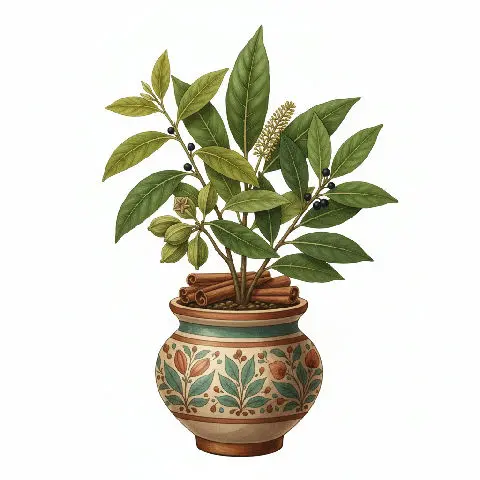
Chaturjata, an esteemed blend in traditional Ayurvedic medicine, is a synergistic combination of four distinct and potent botanicals: Twak (Cinnamon, Cinnamomum zeylanicum), Patra (Indian Bay Leaf, Cinnamomum tamala), Ela (Cardamom, Elettaria cardamomum), and Nagakeshara (Ironwood Tree, Mesua ferrea). Each component contributes unique characteristics that define this classical formulation.
Cinnamon (Cinnamomum zeylanicum) is an evergreen tree, typically growing 10-15 meters tall, characterized by its reddish-brown bark, which is the primary part utilized. It features oval-oblong leaves and small, white flowers.
Native to Sri Lanka and southern India, it thrives in tropical, humid climates with well-drained soil.
Indian Bay Leaf (Cinnamomum tamala), often confused with bay laurel, is a medium-sized evergreen tree native to the Himalayan regions, growing 5-10 meters. Its aromatic, lanceolate leaves, 10-20 cm long, are the main part used. It prefers subtropical to warm temperate climates.
Cardamom (Elettaria cardamomum) is a herbaceous perennial in the ginger family, growing up to 2-4 meters tall. It is recognized by its large, lance-shaped leaves and small, pale flowers that yield green, ovoid seed pods.
Indigenous to the moist evergreen forests of southern India, it requires rich, loamy soil and partial shade.
Nagakeshara (Mesua ferrea), also known as the Ironwood Tree, is a slow-growing evergreen tree that can reach 30 meters in height. It has distinctive reddish-pink young leaves that mature to dark green, and striking white flowers with bright yellow stamens.
Native to tropical Asia, it is often found in evergreen forests and tolerates a range of soil types.
Trusted Scientific References
1. Authoritative external sources for Multiple spices
1.1 Wikipedia — Multiple spices
1.2 Kew POWO (Plants of the World Online)
1.3 PubMed — peer-reviewed research
1.4 NCBI Taxonomy Browser
1.5 GBIF — Global Biodiversity
1.6Chaturjata should be interpreted through verified botanical identity, practical care, and responsible safety language. This recovery note adds the missing context needed for a complete profile: match light to the plant's habit, use well-drained soil, water according to season, and avoid unsupported medicinal or edible claims. For publishing, the plant can be presented as a source-backed medicinal plant with clear care guidance, common problem diagnosis, and conservative safety wording.
1.1.Chaturjata — Defining Traits
- ✓Traditional Ayurvedic formulation — Traditional Ayurvedic formulation with centuries of documented use.
- ✓Synergistic blend of — Synergistic blend of four potent aromatic and medicinal spices.
- ✓Renowned for its Kapha — balancing and digestive stimulant properties.
- ✓Rich in volatile — Rich in volatile oils, offering carminative and expectorant benefits.
- ✓Acts as a — Acts as a natural antioxidant, protecting cells from oxidative stress.
- ✓Enhances taste perception — Enhances taste perception and supports the body's natural detoxification processes.
- ✓Versatile in application, — Versatile in application, from culinary enhancement to complex herbal remedies.
- ✓Contributes to improved — Contributes to improved skin complexion and overall metabolic wellness.
- ✓Possesses mild anti — inflammatory and antimicrobial characteristics.
- ✓Valued for its — Valued for its ability to improve the bioavailability of other medicinal compounds.
1.2.Chaturjata — Quick Summary
- ✓Chaturjata is an Ayurvedic blend of Cinnamon, Indian Bay Leaf, Cardamom, and Nagakeshara.
- ✓It is primarily used to balance Kapha dosha and support digestive and respiratory health.
- ✓The blend enhances taste, aids detoxification, and exhibits antioxidant properties.
- ✓Commonly consumed as a 'Churna' (powder) with honey or water.
- ✓Rich in volatile oils, phenylpropanoids, and flavonoids, contributing to its therapeutic actions.
- ✓Caution is advised for high doses, pregnant individuals, and those on specific medications.
2.Chaturjata — Taxonomic Classification
3.Chaturjata — Botanical Stats
4.Chaturjata — Morphological Account
5.Chaturjata — Geographic Distribution
6.Chaturjata — Historical Applications
7.Chaturjata — Active Compounds
- ✓Volatile Oils — Rich in essential oils, including cinnamaldehyde from Cinnamon, 1,8-cineole and limonene from Cardamom, and eugenol from Indian Bay Leaf, contributing to aroma and therapeutic effects.
- ✓Phenylpropanoids — Key compounds like cinnamaldehyde and eugenol are found in Cinnamon and Indian Bay Leaf, known for their antimicrobial, anti-inflammatory, and antioxidant activities.
- ✓Terpenes — Cardamom is particularly high in monoterpenes like alpha-terpineol, limonene, and sabinene, contributing to its expectorant and digestive properties.
- ✓Coumarins — Present in Cinnamon and Nagakeshara, including mesuol and mammeisin in Nagakeshara, which are associated with anti-inflammatory and anticoagulant properties.
- ✓Flavonoids — Found in Nagakeshara, Cinnamon, and Indian Bay Leaf, these compounds contribute to the blend's antioxidant and anti-inflammatory potential.
- ✓Tannins — Present in varying amounts across the ingredients, particularly Cinnamon and Nagakeshara, offering astringent and antioxidant benefits.
- ✓Phenolic Acids — Such as cinnamic acid derivatives, contributing to the overall antioxidant capacity and protective effects.
- ✓Xanthones — Notably present in Nagakeshara, these compounds exhibit a range of pharmacological activities including anti-inflammatory and hepatoprotective effects.
- ✓Resins — Contribute to the texture and some therapeutic properties of the spices, especially in their raw forms.
- ✓Alkaloids — Found in trace amounts, these nitrogen-containing compounds may contribute to specific physiological responses.
8.Chaturjata — Modern Studies
- ✓Balances Kapha Dosha — Chaturjata is traditionally revered for its ability to pacify and balance the Kapha dosha, addressing conditions related to excess phlegm, sluggishness, and coldness in the body.
- ✓Improves Skin Tone and Complexion — The blend's detoxifying and antioxidant properties contribute to enhanced skin radiance, promoting a clearer and more even complexion.
- ✓Enhances Taste Perception — Known as a 'Rochana' in Ayurveda, it stimulates the taste buds and improves the sense of taste, making food more appealing, especially during convalescence.
- ✓Supports Detoxification — The combined actions of its ingredients aid in eliminating 'Ama' (toxins) from the body, supporting natural cleansing processes and metabolic health.
- ✓Aids Digestion and Metabolism — The carminative and digestive stimulant properties of Cinnamon and Cardamom help improve appetite, reduce flatulence, and enhance nutrient absorption.
- ✓Promotes Respiratory Health — Cardamom, Cinnamon, and Indian Bay Leaf are known for their expectorant and decongestant qualities, beneficial in managing coughs, colds, and respiratory congestion.
- ✓Exhibits Antioxidant Activity — Rich in phenolic compounds and volatile oils, Chaturjata components collectively offer significant antioxidant protection against free radical damage.
- ✓Possesses Anti-inflammatory Effects — Constituents like cinnamaldehyde and eugenol from Cinnamon and Indian Bay Leaf contribute to modulating inflammatory responses in the body.
- ✓Supports Cardiovascular Wellness — Cinnamon, in particular, has been studied for its potential to support healthy blood sugar and cholesterol levels, indirectly benefiting heart health.
- ✓Offers Antimicrobial Properties — The essential oils present in all four spices demonstrate broad-spectrum antimicrobial activity, helping to protect against various pathogens.
- ✓Acts as a Bioavailability Enhancer — This blend is often used in Ayurvedic formulations to improve the absorption and efficacy of other medicinal compounds.
- ✓Provides Aromatic and Uplifting Effects — The fragrant volatile oils contribute to a sense of well-being, potentially alleviating mild stress and refreshing the mind.
8.1.Chaturjata — Reported Uses
9.Chaturjata — Precautions & Warnings
9.1.Chaturjata — Warnings
- ✓Gastric Irritation — High doses, particularly of Cinnamon, may cause a burning sensation, heartburn, or gastritis in sensitive individuals.
- ✓Allergic Reactions — Some individuals may experience skin rashes, itching, or respiratory discomfort due to hypersensitivity to any of the component spices.
- ✓Blood Thinning — Certain coumarins in Cassia Cinnamon (not C. zeylanicum, but a common adulterant) can have blood-thinning effects, warranting caution with anticoagulant medications.
- ✓Hypoglycemic Effects — Cinnamon can lower blood sugar levels, requiring careful monitoring for individuals with diabetes, especially if on medication.
- ✓Drug Interactions — Potential interactions with medications, including antidiabetics, anticoagulants, and liver-metabolized drugs, due to effects on metabolic enzymes.
- ✓Pregnancy and Lactation Concerns — High doses are generally advised against during pregnancy and lactation due to insufficient safety data and potential uterine stimulation.
9.2.Chaturjata — Safety Profile
- ✓Consult Healthcare Professional — Always seek advice from an Ayurvedic practitioner or physician before initiating use, especially for therapeutic purposes or if pregnant/nursing.
- ✓Adhere to Recommended Dosage — Strictly follow prescribed dosages to minimize the risk of adverse effects, as excessive consumption can lead to irritation.
- ✓Monitor for Allergic Reactions — Discontinue use immediately if any signs of allergic reaction, such as skin rash, itching, or difficulty breathing, occur.
- ✓Exercise Caution with Specific Conditions — Individuals with bleeding disorders, diabetes, or gastrointestinal sensitivities should use Chaturjata with medical supervision.
- ✓Avoid During Pregnancy and Lactation — Due to the potential for uterine stimulation and lack of comprehensive safety data, it is best to avoid high doses during these periods.
- ✓Source Quality Ingredients — Ensure that all component spices are of high quality, pure, and free from adulteration to guarantee safety and efficacy.
- ✓Interact with Medications — Inform your doctor about Chaturjata use if taking Western medications, particularly blood thinners, antidiabetics, or liver-affecting drugs.
10.Chaturjata — How to Use
- ✓Churna (Powder) — The most common traditional form, where dried ingredients are ground into a fine powder and consumed with honey, ghee, or warm water.
- ✓Infusion (Tea) — Individual components, particularly Cinnamon and Cardamom, can be steeped in hot water to create a fragrant and medicinal tea.
- ✓Decoction — A stronger preparation made by simmering the coarser parts of the spices in water, often used for more potent therapeutic effects.
- ✓Culinary Spice — The individual spices are widely used in cooking to add flavor, aroma, and digestive benefits to various dishes, both sweet and savory.
- ✓Essential Oil Extraction — Volatile oils from Cinnamon, Cardamom, and Indian Bay Leaf are extracted for use in aromatherapy, topical applications, or as flavorings.
- ✓Ingredient in Complex Formulations — Chaturjata is a key component in numerous Ayurvedic medicines, such as Chyawanprash, enhancing their efficacy and balancing properties.
- ✓Topical Application — Essential oils or pastes made from the individual spices can be applied externally for local pain relief or antiseptic purposes, diluted appropriately.
- ✓Oral Rinses — Infusions or diluted essential oils can be used as mouth rinses for oral hygiene and to combat bad breath.
11.Chaturjata — Growing Guide
- ✓Cinnamon (Cinnamomum zeylanicum) — Propagated from seeds or cuttings, requiring tropical climates with high humidity, well-drained sandy loam soil, and partial shade for optimal growth.
- ✓Indian Bay Leaf (Cinnamomum tamala) — Grown from seeds or root suckers, thriving in subtropical to warm temperate regions, tolerating various soil types but preferring fertile, moist conditions.
- ✓Cardamom (Elettaria cardamomum) — Primarily propagated from rhizomes or seeds, necessitating humid tropical forest conditions, dappled shade, rich organic soil, and consistent moisture.
- ✓Nagakeshara (Mesua ferrea) — Propagated by seeds, growing slowly in tropical evergreen forests, preferring well-drained, deep loamy soils, and full sun exposure once established.
- ✓Soil Preparation — All components generally benefit from well-aerated, fertile soil with good drainage, often enriched with organic matter to support healthy growth.
- ✓Water Requirements — Consistent and adequate moisture is crucial, especially for Cardamom and Cinnamon, without waterlogging, which can lead to root rot.
- ✓Harvesting — Specific parts are harvested: bark for Cinnamon, leaves for Indian Bay Leaf, ripe pods for Cardamom, and flowers/seeds for Nagakeshara, at their optimal maturity for potency.
Reviewed by the Flora Medical Global Botanical Review Panel
Multi-disciplinary editorial group · Botany · Ethnobotany · Herbal-medicine literature
Who reviewed this: This page was checked by the Flora Medical Global Botanical Review Panel — an in-house editorial group of botany graduates, ethnobotany researchers, and horticulture practitioners who collectively maintain our 7,000+ plant encyclopedia. Meet the team.
Our 4-step verification process
1. Taxonomic verification
Scientific names and synonyms cross-checked against Kew POWO, World Flora Online, and The Plant List.
2. Phytochemical & medicinal cross-reference
Active compounds, traditional uses, and reported activities are cross-referenced with PubMed, USDA Dr. Duke's database, and peer-reviewed ethnobotanical literature.
3. Conservation & distribution check
Distribution, ecology, and conservation status confirmed against GBIF occurrence records and the IUCN Red List.
4. Editorial & safety review
Every entry passes an editorial pass for clarity, originality, and safety notices (toxicity, contraindications, dosage caveats) before publication.
Last reviewed:
Important medical disclaimer: This content is for educational and research purposes only. It is not medical advice and is not a substitute for consultation with a licensed healthcare provider. Do not use any herb to self-treat a medical condition without professional guidance.
Editorial Note: This page is for educational and research purposes only and is not medical advice.
Written by: Flora Medical Global Editorial Team
Reviewed by: Flora Medical Global Botanical Review Panel
Last Updated: June 16, 2026





Chaturjata — Comments & Community Reviews
Rate this plant