
Medical Disclaimer: This content is for educational purposes only. It is not medical advice. Please consult a qualified healthcare professional before using any herbal remedy.
Safety Overview
1.Chinese Wisteria — Essential Profile
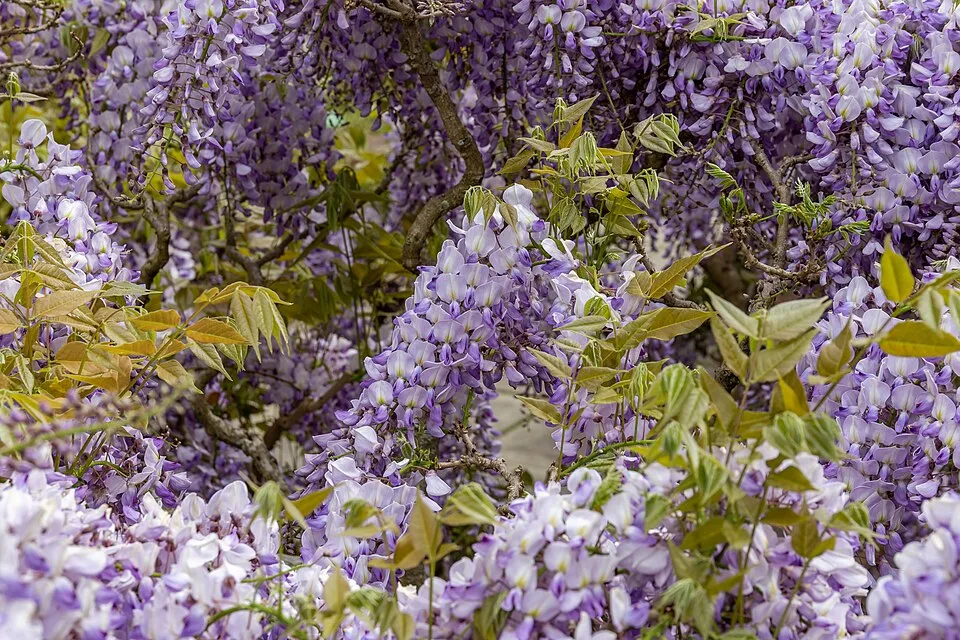
Chinese Wisteria, scientifically designated as Wisteria sinensis, is an imposing and resilient deciduous climbing vine, indigenous to the temperate zones of central and southern China. This vigorous liana is celebrated for its impressive growth, often reaching over 20 meters in height, gracefully twining in an anticlockwise direction around supportive structures or host trees. Its stems, initially supple, mature into a robust framework cloaked in grey-brown bark that develops a rough, fissured texture.
The foliage comprises pinnately compound leaves, each typically bearing 9 to 15 ovate to elliptical leaflets measuring 9-12 centimeters, presenting a smooth margin and a glossy dark green hue that maintains the plant's dense aesthetic throughout the growing season. The plant's most spectacular feature emerges in spring: pendulous flower racemes, often extending up to 30 centimeters. These striking clusters display numerous pea-like blossoms in captivating shades of lavender, blue-purple, or occasionally white, with each raceme holding 10 to 20 individual, intensely fragrant flowers.
This pervasive sweetness acts as a potent attractant for pollinators, particularly bees, contributing significantly to local biodiversity. Post-bloom, Wisteria sinensis develops slender, velvety brown pods, approximately 10 centimeters long, encasing several hard, disc-shaped seeds. As a member of the Fabaceae (legume or pea) family, it plays an ecological role in nitrogen fixation through symbiotic relationships with soil bacteria.
Trusted Scientific References
1. Authoritative external sources for Wisteria sinensis
1.1 Wikipedia — Wisteria sinensis
1.2 Kew POWO (Plants of the World Online)
1.3 PubMed — peer-reviewed research
1.4 NCBI Taxonomy Browser
1.5 GBIF — Global Biodiversity
1.6Chinese Wisteria should be interpreted through verified botanical identity, practical care, and responsible safety language. This recovery note adds the missing context needed for a complete profile: match light to the plant's habit, use well-drained soil, water according to season, and avoid unsupported medicinal or edible claims. For publishing, the plant can be presented as a source-backed medicinal plant with clear care guidance, common problem diagnosis, and conservative safety wording.
1.1.Chinese Wisteria — Notable Characteristics
- ✓Vigorous deciduous climbing — Vigorous deciduous climbing liana, reaching over 20 meters.
- ✓Produces long, pendulous racemes of fragrant, pea — like flowers.
- ✓Flowers typically display shades of lavender, blue — purple, or white.
- ✓Foliage consists of — Foliage consists of attractive pinnately compound leaves.
- ✓Develops velvety brown seed pods containing toxic, disc — shaped seeds.
- ✓Stems twine anticlockwise, — Stems twine anticlockwise, forming a robust, woody structure.
- ✓Classified within the — Classified within the Fabaceae family, known for nitrogen fixation.
- ✓Exhibits a distinctively — Exhibits a distinctively sweet and pervasive floral fragrance.
- ✓Hardy in temperate climates, specifically USDA zones 5 — 9.
- ✓Primarily grown as — Primarily grown as an ornamental plant for its aesthetic appeal.
1.2.Chinese Wisteria — In Brief
- ✓Magnificent deciduous climbing vine native to China.
- ✓Known for spectacular lavender-blue, fragrant flower racemes.
- ✓All plant parts, especially seeds and pods, are poisonous, containing wisterin.
- ✓Traditional medicinal uses are extremely limited and come with high toxicity warnings.
- ✓A nitrogen-fixing plant, beneficial for soil health.
- ✓Primarily valued for its ornamental beauty and vigorous growth.
2.Chinese Wisteria — Botanical Identity
3.Chinese Wisteria — Key Data
4.Chinese Wisteria — Botanical Features
5.Chinese Wisteria — Origin & Spread
6.Chinese Wisteria — Folk Medicine Applications
7.Chinese Wisteria — Phytochemistry
- ✓Glycosides — A primary constituent, wisterin, is a toxic glycoside concentrated in the seeds and seedpods, responsible for the plant's emetic and purgative effects upon ingestion.
- ✓Resins — Present in the bark, seeds, and seedpods, these compounds contribute to the plant's overall toxicity and can cause gastrointestinal irritation.
- ✓Allantoic Acid — Identified in the leaves, allantoic acid is known for its cell-proliferating and skin-soothing properties in other plant contexts, though its role here is not fully elucidated.
- ✓Flavonoids — The flowers and leaves likely contain various flavonoids, such as quercetin derivatives, which are common plant pigments and often exhibit antioxidant and anti-inflammatory activities.
- ✓Saponins — These soap-like compounds may be present in trace amounts, potentially contributing to the plant's foam-forming properties and possibly influencing absorption.
- ✓Tannins — Astringent polyphenolic compounds found in various plant parts, particularly the bark and leaves, which can have protein-binding properties.
- ✓Volatile Oils — Responsible for the distinctive sweet fragrance of the flowers, these complex mixtures of terpenes and other aromatic compounds act as pollinator attractants.
- ✓Alkaloids — While not extensively documented, trace amounts of alkaloids, known for their diverse pharmacological effects, may be present in various plant tissues.
- ✓Amino Acids — As a legume, Wisteria sinensis contains various amino acids, including non-protein amino acids, essential for plant metabolism and growth.
8.Chinese Wisteria — Pharmacological Findings
- ✓Diuretic Support — Traditionally, the seeds of Wisteria sinensis have been noted for their diuretic properties, assisting in the promotion of urine flow and potentially aiding in conditions of fluid retention.
- ✓Cardiovascular Health — Historical accounts indicate the seeds were employed in traditional practices for addressing various heart ailments, though precise mechanisms and modern corroboration are limited.
- ✓Traditional Chinese Medicine (TCM) Applications — Beyond seeds, the stems and flowers are mentioned in some Chinese medicinal texts for general applications, suggesting a broader, albeit less defined, historical usage.
- ✓Anti-inflammatory Potential — While not extensively researched for Wisteria sinensis, many plants in the Fabaceae family contain compounds that exhibit anti-inflammatory effects, hinting at a potential, unverified benefit.
- ✓Antioxidant Properties — Like numerous botanical species, Wisteria sinensis likely contains various phytochemicals, such as flavonoids, which possess antioxidant capabilities that could protect cells from oxidative stress.
- ✓Digestive Regulation (Cautionary) — In some very limited traditional contexts, specific preparations might have been cautiously considered for digestive balance, though this is heavily overshadowed by the plant's inherent toxicity.
- ✓Respiratory System Support (Exploratory) — Certain traditional herbals sometimes attribute mild respiratory benefits to fragrant flowers, though for Chinese Wisteria, this remains purely speculative and unproven.
8.1.Chinese Wisteria — Therapeutic Indications
9.Chinese Wisteria — Safety Considerations
9.1.Chinese Wisteria — Warnings
- ✓Gastrointestinal Distress — Ingestion of any plant part, especially seeds, pods, and bark, commonly leads to severe nausea, vomiting, abdominal pain, and diarrhea.
- ✓Wisterin Poisoning — The glycoside wisterin causes acute poisoning, particularly dangerous for children, manifesting as severe gastro-enteritis.
- ✓Neurological Symptoms — In more severe cases of poisoning, central nervous system depression, dizziness, and confusion can occur.
- ✓Cardiac Irregularities — Despite traditional uses for heart ailments, the inherent toxicity can potentially induce adverse cardiac effects if ingested improperly.
- ✓Oral Irritation — Chewing plant material can cause a burning sensation and irritation in the mouth and throat.
- ✓Allergic Contact Dermatitis — Direct skin contact with the sap or plant parts may cause localized irritation or allergic reactions in sensitive individuals.
9.2.Chinese Wisteria — Toxicity Assessment
- ✓Highly Toxic — All parts of Wisteria sinensis, particularly the seeds, pods, and bark, contain poisonous compounds like wisterin and resins.
- ✓Not for Self-Medication — Internal use is strictly contraindicated without explicit, highly specialized medical and botanical supervision due to severe toxicity risks.
- ✓Child and Pet Hazard — Keep the plant, especially fallen pods and seeds, completely out of reach of children and pets, who are highly susceptible to poisoning.
- ✓Professional Guidance — Any consideration of traditional medicinal use requires consultation with a qualified medical herbalist or physician, acknowledging the plant's low safety profile.
- ✓Avoid Raw Ingestion — Never consume raw or improperly processed plant material, as it significantly increases the risk of severe gastrointestinal and systemic poisoning.
- ✓Pregnancy and Lactation — Pregnant and breastfeeding individuals should completely avoid Wisteria sinensis due to its toxicity and the absence of safety data.
10.Chinese Wisteria — Preparation Methods
- ✓Ornamental Cultivation — Primarily cultivated for its spectacular floral displays, used to adorn arbors, pergolas, walls, and as a specimen plant.
- ✓Traditional Culinary Use of Flowers — Historically, thoroughly washed flowers have been cooked, boiled, or made into fritters in some regions, though caution is paramount.
- ✓Traditional Sweet Preparations — Flowers were traditionally cured in sugar and mixed with flour to create local delicacies, such as 'Teng Lo', consumed with extreme care.
- ✓Leaf Infusions (Historical) — Young leaves have occasionally been used as a tea substitute, but this practice should be approached with significant reservation due to potential toxicity.
- ✓Seed Preparations (Ethnomedicinal) — In traditional medicine, cooked seeds were historically used for diuretic and cardiac purposes, but only under the strictest guidance of highly experienced practitioners due to their poisonous nature.
- ✓Fiber Production — The stems can be processed to extract a fiber suitable for papermaking, yielding a buff-colored paper.
- ✓Aromatic Enhancement — The intensely fragrant flowers are appreciated for their sweet scent, contributing to sensory gardens and perfumery, though direct contact should be mindful.
11.Chinese Wisteria — Garden Cultivation
- ✓Site Selection — Prefers a sunny, south or southwest-facing position, sheltered from harsh winds and early morning frost, to encourage abundant flowering.
- ✓Soil Requirements — Thrives in good loamy soil that is moist but well-drained; avoid overly rich soil as it promotes excessive foliage at the expense of blooms.
- ✓PH Preference — Best in mildly acidic to neutral soils; alkaline conditions can lead to chlorosis, characterized by yellowing leaves.
- ✓Hardiness Zone — Hardy in USDA zones 5-9, tolerating temperatures down to approximately -15°C (5°F).
- ✓Pruning — Prune drastically in early spring after flowering, cutting back unwanted side-branches to 2-3 leaves to encourage the formation of flowering spurs.
- ✓Establishment Period — Plants may take several years to establish and begin profuse flowering; root restriction can sometimes be beneficial for shy bloomers.
- ✓Pest Management — Protect young buds from birds, particularly sparrows, as they frequently consume them, leading to poor flowering.
- ✓Nitrogen Fixation — Benefits surrounding soil by fixing atmospheric nitrogen, reducing the need for external nitrogen fertilization.
Reviewed by the Flora Medical Global Botanical Review Panel
Multi-disciplinary editorial group · Botany · Ethnobotany · Herbal-medicine literature
Who reviewed this: This page was checked by the Flora Medical Global Botanical Review Panel — an in-house editorial group of botany graduates, ethnobotany researchers, and horticulture practitioners who collectively maintain our 7,000+ plant encyclopedia. Meet the team.
Our 4-step verification process
1. Taxonomic verification
Scientific names and synonyms cross-checked against Kew POWO, World Flora Online, and The Plant List.
2. Phytochemical & medicinal cross-reference
Active compounds, traditional uses, and reported activities are cross-referenced with PubMed, USDA Dr. Duke's database, and peer-reviewed ethnobotanical literature.
3. Conservation & distribution check
Distribution, ecology, and conservation status confirmed against GBIF occurrence records and the IUCN Red List.
4. Editorial & safety review
Every entry passes an editorial pass for clarity, originality, and safety notices (toxicity, contraindications, dosage caveats) before publication.
Last reviewed:
Important medical disclaimer: This content is for educational and research purposes only. It is not medical advice and is not a substitute for consultation with a licensed healthcare provider. Do not use any herb to self-treat a medical condition without professional guidance.
Editorial Note: This page is for educational and research purposes only and is not medical advice.
Written by: Flora Medical Global Editorial Team
Reviewed by: Flora Medical Global Botanical Review Panel
Last Updated: June 16, 2026





Chinese Wisteria — Comments & Community Reviews
Rate this plant