

Medical Disclaimer: This content is for educational purposes only. It is not medical advice. Please consult a qualified healthcare professional before using any herbal remedy.
Safety Overview
1.Dragon Blood Tree — Plant Snapshot
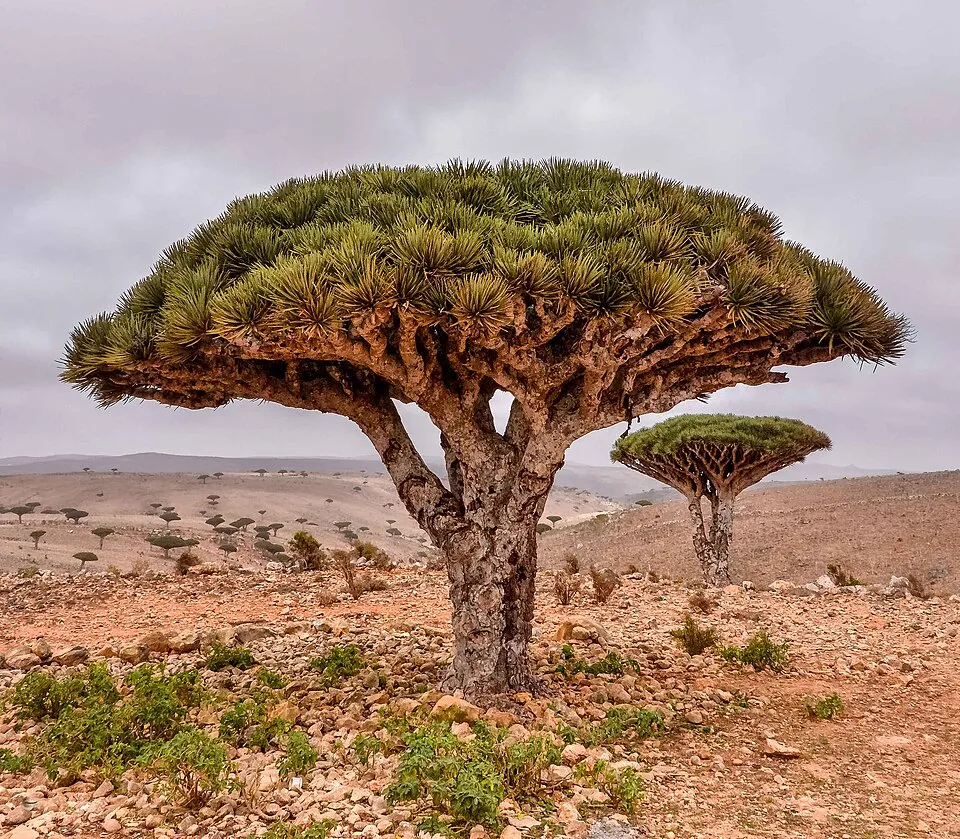
Dracaena cinnabari, popularly known as the Dragon Blood Tree, is an emblematic evergreen species indigenous to the Socotra Archipelago in Yemen. This remarkable tree typically attains heights of 9 to 18 meters (30 to 60 feet), showcasing a truly unique and distinctive umbrella-shaped canopy. This characteristic form is sculpted by its robust, often bifurcating branches, which are initially cloaked in a smooth, greenish bark that progressively develops deep fissures and a rugged texture with increasing age. The leaves of Dracaena cinnabari are rigid, sword-shaped, measuring approximately 60 to 80 cm in length, and exhibit a lustrous, dark green hue. This morphology is a critical adaptation for efficiently capturing scarce sunlight and minimizing water loss in the arid, high-altitude conditions of its native habitat, often found between 323 and 1483 meters above sea level.
Leaves are found exclusively at the tips of the youngest branches and are shed every three to four years, coinciding with the maturation of new foliage, a growth habit known as 'dracoid habitus.' The tree's small, inconspicuous flowers, which can be white or greenish, are borne in dense terminal clusters or racemes. These blossoms eventually give way to small, fleshy, berry-like fruits. Initially green, these fruits mature to a vibrant orange-red, each typically containing one to four seeds, with an average weight of 68 mg and a diameter of 4 to 5 mm. It is the tree's striking crimson sap, known as Dragon's Blood, that truly defines its common name. This deep red resinous exudate flows readily when the bark is incised or the tree is injured, acting as a potent natural defense mechanism against herbivores and pathogens.
This resilient species thrives predominantly in the limestone and volcanic soils prevalent across the central and eastern highlands of Socotra Island. Taxonomically, Dracaena cinnabari belongs to the family Asparagaceae, a classification that underscores its evolutionary relationships with a diverse array of both ornamental and other medicinally significant plants. While historically placed in Agavaceae, modern phylogenetic studies confirm its current placement. Unfortunately, this iconic species is listed as vulnerable by the International Union for Conservation of Nature (IUCN) Red List, primarily due to habitat degradation and limited regeneration. Its current distribution in Yemen covers only about 5% of its potential historical habitat, making conservation efforts param ...[CURRENT TEXT EXISTS: 3019 chars]
1.1.Dragon Blood Tree — Defining Traits
- ✓Umbrella — shaped Canopy — A highly distinctive, dense, and rounded crown that spreads wide, providing shade and unique aesthetics.
- ✓Red Sap Exudate — Produces a deep crimson resin, known as Dragon's Blood, upon injury, which is its most famous characteristic.
- ✓Sword — shaped Leaves — Robust, glossy green, linear to lanceolate leaves clustered at the branch tips, adapted for arid conditions.
- ✓Endemic to Socotra — Exclusively found in the Socotra Archipelago, making it a unique and geographically significant species.
- ✓Drought Adaptations — Features thick, waxy leaves and a compact growth form to minimize water loss in its arid habitat.
- ✓Slow — growing & Long-lived — A very slow-growing tree with an exceptionally long lifespan, contributing to its ancient appearance.
- ✓Vulnerable Species Status — Listed by IUCN as vulnerable, highlighting its conservation importance due to habitat loss and limited regeneration.
- ✓Rich Phytochemistry — Contains a complex profile of flavonoids, chalcones, and other phenolic compounds responsible for its medicinal properties.
- ✓Traditional Medicinal Use — Historically utilized across various traditional systems for wound healing, anti-inflammatory, and digestive benefits.
- ✓Unique Bark Texture — Smooth green bark on young branches that becomes deeply fissured and rough with age.
- ✓Berry — like Fruits — Produces small, orange-red, fleshy berries containing 1-4 seeds, attractive to local wildlife.
- ✓High — Altitude Habitat — Thrives in mountainous and highland regions of Socotra, often above 300 meters above sea level.
- ✓'Dracoid Habitus' — Exhibits a distinctive growth pattern where leaves are shed every few years before new ones mature simultaneously.
- ✓Cultural Significance — Known locally as 'Dam Alakhwin' and historically used as a dye and art pigment.
1.2.Dragon Blood Tree — In Brief
- ✓Iconic Tree — Dracaena cinnabari is famous for its unique umbrella-shaped canopy and red sap.
- ✓Dragon's Blood Resin — The deep red resin is the primary medicinal component, known as 'Dragon's Blood'.
- ✓Potent Wound Healer — Traditionally prized for its exceptional ability to heal wounds and regenerate skin.
- ✓Anti-inflammatory & Antioxidant — Rich in flavonoids and phenolics, offering strong anti-inflammatory and free-radical scavenging benefits.
- ✓Traditional Medicine Staple — Used in Ayurvedic, TCM, and local Socotran folk medicine for diverse ailments.
- ✓Socotra Endemic & Vulnerable — Native to Socotra Island, Yemen, and listed as a vulnerable species requiring conservation.
- ✓Diverse Phytochemistry — Contains a complex array of flavonoids, chalcones, triterpenoids, and other bioactive compounds.
- ✓Caution for Internal Use — While topical use is common, internal ingestion requires careful dosing and professional guidance due to potential side effects.
2.Dragon Blood Tree — Systematic Position
3.Dragon Blood Tree — Quick Facts
4.Dragon Blood Tree — Structural Profile
5.Dragon Blood Tree — Where It Grows
6.Dragon Blood Tree — Cultural & Traditional Roles
7.Dragon Blood Tree — Secondary Metabolites
- ✓Flavonoids — This broad category includes numerous compounds such as 7,4′-dihydroxy-3′-methoxyflavan, 7,3′-dihydroxy-4′-methoxyflavan, 7,4′-dihydroxyflavone, and 7-hydroxyflavan-4-one. These compounds are largely responsible for the resin's potent antioxidant, anti-inflammatory, and antimicrobial activities.
- ✓Biflavonoids — A significant subgroup of flavonoids, biflavonoids are formed from two flavonoid units. Cinnabarone is a key biflavonoid identified in Dracaena cinnabari, contributing to its unique pharmacological profile, particularly in wound healing and anti-inflammatory processes.
- ✓Triflavonoids — These complex compounds consist of three flavonoid units linked together, further enhancing the resin's antioxidant and protective effects within biological systems.
- ✓Chalcones — Compounds like 4,4′-dihydroxy-2′-methoxychalcone are present, known for their anti-inflammatory, antioxidant, and potentially anti-cancer properties. They are precursors to flavonoids and contribute to the resin's vibrant color.
- ✓Chalcanes — Structurally related to chalcones but with a saturated carbon backbone, these compounds also exhibit various biological activities, including anti-inflammatory and antioxidant effects.
- ✓Dihydrochalcones — Examples include 4-hydroxy-2-methoxydihydrochalcone and 4,4′-dihydroxy-2-methoxydihydrochalcone. These compounds are part of the broader chalcone family and contribute to the resin's protective actions against oxidative stress and inflammation.
- ✓Metacyclophanes — These are cyclic aromatic compounds with unique structural features, which may contribute to the resin's diverse biological activities, though their specific pharmacological roles are still under investigation.
- ✓Sterols — Including phytosterols, these compounds are plant-derived steroids that can have cholesterol-lowering effects and anti-inflammatory properties. They play a role in membrane fluidity and cell signaling.
- ✓Triterpenoids — A diverse group of compounds with various pharmacological actions, including anti-inflammatory, hepatoprotective, and adaptogenic effects. They contribute to the resin's overall therapeutic versatility.
- ✓Saponins — These glycosides are known for their detergent-like properties and can exhibit immunomodulatory, anti-inflammatory, and antimicrobial activities, often forming a protective lather in traditional preparations.
- ✓Phenolic Compounds (General) — Beyond specific flavonoids, the resin contains a wide array of other phenolic compounds, which collectively contribute to its robust antioxidant capacity, crucial for cell protection and anti-aging effects.
- ✓Cinnamoyl Derivatives — While not explicitly listed as a category, the name 'cinnabari' hints at potential cinnamoyl-related structures or derivatives, which are often associated with anti-inflammatory and antimicrobial properties in other plants.
8.Dragon Blood Tree — Modern Studies
- ✓Potent Wound Healing — Dragon's Blood resin has been extensively utilized in traditional medicine for its remarkable ability to accelerate wound closure. Its rich content of proanthocyanidins and phenolic compounds stimulates collagen synthesis and promotes angiogenesis, leading to faster tissue regeneration and reduced scarring.
- ✓Anti-inflammatory Action — The resin exhibits significant anti-inflammatory properties, attributed to its diverse array of flavonoids and triterpenoids. It helps to alleviate pain and swelling associated with various inflammatory conditions, both internally and externally, making it valuable in treating skin irritations, joint pain, and gastrointestinal inflammation.
- ✓Antimicrobial Efficacy — With a broad spectrum of antimicrobial activity, Dragon's Blood is effective against various bacteria, fungi, and potentially some parasites. Its natural antiseptic qualities make it a traditional remedy for preventing infection in open wounds, treating skin infections, and supporting oral hygiene.
- ✓Antioxidant Protection — High concentrations of polyphenols, including flavonoids and chalcones, provide potent antioxidant effects. These compounds neutralize free radicals, protecting cells from oxidative stress and damage, which is crucial for overall health and disease prevention, including anti-aging applications for skin.
- ✓Antidiarrheal Properties — Traditionally used in TCM and other systems, Dracaena cinnabari resin helps to manage diarrhea. Its astringent properties, combined with antimicrobial action, can soothe the intestinal lining, reduce inflammation, and combat pathogenic microorganisms responsible for digestive upset.
- ✓Gastrointestinal Health Support — Beyond diarrhea, the resin is employed to improve overall digestive health. It aids in healing gastric ulcers, protecting the stomach lining, and reducing discomfort associated with various gastrointestinal ailments, thanks to its anti-ulcer and anti-inflammatory compounds.
- ✓Hemostatic Agent — Known to stop bleeding, Dragon's Blood resin has been used to staunch blood flow from minor cuts and abrasions. Its astringent qualities help to constrict blood vessels and promote clot formation, making it a valuable first-aid remedy.
- ✓Analgesic Effects — The resin possesses pain-relieving properties, traditionally applied topically to alleviate localized pain from injuries, sprains, and bruises. This analgesic action is often linked to its anti-inflammatory and nerve-calming constituents.
- ✓Skin Repair and Rejuvenation — Applied topically, Dragon's Blood promotes skin cell turnover and elasticity, aiding in the repair of damaged skin and reducing the appearance of fine lines and wrinkles. It creates a protective barrier, enhancing the skin's natural healing processes and offering a rejuvenating effect.
- ✓Antiviral Potential — Preliminary research suggests that certain compounds within Dragon's Blood resin may possess antiviral activity. While more studies are needed, this indicates potential for its use in combating various viral infections, a promising area for modern pharmaceutical development.
- ✓Anti-ulcer Activity — Constituents like flavonoids contribute to its ability to protect the gastric mucosa and promote the healing of ulcers. This protective effect is mediated by reducing oxidative stress and inflammation in the stomach lining.
- ✓Immune Function Enhancement — By reducing oxidative stress and inflammation, and possessing antimicrobial properties, the resin can indirectly support and enhance the body's natural immune responses, helping it to ward off infections and maintain overall wellness.
- ✓Traditional Treatment for Dental Injuries — In folk medicine, the resin has been applied to treat traumatic dental injuries, likely due to its antiseptic, anti-inflammatory, and wound-healing properties, helping to reduce pain and prevent infection in the oral cavity.
- ✓Management of Blood Stasis — In traditional systems like TCM, Dragon's Blood is used to invigorate blood circulation and resolve blood stasis, which is believed to be a root cause of pain and various circulatory disorders. This supports its use for traumatic injuries and internal discomfort.
- ✓Potential Anti-Tumor Effects — Early in vitro studies have indicated potential anti-tumor activity of certain phytochemicals found in the resin. These effects warrant further investigation to determine their therapeutic relevance in cancer research and treatment.
8.1.Dragon Blood Tree — Indications & Uses
9.Dragon Blood Tree — Risk Profile
9.1.Dragon Blood Tree — Reported Side Effects
- ✓Gastrointestinal Upset — Oral ingestion, especially in higher doses, can lead to stomach discomfort, nausea, vomiting, or constipation due to its astringent nature.
- ✓Allergic Reactions — Some individuals may experience contact dermatitis, skin redness, itching, or swelling when Dragon's Blood resin is applied topically. Patch testing is recommended.
- ✓Liver and Kidney Stress — Prolonged or excessive internal use of Dragon's Blood, particularly unpurified forms, may potentially place undue stress on the liver and kidneys, although specific human data is limited.
- ✓Discoloration of Skin/Clothing — The deep red pigment of the resin can temporarily stain skin and permanently stain clothing, requiring careful handling during preparation and application.
- ✓Blood Pressure Changes — Some traditional texts suggest a potential influence on blood pressure; individuals with pre-existing cardiovascular conditions should exercise caution with internal use.
- ✓Interaction with Medications — Due to its potential effects on blood clotting and inflammation, it may interact with anticoagulant medications or immunosuppressants, increasing their effects or causing adverse reactions.
9.2.Dragon Blood Tree — Clinical Safety Notes
- ✓Drug Interactions — Dragon's Blood resin may interact with anticoagulant and antiplatelet medications (e.g., warfarin, aspirin), potentially increasing the risk of bleeding. It may also interfere with immunosuppressants or drugs metabolized by the liver. Consult a healthcare professional before use, especially if on prescription medication.
- ✓Pregnancy and Lactation Warning — The internal use of Dracaena cinnabari is generally contraindicated during pregnancy and breastfeeding due to insufficient safety data. Its effects on fetal development or transfer into breast milk are unknown.
- ✓Children and Elderly — Internal use in children and the elderly should be approached with extreme caution, preferably under the guidance of a qualified healthcare provider, due to their potentially increased sensitivity and different metabolic capacities.
- ✓Pre-existing Conditions — Individuals with liver disease, kidney impairment, or bleeding disorders should avoid internal use of Dragon's Blood resin. Its use should also be carefully considered for those with gastrointestinal sensitivities.
- ✓Dosage Limitations — Adhere strictly to recommended dosages, particularly for internal consumption. Overdosing can lead to adverse effects, and long-term internal use requires expert supervision.
- ✓Purity and Sourcing — Ensure that any Dragon's Blood product is sourced from reputable suppliers and is free from adulterants, contaminants, or other Dracaena species that may have different chemical profiles and safety concerns.
- ✓Topical vs. Internal Use — While topical application is generally considered safer, ingestion should always be approached with greater caution and professional advice, given the concentration of active compounds and potential systemic effects.
- ✓Allergic Sensitivity — Conduct a patch test on a small area of skin before extensive topical application to check for any allergic reactions or sensitivities.
10.Dragon Blood Tree — Preparation & Dosage
- ✓Topical Application for Wounds — For minor cuts, abrasions, or skin irritations, mix a small amount of powdered Dragon's Blood resin with a carrier oil (like jojoba or coconut oil) or aloe vera gel to form a paste. Apply a thin layer directly to the affected area 1-2 times daily until healed. Do not apply to deep, open wounds without professional guidance.
- ✓Tincture for Internal Use — Prepare a tincture by macerating Dragon's Blood resin in high-proof alcohol for several weeks. For digestive issues like diarrhea or ulcers, a typical dosage might be 5-10 drops of the tincture in water, 2-3 times daily. Consult a qualified herbalist for precise dosing, as internal use requires caution.
- ✓Resin Powder for Diarrhea — In traditional contexts, a small pinch (e.g., 200-500 mg) of finely powdered Dragon's Blood resin can be mixed with water or honey and ingested to alleviate acute diarrhea. This should be a short-term remedy only.
- ✓Decoction for Oral Health — To create a mouthwash for gum inflammation or minor oral sores, simmer a small piece of resin (approx. 1-2 grams) in 250 ml of water for 10-15 minutes, then strain and let cool. Use as a rinse 2-3 times daily. Do not swallow.
- ✓Infused Oil for Skin Conditions — Infuse Dragon's Blood resin into a warm carrier oil (e.g., olive oil, almond oil) over low heat for several hours or days. Strain the oil and use it to massage into areas affected by eczema, psoriasis, or muscle pain. This allows for localized anti-inflammatory and healing benefits.
- ✓Cosmetic Formulations — Dragon's Blood extract or resin powder can be incorporated into homemade or commercial skincare products like serums, creams, and masks. It is valued for its anti-aging, firming, and protective properties. Follow recipe guidelines for safe concentrations.
- ✓Incense for Traditional Rituals — While not directly medicinal, in some cultures, the resin is burned as incense for spiritual purification and to create a calming atmosphere. Ensure good ventilation if used this way.
- ✓Veterinary Topical Use — Historically, Dragon's Blood resin has been applied topically to aid wound healing in animals. Consult a veterinary professional before using it on pets, especially for open wounds or if there's a risk of ingestion.
11.Dragon Blood Tree — Growth Requirements
- ✓Soil Requirements — Dracaena cinnabari thrives in well-draining, gritty, or sandy soil, mimicking its native volcanic and limestone habitats. A mix of cactus/succulent soil with added perlite or pumice is ideal to prevent root rot.
- ✓Watering — As a drought-tolerant species, it requires infrequent watering. Allow the soil to dry out completely between waterings, especially during cooler months. Overwatering is the most common cause of failure.
- ✓Light Exposure — Dragon Blood Trees need abundant bright sunlight. Position them in a location that receives full sun for most of the day, ideally with some protection from the most intense midday sun in extremely hot climates.
- ✓Temperature and Humidity — They prefer warm temperatures, ideally between 20-30°C (68-86°F), and can tolerate high heat. They are not frost-tolerant and require low humidity, typical of arid environments.
- ✓Propagation — Propagation is primarily from seeds, which can be challenging due to low germination rates, or from cuttings of mature branches. Cuttings should be allowed to callus before planting in well-draining soil.
- ✓Fertilization — Fertilize sparingly, if at all. A balanced, slow-release fertilizer at half strength once a year during the growing season (spring/summer) is sufficient. Excessive fertilization can harm the plant.
- ✓Pruning — Minimal pruning is required, mainly to remove dead or diseased branches. Pruning can also be done to shape the canopy, but be aware that cuts will exude the red resin.
- ✓Pests and Diseases — Generally resistant to most pests and diseases due to its hardy nature. Watch for common houseplant pests like spider mites or mealybugs if grown indoors, and ensure good air circulation to prevent fungal issues.
- ✓Container Growing — Younger plants can be grown in large containers with appropriate drainage. As they mature, their size may necessitate outdoor planting in suitable climates or specialized care.
- ✓Conservation Status — Due to its vulnerable status, responsible cultivation practices are crucial. Sourcing from reputable nurseries that engage in sustainable practices is highly recommended to avoid contributing to wild harvesting pressures.
Reviewed by the Flora Medical Global Botanical Review Panel
Multi-disciplinary editorial group · Botany · Ethnobotany · Herbal-medicine literature
Who reviewed this: This page was checked by the Flora Medical Global Botanical Review Panel — an in-house editorial group of botany graduates, ethnobotany researchers, and horticulture practitioners who collectively maintain our 7,000+ plant encyclopedia. Meet the team.
Our 4-step verification process
1. Taxonomic verification
Scientific names and synonyms cross-checked against Kew POWO, World Flora Online, and The Plant List.
2. Phytochemical & medicinal cross-reference
Active compounds, traditional uses, and reported activities are cross-referenced with PubMed, USDA Dr. Duke's database, and peer-reviewed ethnobotanical literature.
3. Conservation & distribution check
Distribution, ecology, and conservation status confirmed against GBIF occurrence records and the IUCN Red List.
4. Editorial & safety review
Every entry passes an editorial pass for clarity, originality, and safety notices (toxicity, contraindications, dosage caveats) before publication.
Last reviewed:
Important medical disclaimer: This content is for educational and research purposes only. It is not medical advice and is not a substitute for consultation with a licensed healthcare provider. Do not use any herb to self-treat a medical condition without professional guidance.
Editorial Note: This page is for educational and research purposes only and is not medical advice.
Written by: Flora Medical Global Editorial Team
Reviewed by: Flora Medical Global Botanical Review Panel
Last Updated: June 16, 2026





Dragon Blood Tree — Comments & Community Reviews
Rate this plant