
Medical Disclaimer: This content is for educational purposes only. It is not medical advice. Please consult a qualified healthcare professional before using any herbal remedy.
Safety Overview
1.Gambir — Botanical Snapshot
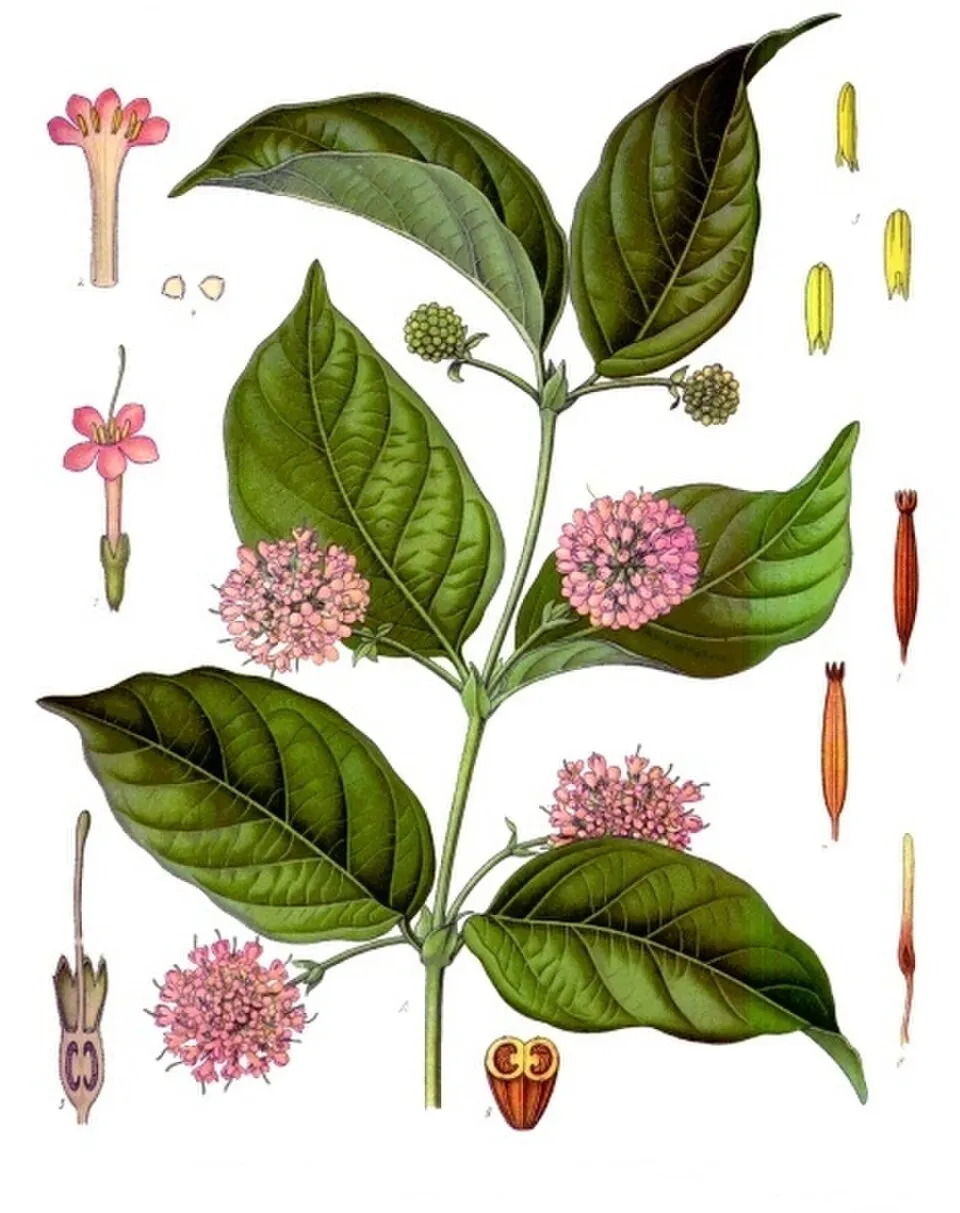
Uncaria gambir, commonly known as Gambir, is a robust perennial shrub belonging to the Rubiaceae family, a diverse group renowned for its medicinally active species. This plant typically grows to heights of 1 to 3 meters, thriving in the warm, humid climates of tropical Southeast Asia, specifically being native to Indonesia, Malaysia, and parts of Thailand.
It is commonly found flourishing in rainforest ecosystems and on steep slopes, often at altitudes ranging between 200 and 800 meters above sea level.
The morphology of Uncaria gambir is characterized by its opposite, simple leaves, which are ovate to oblong in shape, measuring approximately 10–15 cm in length and 5–8 cm in width. These leaves possess a distinctive glossy dark green color with entire margins and slightly elongated petioles, contributing to their visual appeal. Gambir produces charming clusters of small, tubular flowers, predominantly yellow to orange in hue, which emerge from the axils of the leaves.
Each flower is about 2.5 cm long and exhibits a unique five-lobed corolla, attracting a variety of pollinators. The plant’s bark is smooth, varying in color from light brown to a reddish-brown, and has a mildly fibrous texture. Notably, the stems of Uncaria gambir contain a yellowish sap, which is the primary part harvested for its significant astringent properties, forming the basis of its traditional and modern applications.
Its cultivation is often integrated into sustainable agroforestry practices within its native range, providing both ecological benefits and a valuable resource for local communities.
Trusted Scientific References
1. Authoritative external sources for Uncaria gambir
1.1 Wikipedia — Uncaria gambir
1.2 Kew POWO (Plants of the World Online)
1.3 PubMed — peer-reviewed research
1.4 NCBI Taxonomy Browser
1.5 GBIF — Global Biodiversity
1.6Gambir should be interpreted through verified botanical identity, practical care, and responsible safety language. This recovery note adds the missing context needed for a complete profile: match light to the plant's habit, use well-drained soil, water according to season, and avoid unsupported medicinal or edible claims. For publishing, the plant can be presented as a source-backed medicinal plant with clear care guidance, common problem diagnosis, and conservative safety wording.
1.1.Gambir — Distinguishing Points
- ✓Native to Southeast — Native to Southeast Asia, particularly Indonesia and Malaysia.
- ✓A perennial shrub growing 1 — 3 meters tall with glossy dark green leaves.
- ✓Contains high concentrations — Contains high concentrations of catechins, including (+)-catechin and (-)-epicatechin.
- ✓Renowned for its — Renowned for its strong astringent, antioxidant, and anti-inflammatory properties.
- ✓Traditionally employed for — Traditionally employed for treating diarrhea, gum inflammation, and skin ailments.
- ✓Plays a significant — Plays a significant role in traditional medicine systems like Ayurveda and local Southeast Asian practices.
- ✓Cultivated through agroforestry, — Cultivated through agroforestry, supporting local economies and ecosystems.
- ✓Exhibits antimicrobial, anti — hyperglycemic, and anti-hyperuricemic potential in research.
- ✓The yellowish sap — The yellowish sap from its stems and leaves is the primary source of medicinal extract.
- ✓A valuable botanical — A valuable botanical with prospects for pharmaceutical development and diverse therapeutic applications.
1.2.Gambir — Concise Overview
- ✓Uncaria gambir is a Southeast Asian shrub from the Rubiaceae family, valued for its medicinal properties.
- ✓Rich in catechins, flavonoids, and alkaloids, it exhibits potent astringent, antioxidant, and anti-inflammatory activities.
- ✓Traditionally used for digestive issues, oral health, and wound healing, it is a staple in regional herbal medicine.
- ✓Modern research explores its potential in managing conditions like hyperglycemia, hyperuricemia, and microbial infections.
- ✓Indonesia is a major global supplier of Gambir, highlighting its economic and cultural significance.
- ✓Always exercise caution and consult a healthcare professional before use due to potential side effects and interactions.
2.Gambir — Scientific Identity
3.Gambir — Key Data
4.Gambir — Botanical Description
5.Gambir — Origin & Spread
6.Gambir — Heritage Uses
7.Gambir — Phytochemistry
- ✓Catechins — These are the primary active compounds in Uncaria gambir, notably (+)-catechin and (-)-epicatechin, responsible for its potent astringent, antioxidant, and anti-inflammatory actions.
- ✓Flavonoids — Gambir contains various flavonoids such as quercetin and kaempferol derivatives, contributing significantly to its antioxidant, anti-inflammatory, and potential anti-hyperglycemic activities.
- ✓Alkaloids — The plant contains indole alkaloids, though in smaller quantities compared to other Uncaria species, which may contribute to its diverse pharmacological profile.
- ✓Phenolic Acids — Compounds like gallic acid and ellagic acid are present, enhancing the overall antioxidant capacity and contributing to astringent effects.
- ✓Tannins — A broader category of polyphenols that includes catechins, providing strong astringent properties crucial for its traditional use in treating diarrhea and gum inflammation.
- ✓Proanthocyanidins — These oligomeric and polymeric flavonoids contribute to the plant's antioxidant and cardiovascular protective effects.
- ✓Triterpenoids — Though less prominent, these compounds can offer anti-inflammatory and adaptogenic properties.
- ✓Glycosides — Various glycosides may be present, contributing to different biological activities and enhancing the bioavailability of other compounds.
8.Gambir — Scientific Evidence
- ✓Astringent Properties — Gambir's high catechin content makes it a potent astringent, effective in constricting tissues and reducing secretions, beneficial for conditions like diarrhea and excessive fluid loss.
- ✓Antioxidant Activity — Rich in flavonoids and phenolic compounds, Uncaria gambir exhibits strong antioxidant capabilities, helping to neutralize free radicals and protect cells from oxidative damage.
- ✓Anti-inflammatory Effects — Studies suggest Gambir can modulate inflammatory pathways, offering relief from inflammation, which is useful in conditions ranging from gum disease to systemic inflammation.
- ✓Antimicrobial Action — Extracts of Gambir have demonstrated antibacterial and antifungal properties, aiding in the combat against various pathogens and supporting overall microbial balance.
- ✓Digestive Support — Traditionally used to alleviate digestive issues, Gambir helps tone the bowel and reduce symptoms of stomach ache, dysentery, and other gastrointestinal disturbances.
- ✓Oral Health Enhancement — Its astringent and antimicrobial qualities make it excellent for oral care, reducing gum inflammation, treating oral ulcers, and alleviating tooth pain.
- ✓Anti-hyperglycemic Potential — Research indicates that Gambir may possess anti-diabetic properties, potentially helping to regulate blood sugar levels, though more human studies are needed.
- ✓Anti-hyperuricemic Benefits — Some evidence suggests Gambir can help reduce elevated uric acid levels, which could be beneficial in managing conditions like gout.
- ✓Wound Healing — Applied topically, Gambir's astringent and antimicrobial properties can promote the healing of wounds and ulcers by tightening tissues and preventing infection.
- ✓Anti-lipid Peroxidation — Gambir compounds can inhibit lipid peroxidation, a process that damages cell membranes, contributing to its overall protective effects on cardiovascular health.
8.1.Gambir — Therapeutic Indications
9.Gambir — Safety Considerations
9.1.Gambir — Reported Side Effects
- ✓Constipation — Excessive or prolonged use due to its potent astringent properties can lead to constipation.
- ✓Digestive Upset — In sensitive individuals, high doses may cause mild stomach discomfort or nausea.
- ✓Allergic Reactions — Rare instances of allergic reactions, such as skin rash or itching, may occur.
- ✓Drug Interactions — Potential to interact with medications, especially those affecting blood clotting or gastrointestinal motility.
- ✓Liver/Kidney Stress — Theoretical risk with very high, prolonged doses, as with many highly concentrated herbal extracts.
- ✓Dry Mouth — Astringent action can lead to a sensation of dryness in the mouth when used as an oral rinse.
9.2.Gambir — Risk Assessment
- ✓Consult Healthcare Provider — Always seek advice from a qualified healthcare professional before using Gambir, especially if pregnant, breastfeeding, or on medication.
- ✓Pregnancy and Lactation — Avoid use during pregnancy and lactation due to insufficient safety data.
- ✓Dosage Adherence — Strictly adhere to recommended dosages and duration of use to prevent adverse effects.
- ✓Monitor for Allergic Reactions — Discontinue use immediately if any signs of allergic reaction appear.
- ✓Not for Long-Term Unsupervised Use — Best used for acute conditions under professional guidance rather than prolonged self-medication.
- ✓Quality Sourcing — Ensure Gambir products are sourced from reputable suppliers to guarantee purity and prevent contamination.
- ✓Children — Use in children should be under strict medical supervision due to limited safety data.
10.Gambir — Usage Guide
- ✓Oral Decoction — Leaves and young twigs can be boiled to create a decoction, traditionally consumed for digestive issues like diarrhea and dysentery.
- ✓Topical Paste/Poultice — Ground Gambir extract mixed with water can be applied as a paste to wounds, ulcers, and skin inflammations for its healing and astringent effects.
- ✓Mouthwash/Gargle — A diluted infusion or extract is used as a mouthwash to reduce gum inflammation, treat oral ulcers, and alleviate sore throat.
- ✓Standardized Extract — Modern applications often use standardized Gambir extracts, available in capsule or tablet form, for precise dosing of active compounds.
- ✓Tincture — An alcoholic extract of Gambir can be prepared, offering a concentrated form for internal or external use, dosed in drops.
- ✓Chewing Quid Component — In some traditional cultures, Gambir is a component of betel quid, chewed for its stimulating and oral health benefits.
- ✓Powdered Form — Dried and powdered Gambir can be encapsulated or mixed with other herbs for various traditional remedies.
- ✓Infusion — Dried leaves and stems steeped in hot water can create a milder infusion, suitable for regular consumption.
11.Gambir — Garden Cultivation
- ✓Soil Preference — Thrives in well-drained, moist soils rich in organic matter, ideally with a slightly acidic to neutral pH.
- ✓Light Requirements — Prefers partial to full sun exposure for optimal growth and production of active compounds.
- ✓Climate — Requires a tropical to subtropical climate with consistent warmth and high humidity, typical of its native Southeast Asian habitat.
- ✓Propagation — Primarily propagated through stem cuttings, which ensure genetic consistency, though seed propagation is also possible.
- ✓Watering — Needs regular and consistent watering, especially during dry periods, to maintain soil moisture without becoming waterlogged.
- ✓Pruning — Regular pruning helps maintain plant shape, encourages bushier growth, and facilitates easier harvesting of leaves and young stems.
- ✓Harvesting — Leaves and young stems, particularly those with a yellowish sap, are typically harvested, often before flowering, for maximum catechin content.
- ✓Altitude — Best grown at altitudes between 200 and 800 meters above sea level, mimicking its natural ecological niche.
Reviewed by the Flora Medical Global Botanical Review Panel
Multi-disciplinary editorial group · Botany · Ethnobotany · Herbal-medicine literature
Who reviewed this: This page was checked by the Flora Medical Global Botanical Review Panel — an in-house editorial group of botany graduates, ethnobotany researchers, and horticulture practitioners who collectively maintain our 7,000+ plant encyclopedia. Meet the team.
Our 4-step verification process
1. Taxonomic verification
Scientific names and synonyms cross-checked against Kew POWO, World Flora Online, and The Plant List.
2. Phytochemical & medicinal cross-reference
Active compounds, traditional uses, and reported activities are cross-referenced with PubMed, USDA Dr. Duke's database, and peer-reviewed ethnobotanical literature.
3. Conservation & distribution check
Distribution, ecology, and conservation status confirmed against GBIF occurrence records and the IUCN Red List.
4. Editorial & safety review
Every entry passes an editorial pass for clarity, originality, and safety notices (toxicity, contraindications, dosage caveats) before publication.
Last reviewed:
Important medical disclaimer: This content is for educational and research purposes only. It is not medical advice and is not a substitute for consultation with a licensed healthcare provider. Do not use any herb to self-treat a medical condition without professional guidance.
Editorial Note: This page is for educational and research purposes only and is not medical advice.
Written by: Flora Medical Global Editorial Team
Reviewed by: Flora Medical Global Botanical Review Panel
Last Updated: June 16, 2026





Gambir — Comments & Community Reviews
Rate this plant