
Medical Disclaimer: This content is for educational purposes only. It is not medical advice. Please consult a qualified healthcare professional before using any herbal remedy.
Safety Overview
1.Marshmallow — Plant Snapshot
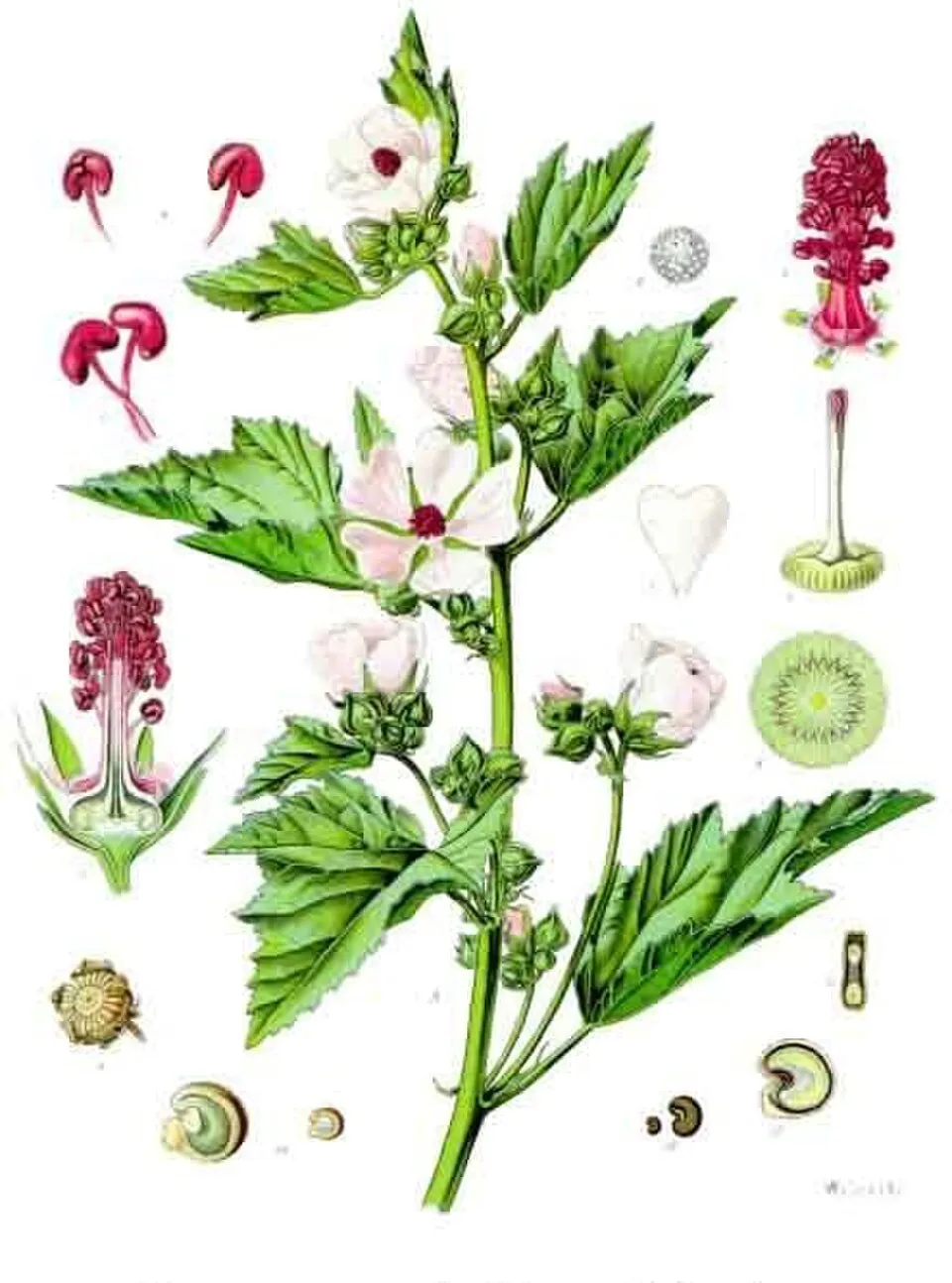
Althaea officinalis, commonly known as marshmallow, is a robust perennial herb belonging to the Malvaceae family, distinguished by its velvety foliage and delicate pale flowers. This resilient plant thrives in moist, saline soils characteristic of marshlands, riverbanks, and coastal areas across its native range, which spans Europe, Western Asia, and North Africa. Typically reaching heights of 1 to 2 meters, marshmallow exhibits a sturdy, erect stem often branching towards the top. Its leaves are broadly ovate to heart-shaped, featuring a soft, downy texture due to stellate hairs, and can measure up to 15 cm in length.
From early summer through autumn (June to September), the plant produces charming pale pink to white flowers, arranged in axillary clusters, adding to its understated beauty. The most pharmacologically significant part is its thick, fleshy taproot, which is rich in mucilaginous compounds. The genus name 'Althaea' is derived from the Greek word 'altho,' meaning 'to heal,' a testament to its ancient and enduring therapeutic reputation. Historical records indicate its use by ancient Egyptians for soothing respiratory ailments and by Romans for skin irritations.
Prominent figures like Dioscorides and Pliny the Elder documented its utility for coughs, digestive complaints, and wound care. During the medieval period, marshmallow became a cornerstone in monastic herb gardens, valued for its efficacy in treating respiratory and gastrointestinal discomforts. Beyond its medicinal applications, the candied root once served as a traditional sweetmeat, a precursor to the modern confectionery. The plant's ecological adaptability also renders it valuable in wetland restoration projects, underscoring its multifaceted importance.
Trusted Scientific References
1. Authoritative external sources for Althaea officinalis
1.1 Wikipedia — Althaea officinalis
1.2 Kew POWO (Plants of the World Online)
1.3 PubMed — peer-reviewed research
1.4 NCBI Taxonomy Browser
1.5 GBIF — Global Biodiversity
1.6Marshmallow should be interpreted through verified botanical identity, practical care, and responsible safety language. This recovery note adds the missing context needed for a complete profile: match light to the plant's habit, use well-drained soil, water according to season, and avoid unsupported medicinal or edible claims. For publishing, the plant can be presented as a source-backed medicinal plant with clear care guidance, common problem diagnosis, and conservative safety wording.
1.1.Marshmallow — Key Features
- ✓Botanical Name — Althaea officinalis, belonging to the Malvaceae family.
- ✓Common Names — Marshmallow, White Mallow, Common Mallow, Mortification Root.
- ✓Primary Medicinal Part — The root, known for its high mucilage content.
- ✓Key Action — Demulcent, forming a protective layer over mucous membranes.
- ✓Traditional Uses — Widely used in European, Arabic, and Ayurvedic medicine.
- ✓Habitat — Thrives in damp, marshy environments across Europe, Asia, and North Africa.
- ✓Morphological Characteristics — Tall perennial with soft, velvety leaves and pale pink-white flowers.
- ✓Digestive Health — Supports gut lining integrity and soothes irritation from conditions like ulcers and IBS.
- ✓Respiratory Health — Effective for soothing coughs, sore throats, and bronchial irritation.
- ✓Topical Application — Used for skin inflammation, minor wounds, and burns.
1.2.Marshmallow — Concise Overview
- ✓Ancient Healing Herb — Marshmallow has a long history of use in traditional medicine for its soothing properties.
- ✓Rich in Mucilage — Its primary active component, mucilage, provides demulcent and protective effects.
- ✓Respiratory and Digestive Aid — Highly valued for alleviating coughs, sore throats, gastritis, and other mucosal irritations.
- ✓Topical Skin Soother — Effective in poultices and washes for skin inflammation, wounds, and burns.
- ✓Potential Drug Interactions — Can interfere with the absorption of oral medications; take separately.
- ✓Generally Safe — Considered safe for most when used appropriately, but precautions apply for specific conditions.
2.Marshmallow — Taxonomic Classification
3.Marshmallow — Botanical Stats
4.Marshmallow — Structural Profile
5.Marshmallow — Where It Grows
6.Marshmallow — Ethnobotanical Uses
7.Marshmallow — Active Compounds
- ✓Mucilage Polysaccharides — Primarily composed of rhamnogalacturonans, arabinogalactans, and glucuronic acid, responsible for the plant's characteristic demulcent and soothing properties.
- ✓Flavonoids — Includes compounds like kaempferol, quercetin, and their glycosides, contributing to antioxidant and anti-inflammatory activities.
- ✓Phenolic Acids — Such as caffeic acid, ferulic acid, p-coumaric acid, and their derivatives, which possess antioxidant and antimicrobial properties.
- ✓Coumarins — Furanocoumarins and simple coumarins are present, offering potential anti-inflammatory and antiseptic effects.
- ✓Tannins — Found in lesser amounts, contributing astringent properties that can help tighten tissues and reduce inflammation.
- ✓Asparagine — An amino acid present in the root, which may contribute to its nutritive value and overall therapeutic profile.
- ✓Pectins — A type of soluble fiber, contributing to the demulcent and digestive regulatory actions.
- ✓Mineral Salts — Rich in various essential minerals, including calcium, magnesium, and iron, supporting overall physiological functions.
- ✓Sterols — Such as beta-sitosterol, which may offer anti-inflammatory and immune-modulating effects.
- ✓Volatile Oil — Present in small quantities, contributing to the plant's subtle aroma and possibly some antiseptic qualities.
8.Marshmallow — Modern Studies
- ✓Demulcent Action — Marshmallow root and leaf are rich in mucilage, forming a protective, soothing layer over irritated mucous membranes in the respiratory, digestive, and urinary tracts.
- ✓Soothing Respiratory Irritation — Traditionally used to alleviate dry coughs, sore throats, and bronchitis by coating the throat and reducing irritation.
- ✓Digestive System Support — Helps calm inflammation and irritation in the gastrointestinal tract, beneficial for conditions like gastritis, peptic ulcers, and irritable bowel syndrome (IBS).
- ✓Constipation Relief — The mucilage acts as a bulk-forming laxative, promoting regular bowel movements and easing constipation without harsh stimulation.
- ✓Diarrhea Management — Can help normalize stool consistency and soothe an inflamed gut lining during episodes of diarrhea.
- ✓Skin Healing and Protection — Applied topically, it can reduce inflammation, soothe skin irritations, minor burns, insect bites, and promote wound healing due to its emollient properties.
- ✓Anti-inflammatory Properties — Contains compounds that may help reduce inflammation internally and externally, contributing to its broad therapeutic effects.
- ✓Mild Immunomodulatory Effects — Some polysaccharide components may subtly influence immune responses, supporting overall health.
- ✓Urinary Tract Soothing — Its demulcent action can help soothe irritation in the urinary tract, potentially beneficial for conditions like cystitis.
- ✓Antioxidant Activity — Contains flavonoids and phenolic acids which contribute to its antioxidant capacity, protecting cells from oxidative damage.
8.1.Marshmallow — Reported Uses
9.Marshmallow — Adverse Effects
9.1.Marshmallow — Warnings
- ✓Decreased Drug Absorption — Marshmallow's mucilage can form a barrier, potentially reducing the absorption of orally administered medications. Take marshmallow at least one hour after other oral drugs.
- ✓Bleeding Risk — Some constituents, particularly in the flower, might slow blood clotting. Individuals with bleeding disorders or those on anticoagulant medications should use with caution.
- ✓Hypoglycemia — While not a primary concern, some studies suggest a potential for mild blood sugar lowering effects. Diabetics should monitor blood glucose levels.
- ✓Allergic Reactions — Although rare, individuals sensitive to plants in the Malvaceae family may experience allergic reactions, such as skin rash or respiratory symptoms.
- ✓Digestive Upset — In some sensitive individuals, high doses might cause mild gastrointestinal discomfort, such as bloating or gas.
- ✓Surgical Bleeding — Due to potential blood-thinning effects, discontinue marshmallow use at least two weeks before any scheduled surgery.
9.2.Marshmallow — Clinical Safety Notes
- ✓Pregnancy and Breastfeeding — Insufficient reliable information exists regarding the safety of marshmallow in medicinal amounts during pregnancy and breastfeeding. It is advisable to stick to food amounts or avoid.
- ✓Bleeding Disorders — Marshmallow may slow blood clotting, increasing the risk of bleeding. Individuals with bleeding disorders or those undergoing surgery should exercise caution or avoid.
- ✓Diabetes — While not a strong effect, some evidence suggests marshmallow might slightly lower blood sugar. Diabetics should monitor blood glucose levels closely if using therapeutically.
- ✓Medication Interactions — Due to its mucilage content, marshmallow can interfere with the absorption of orally taken medications. Administer marshmallow at least one hour after other oral drugs.
- ✓Surgery — Discontinue use of marshmallow at least two weeks prior to any scheduled surgical procedure to minimize the risk of increased bleeding.
- ✓General Safety — Marshmallow root and leaf are generally considered safe when consumed in amounts found in foods or in larger medicinal doses, though flower safety is less established.
- ✓Children — While often used in children for coughs and sore throats, always consult a healthcare professional for appropriate dosing and safety for pediatric use.
10.Marshmallow — How to Use
- ✓Herbal Infusion (Tea) — Steep 1-2 teaspoons of dried marshmallow root or leaf in a cup of cold water for several hours (cold infusion) or hot water for 10-15 minutes (hot infusion) to extract mucilage. Drink 2-3 times daily.
- ✓Decoction — Simmer 1 tablespoon of dried, cut marshmallow root in 2 cups of water for 15-20 minutes, then strain. This method is better for extracting more active compounds from the root.
- ✓Syrup — Combine a strong marshmallow decoction with honey or glycerin to create a soothing syrup for coughs and sore throats.
- ✓Poultice — Mix powdered marshmallow root with a small amount of warm water to form a paste, apply directly to skin irritations, minor wounds, or boils, and cover with a clean cloth.
- ✓Tincture — Prepare by macerating dried marshmallow root in alcohol (e.g., 25-45% ethanol) for several weeks, then straining. Dosage typically involves drops diluted in water.
- ✓Glycerite — An alcohol-free alternative to tinctures, where marshmallow root is extracted in vegetable glycerin, suitable for children or those avoiding alcohol.
- ✓Topical Wash or Compress — Use a cooled infusion or decoction as a wash for irritated skin, or soak a cloth in it to create a soothing compress.
- ✓Culinary Use — Historically, the root was boiled and fried or candied; modern use is primarily medicinal, though young leaves can be added to salads.
11.Marshmallow — Growth Requirements
- ✓Site Selection — Prefers full sun to partial shade and consistently moist, well-drained soil, ideally in a marshy or riverside environment.
- ✓Soil Preparation — Thrives in deep, rich, fertile loamy soil with a neutral to slightly alkaline pH (6.0-8.0), enriched with compost.
- ✓Propagation — Can be propagated from seeds, root divisions, or stem cuttings. Seeds should be stratified for best germination.
- ✓Planting — Sow seeds directly in spring after the last frost or start indoors. Plant root divisions in early spring or autumn.
- ✓Watering — Requires consistent moisture, especially during dry periods; avoid letting the soil dry out completely.
- ✓Fertilization — Benefits from a balanced organic fertilizer applied in spring, particularly if soil fertility is low.
- ✓Pest and Disease Control — Generally hardy, but monitor for rust, slugs, and snails; employ organic pest management practices.
- ✓Harvesting — Roots are typically harvested in autumn of the second or third year for maximum mucilage content, leaves and flowers can be harvested as needed.
Reviewed by the Flora Medical Global Botanical Review Panel
Multi-disciplinary editorial group · Botany · Ethnobotany · Herbal-medicine literature
Who reviewed this: This page was checked by the Flora Medical Global Botanical Review Panel — an in-house editorial group of botany graduates, ethnobotany researchers, and horticulture practitioners who collectively maintain our 7,000+ plant encyclopedia. Meet the team.
Our 4-step verification process
1. Taxonomic verification
Scientific names and synonyms cross-checked against Kew POWO, World Flora Online, and The Plant List.
2. Phytochemical & medicinal cross-reference
Active compounds, traditional uses, and reported activities are cross-referenced with PubMed, USDA Dr. Duke's database, and peer-reviewed ethnobotanical literature.
3. Conservation & distribution check
Distribution, ecology, and conservation status confirmed against GBIF occurrence records and the IUCN Red List.
4. Editorial & safety review
Every entry passes an editorial pass for clarity, originality, and safety notices (toxicity, contraindications, dosage caveats) before publication.
Last reviewed:
Important medical disclaimer: This content is for educational and research purposes only. It is not medical advice and is not a substitute for consultation with a licensed healthcare provider. Do not use any herb to self-treat a medical condition without professional guidance.
Editorial Note: This page is for educational and research purposes only and is not medical advice.
Written by: Flora Medical Global Editorial Team
Reviewed by: Flora Medical Global Botanical Review Panel
Last Updated: June 16, 2026





Marshmallow — Comments & Community Reviews
Rate this plant