
Medical Disclaimer: This content is for educational purposes only. It is not medical advice. Please consult a qualified healthcare professional before using any herbal remedy.
Safety Overview
1.Mexican Poppy — Plant Snapshot
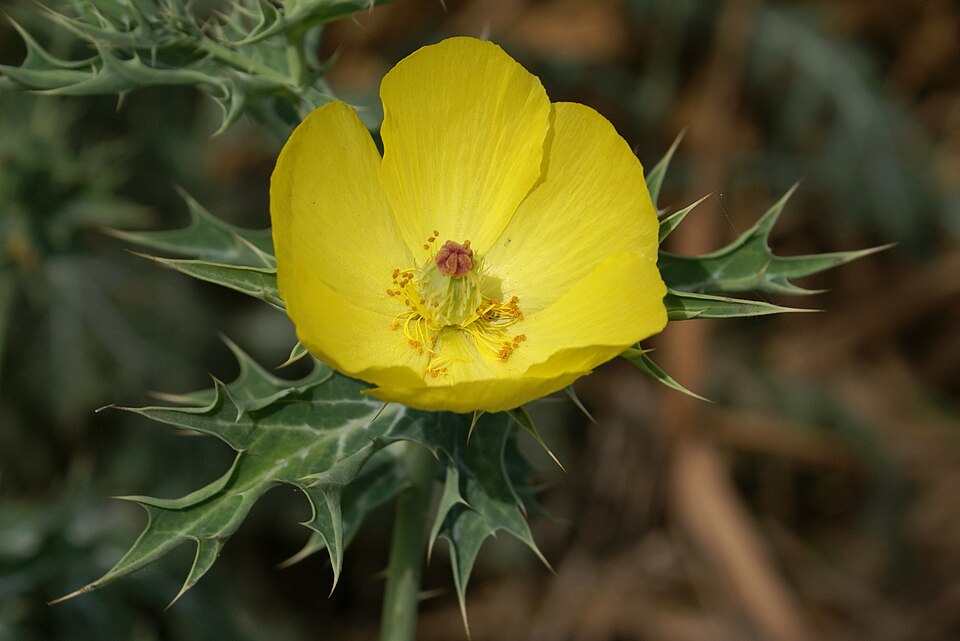
Argemone mexicana, commonly known as Mexican poppy or Prickly Poppy, is a resilient annual or sometimes biennial herbaceous plant belonging to the Papaveraceae family. This species is indigenous to the tropical and subtropical regions of the Americas, but its remarkable adaptability and prolific seed production have led to its naturalization across vast areas of Africa, Asia, and Australia. It frequently thrives in disturbed soils, roadsides, and agricultural wastelands, often becoming an invasive species. Morphologically, Mexican poppy is distinctive for its spiny, glaucous (bluish-green) leaves, which bear a strong resemblance to thistles, characterized by prominent white veins and sharply serrated margins.
The plant typically reaches a height of up to 0.6 meters and is celebrated for its vibrant yellow to orange-yellow flowers. These solitary or small clustered blooms, measuring approximately 2.5 to 5 cm in diameter, exhibit the classic poppy structure. Its fruit is a spiny capsule containing numerous small, black seeds. These seeds, unfortunately, bear a striking resemblance to mustard seeds, leading to dangerous adulteration in mustard oil, which has historically caused severe public health crises like epidemic dropsy.
The plant's stems and leaves, when damaged, exude a characteristic yellow latex, rich in various bioactive compounds. Historically, Argemone mexicana holds significant ethnobotanical value, with traditional medicine systems such as Ayurveda and Unani utilizing it for treating a range of conditions, including skin diseases, jaundice, and malarial fever. Its widespread distribution and increasing scientific interest underscore its potential, despite its known toxicity and invasive nature.
Trusted Scientific References
1. Authoritative external sources for Argemone mexicana
1.1 Wikipedia — Argemone mexicana
1.2 Kew POWO (Plants of the World Online)
1.3 PubMed — peer-reviewed research
1.4 NCBI Taxonomy Browser
1.5 GBIF — Global Biodiversity
1.6Mexican Poppy should be interpreted through verified botanical identity, practical care, and responsible safety language. This recovery note adds the missing context needed for a complete profile: match light to the plant's habit, use well-drained soil, water according to season, and avoid unsupported medicinal or edible claims. For publishing, the plant can be presented as a source-backed medicinal plant with clear care guidance, common problem diagnosis, and conservative safety wording.
1.1.Mexican Poppy — Standout Qualities
- ✓Spiny, glaucous leaves — Spiny, glaucous leaves with white veins.
- ✓Striking yellow or orange — yellow poppy-like flowers.
- ✓Exudes a characteristic — Exudes a characteristic yellow latex when damaged.
- ✓Produces spiny capsules — Produces spiny capsules containing small, black seeds.
- ✓Seeds resemble mustard — Seeds resemble mustard seeds, posing an adulteration risk.
- ✓Contains potent and — Contains potent and toxic isoquinoline alkaloids.
- ✓Native to the — Native to the Americas, widely naturalized globally.
- ✓Adaptable, growing in — Adaptable, growing in dry, disturbed soils and full sun.
- ✓Traditionally used for — Traditionally used for various ailments, despite toxicity.
- ✓Considered an invasive — Considered an invasive weed in many agricultural settings.
1.2.Mexican Poppy — In Brief
- ✓Mexican Poppy is a spiny, yellow-flowered plant native to the Americas.
- ✓Contains toxic isoquinoline alkaloids like sanguinarine and chelerythrine.
- ✓Historically used for skin ailments, pain, and coughs in traditional medicine.
- ✓Known for adulterating mustard oil, causing epidemic dropsy.
- ✓All parts are toxic; internal use is strictly contraindicated.
- ✓Thrives in disturbed, dry, sunny environments.
2.Mexican Poppy — Taxonomic Classification
3.Mexican Poppy — Reference Facts
4.Mexican Poppy — Morphological Account
5.Mexican Poppy — Where It Grows
6.Mexican Poppy — Historical Applications
7.Mexican Poppy — Bioactive Constituents
- ✓Isoquinoline Alkaloids — Key compounds include sanguinarine, chelerythrine, protopine, and berberine, primarily found in the latex and seeds, responsible for the plant's medicinal and toxic effects.
- ✓Sanguinarine — A potent isoquinoline alkaloid known for its antimicrobial, anti-inflammatory, and cytotoxic activities, contributing to traditional uses for skin conditions.
- ✓Chelerythrine — Another significant isoquinoline alkaloid, often co-occurring with sanguinarine, exhibiting similar antimicrobial and cytotoxic properties.
- ✓Protopine — An alkaloid with sedative and antispasmodic actions, which may contribute to the plant's traditional use as a mild pain-killer and muscle relaxant.
- ✓Berberine — Present in some varieties, this alkaloid is renowned for its broad-spectrum antimicrobial, anti-inflammatory, and hypoglycemic properties.
- ✓Fatty Acids — The seed oil is rich in fatty acids such as oleic acid, linoleic acid, and palmitic acid, providing emollient properties and contributing to its purgative effect.
- ✓Phenolic Compounds — Various phenolic acids and flavonoids are present, acting as antioxidants and contributing to the plant's overall phytochemical profile.
- ✓Triterpenoids — These compounds contribute to the plant's defense mechanisms and may possess anti-inflammatory or cytotoxic activities.
- ✓Steroids — Plant steroids are found, which can have hormonal or anti-inflammatory effects.
8.Mexican Poppy — Modern Studies
- ✓Analgesic — The plant contains alkaloids that may offer pain-relieving properties, similar to those found in opium poppy, making it a traditional remedy for various aches.
- ✓Antispasmodic — Certain compounds within Argemone mexicana are believed to help relax muscular spasms and alleviate cramps, contributing to its use in traditional remedies.
- ✓Alterative — Extracts from the root are traditionally used as an alterative, suggesting they can gradually improve the body's overall health through enhanced metabolism and elimination.
- ✓Demulcent — The seed oil possesses demulcent qualities, meaning it can soothe and protect irritated mucous membranes and skin when applied externally.
- ✓Expectorant — The flowers of Mexican poppy have been traditionally employed to promote the expulsion of phlegm from the respiratory tract, aiding in the relief of coughs and chest complaints.
- ✓Purgative — The seed oil is known for its strong purgative effect, inducing bowel evacuation, although this action necessitates extreme caution due to its toxicity.
- ✓Skin Healing — The fresh yellow latex and pounded seeds mixed with oil are traditionally applied topically to treat a variety of skin affections, including warts, cold sores, and itchy conditions.
- ✓Anti-inflammatory — Some alkaloids found in the plant exhibit anti-inflammatory properties, which could contribute to its historical use in alleviating swelling and irritation.
- ✓Anthelmintic — Traditional practices suggest the plant may possess properties effective against intestinal worms, though scientific validation is limited.
- ✓Diuretic — Historically, the plant has been used to address conditions like dropsy, implying a potential diuretic action that helps reduce fluid retention.
8.1.Mexican Poppy — Health Applications
9.Mexican Poppy — Adverse Effects
9.1.Mexican Poppy — Possible Adverse Reactions
- ✓Epidemic Dropsy — Prolonged or accidental ingestion of seed oil, especially as an adulterant in mustard oil, causes severe toxic effects mirroring epidemic dropsy, characterized by edema and cardiac issues.
- ✓Gastrointestinal Distress — Internal consumption can lead to severe gastrointestinal upset, including strong purgative effects, abdominal pain, and vomiting.
- ✓Hallucinogenic Effects — The plant contains alkaloids that may induce hallucinogenic experiences, posing significant neurological risks.
- ✓Skin Irritation — Direct contact with the latex can cause skin irritation or allergic reactions in sensitive individuals.
- ✓Ocular Toxicity — Traditional use for cataracts is highly dangerous and can lead to severe eye damage due to the caustic nature of the latex.
- ✓Alkaloid Poisoning — All parts contain toxic isoquinoline alkaloids, which can cause systemic poisoning, affecting various organ systems if ingested.
9.2.Mexican Poppy — Risk Assessment
- ✓Strict Contraindication for Internal Use — Due to the presence of highly toxic alkaloids and the risk of epidemic dropsy, internal consumption of any part of Argemone mexicana is strongly contraindicated.
- ✓Pregnancy and Lactation — Absolutely contraindicated during pregnancy and breastfeeding due to potential teratogenic and toxic effects on the fetus or infant.
- ✓Children and Vulnerable Populations — Should never be administered to children, elderly, or individuals with compromised health due to extreme toxicity.
- ✓Skin Contact Precaution — Exercise caution when handling the plant; wear gloves to avoid skin irritation from the latex.
- ✓Adulteration Risk — Be acutely aware of the risk of Argemone mexicana seed oil adulterating edible oils, which can lead to severe public health crises.
- ✓Professional Guidance — Any historical or traditional medicinal use must be approached with extreme caution and only under the strict supervision of a qualified medical herbalist or physician, given its high toxicity.
- ✓Drug Interactions — Potential for severe interactions with medications, especially those affecting the cardiovascular or central nervous systems, due to its alkaloid content.
10.Mexican Poppy — Preparation & Dosage
- ✓Topical Latex Application — Fresh yellow latex is applied directly to warts, cold sores, or minor skin irritations, utilizing its protein-dissolving properties.
- ✓Root Decoction for Skin — A decoction prepared from the root is traditionally used internally for chronic skin diseases, acting as an alterative.
- ✓Flower Infusion for Coughs — Infusions made from the flowers are consumed to alleviate coughs and other chest complaints, serving as an expectorant.
- ✓Seed Oil for External Skin Issues — Pounded seeds mixed with mustard oil are applied externally to treat itchy skin and other dermatological problems.
- ✓Seed Infusion (Caution) — In very small, carefully controlled quantities, an infusion of the seeds has been used as a sedative for children, strictly under expert guidance due to toxicity.
- ✓Internal Use for Dropsy/Jaundice (Historical) — Historically, the plant was taken internally for dropsy and jaundice, though this practice is now strongly discouraged due to severe toxicity risks.
- ✓Seed Oil as Purgative (External Only) — The seed oil, known for its purgative effects, is used externally for skin issues, never internally due to its potent and dangerous laxative action.
11.Mexican Poppy — Propagation & Care
- ✓Soil Preference — Thrives in light, sandy, well-drained soils, tolerating nutritionally poor conditions.
- ✓PH Range — Adaptable to mildly acidic, neutral, and mildly alkaline soil pH levels.
- ✓Light Requirements — Requires full sun exposure; cannot grow effectively in shaded environments.
- ✓Water Conditions — Prefers dry to moist soil conditions and exhibits good drought tolerance.
- ✓Propagation — Primarily propagates from seeds, which ripen from July to September.
- ✓Hardiness — Generally hardy to USDA zones 7-10, capable of withstanding moderate frost.
- ✓Growth Habit — A pioneering species, often found in disturbed areas, growing up to 0.6 meters tall.
- ✓Self-Fertile — The plant is hermaphrodite and self-fertile, ensuring efficient reproduction.
Reviewed by the Flora Medical Global Botanical Review Panel
Multi-disciplinary editorial group · Botany · Ethnobotany · Herbal-medicine literature
Who reviewed this: This page was checked by the Flora Medical Global Botanical Review Panel — an in-house editorial group of botany graduates, ethnobotany researchers, and horticulture practitioners who collectively maintain our 7,000+ plant encyclopedia. Meet the team.
Our 4-step verification process
1. Taxonomic verification
Scientific names and synonyms cross-checked against Kew POWO, World Flora Online, and The Plant List.
2. Phytochemical & medicinal cross-reference
Active compounds, traditional uses, and reported activities are cross-referenced with PubMed, USDA Dr. Duke's database, and peer-reviewed ethnobotanical literature.
3. Conservation & distribution check
Distribution, ecology, and conservation status confirmed against GBIF occurrence records and the IUCN Red List.
4. Editorial & safety review
Every entry passes an editorial pass for clarity, originality, and safety notices (toxicity, contraindications, dosage caveats) before publication.
Last reviewed:
Important medical disclaimer: This content is for educational and research purposes only. It is not medical advice and is not a substitute for consultation with a licensed healthcare provider. Do not use any herb to self-treat a medical condition without professional guidance.
Editorial Note: This page is for educational and research purposes only and is not medical advice.
Written by: Flora Medical Global Editorial Team
Reviewed by: Flora Medical Global Botanical Review Panel
Last Updated: June 16, 2026





Mexican Poppy — Comments & Community Reviews
Rate this plant