


Medical Disclaimer: This content is for educational purposes only. It is not medical advice. Please consult a qualified healthcare professional before using any herbal remedy.
Safety Overview
1.Sarpagandha (Indian Snakeroot) — Botanical Snapshot
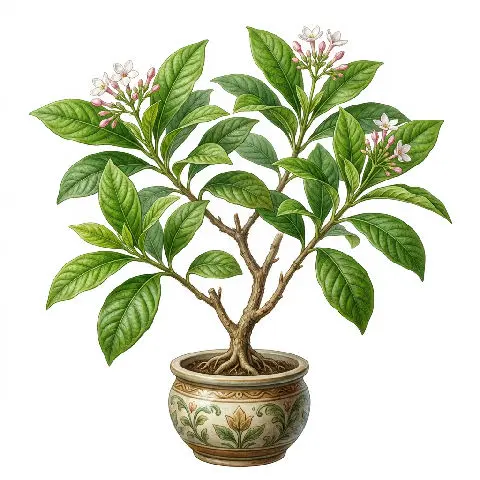
Rauvolfia serpentina, commonly known as Sarpagandha or Indian Snakeroot, is a perennial evergreen shrub belonging to the Apocynaceae family. Typically reaching a height of 1 to 2 meters, it presents lanceolate to elliptical leaves, measuring 8 to 20 cm long and 3 to 7 cm wide, characterized by their glossy dark green upper surface and paler underside, all with smooth margins. The plant produces delicate, fragrant, tubular flowers, ranging from white to pale purple, arranged in axillary or terminal racemes that bloom in clusters during the monsoon season.
Its fruit is a slender follicle, approximately 4 to 6 cm in length, which contains several flat, brown seeds dispersed upon dehiscence. The stem is erect, featuring a light gray to brown bark that is slightly rough to the touch. The root system, which is the primary medicinal part, is tuberous and often twisted.
Indigenous to the tropical and subtropical regions of South and East Asia, Sarpagandha thrives in well-drained, rich soils found in forested environments, along riverbanks, and in grasslands. Its taxonomic classification places it within the Kingdom Plantae, Clade Angiosperms, Order Gentianales, and Family Apocynaceae, highlighting its botanical significance in traditional medicine systems like Ayurveda, where it is highly valued for its tranquilizing and antihypertensive properties.
Trusted Scientific References
1. Authoritative external sources for Rauvolfia serpentina
1.1 Wikipedia — Rauvolfia serpentina
1.2 Kew POWO (Plants of the World Online)
1.3 PubMed — peer-reviewed research
1.4 NCBI Taxonomy Browser
1.5 GBIF — Global Biodiversity
1.6Sarpagandha (Indian Snakeroot) should be interpreted through verified botanical identity, practical care, and responsible safety language. This recovery note adds the missing context needed for a complete profile: match light to the plant's habit, use well-drained soil, water according to season, and avoid unsupported medicinal or edible claims. For publishing, the plant can be presented as a source-backed medicinal plant with clear care guidance, common problem diagnosis, and conservative safety wording.
1.1.Sarpagandha (Indian Snakeroot) — Distinguishing Points
- ✓Potent Antihypertensive Herb — Widely recognized for its blood pressure-lowering capabilities.
- ✓Natural Tranquilizer — Effective in reducing anxiety and promoting mental calmness.
- ✓Rich in Indole Alkaloids — Contains over 50 different alkaloids, with reserpine being the most prominent.
- ✓Endangered Species — Conservation status highlights the need for responsible sourcing and cultivation.
- ✓Traditional Ayurvedic Medicine — Deeply embedded in ancient Indian healing systems for various ailments.
- ✓Sedative and Hypnotic Properties — Aids in managing insomnia and restlessness.
- ✓Significant Drug Interactions — Known to interact with a broad range of pharmaceutical medications.
- ✓Root is Primary Medicinal Part — The plant's therapeutic compounds are concentrated in its roots.
- ✓Native to South and East Asia — Thrives in tropical and subtropical forest environments.
- ✓Requires Expert Supervision — Due to its strong pharmacological actions and potential side effects.
1.2.Sarpagandha (Indian Snakeroot) — In Brief
- ✓Sarpagandha (Rauvolfia serpentina) is a potent Ayurvedic herb known for its antihypertensive and tranquilizing properties.
- ✓Contains powerful indole alkaloids like reserpine, ajmaline, and serpentine, which are responsible for its pharmacological effects.
- ✓Traditionally used for high blood pressure, anxiety, insomnia, and certain neuropsychiatric conditions.
- ✓Classified as an endangered species, requiring sustainable cultivation and conservation efforts.
- ✓Possesses significant side effects including hypotension, bradycardia, and depression, necessitating strict medical supervision.
- ✓Interacts with numerous medications, emphasizing the critical need for professional guidance before use.
2.Sarpagandha (Indian Snakeroot) — Botanical Identity
3.Sarpagandha (Indian Snakeroot) — Fact Sheet
4.Sarpagandha (Indian Snakeroot) — Botanical Description
5.Sarpagandha (Indian Snakeroot) — Ecological Habitat
6.Sarpagandha (Indian Snakeroot) — Heritage Uses
7.Sarpagandha (Indian Snakeroot) — Phytochemistry
- ✓Indole Alkaloids — This is the most significant class, including Reserpine, Ajmaline, Ajmalicine, Serpentine, Serpentinine, and Yohimbine, which are responsible for most of the plant's pharmacological actions.
- ✓Reserpine — A potent antihypertensive and tranquilizing agent that depletes catecholamines (norepinephrine, dopamine, serotonin) from peripheral and central adrenergic neurons.
- ✓Ajmaline — Known for its antiarrhythmic properties, particularly in managing supraventricular and ventricular arrhythmias by affecting cardiac ion channels.
- ✓Serpentine and Ajmalicine — These alkaloids contribute to the plant's hypotensive effects by acting as alpha-adrenergic blocking agents, leading to vasodilation.
- ✓Yohimbine — Present in smaller quantities, it acts as an alpha-2 adrenergic receptor antagonist, with minor contributions to the overall pharmacological profile compared to other alkaloids.
- ✓Flavonoids — These compounds contribute to the plant's antioxidant and anti-inflammatory potential.
- ✓Phenolic Acids — Possess antioxidant activity, helping to neutralize free radicals and protect cellular integrity.
- ✓Saponins — These glycosides may contribute to some of the plant's traditional medicinal uses, although their specific roles are less studied than the alkaloids.
- ✓Phytosterols — Plant sterols found in Rauvolfia serpentina may offer cholesterol-lowering and anti-inflammatory benefits.
8.Sarpagandha (Indian Snakeroot) — Scientific Evidence
- ✓Antihypertensive — Sarpagandha is renowned for its ability to lower high blood pressure, primarily due to alkaloids like reserpine which deplete catecholamine stores in nerve endings, reducing peripheral vascular resistance.
- ✓Anxiolytic — It exhibits significant anxiety-reducing effects by influencing neurotransmitter levels in the brain, leading to a calming and tranquilizing action.
- ✓Sedative and Hypnotic — The plant's constituents can induce a state of relaxation and promote sleep, making it traditionally useful for managing insomnia and restlessness.
- ✓Neuroprotective — Some compounds may offer protection to neuronal cells and support overall brain health, though more research is needed to fully understand these mechanisms.
- ✓Anti-arrhythmic — Alkaloids such as ajmaline have been historically used for their ability to regulate heart rhythm and manage certain cardiac arrhythmias.
- ✓Digestive Aid — In traditional practices, it has been employed to alleviate constipation and other gastrointestinal disturbances, possibly by influencing gut motility.
- ✓Anti-inflammatory — Certain extracts show potential anti-inflammatory properties, which could be beneficial in managing conditions characterized by chronic inflammation.
- ✓Antimicrobial — Traditional uses include addressing infections, suggesting a potential for antimicrobial activity against various pathogens.
- ✓Snake Bite Remedy — Historically, the root was applied topically or consumed as an antidote for snake bites and insect stings, though modern scientific validation is limited.
- ✓Mental Health Support — Beyond anxiety, it has been traditionally used to address certain neuropsychiatric disorders, potentially by modulating dopamine and serotonin pathways.
8.1.Sarpagandha (Indian Snakeroot) — Reported Uses
9.Sarpagandha (Indian Snakeroot) — Safety & Side Effects
9.1.Sarpagandha (Indian Snakeroot) — Side Effects & Warnings
- ✓Low Blood Pressure (Hypotension) — Can cause a significant drop in blood pressure, especially at higher doses or when combined with other hypotensive agents.
- ✓Slow Heart Rate (Bradycardia) — May lead to a dangerously slow heart rate, particularly in susceptible individuals.
- ✓Depression — Long-term use or high doses can induce or exacerbate depressive symptoms, including severe depression.
- ✓Gastrointestinal Irritation — Can irritate the stomach and intestines, potentially causing nausea, vomiting, stomach cramps, or diarrhea.
- ✓Drowsiness and Sedation — May cause significant drowsiness, impairing the ability to drive or operate machinery safely.
- ✓Nasal Congestion — A common side effect attributed to its effect on adrenergic receptors.
- ✓Increased Anxiety — Paradoxically, in some individuals, it might worsen anxiety or agitation.
9.2.Sarpagandha (Indian Snakeroot) — Toxicity Assessment
- ✓Pregnancy and Breastfeeding — Indian Snakeroot is possibly unsafe during pregnancy and breastfeeding as its chemicals can pass to the fetus or infant, potentially causing harm; avoid use.
- ✓Pre-existing Depression — Individuals with a history of depression should avoid Sarpagandha, as it can trigger or worsen depressive episodes.
- ✓Anxiety Disorders — Use with extreme caution in anxiety, as some compounds might paradoxically exacerbate symptoms.
- ✓Cardiovascular Conditions — Individuals with heart disease, low blood pressure, or slow heart rate should use it with extreme caution, due to its profound effects on the cardiovascular system.
- ✓Gastrointestinal Disorders — Contraindicated in those with peptic ulcers, ulcerative colitis, or other inflammatory bowel conditions due to its potential for GI irritation.
- ✓Electroconvulsive Therapy (ECT) — Should not be used in individuals undergoing ECT; discontinue use at least one week prior to therapy.
- ✓Gallbladder Disease — Use with caution as it might worsen symptoms of gallbladder disease.
- ✓Pheochromocytoma — Avoid use as it may increase the risk of dangerously high blood pressure in this condition.
10.Sarpagandha (Indian Snakeroot) — Preparation Methods
- ✓Root Powder — The dried root is traditionally ground into a fine powder, which can be taken orally, often mixed with honey or water, for its antihypertensive and sedative effects.
- ✓Decoctions — A decoction is prepared by boiling the root in water, allowing for the extraction of its active compounds, commonly used in Ayurvedic practices.
- ✓Tinctures — Alcoholic extracts of the Sarpagandha root are prepared to concentrate its alkaloids, offering a potent form for medicinal use.
- ✓Standardized Extracts — Modern formulations often use standardized extracts, ensuring a consistent concentration of key active alkaloids like reserpine or ajmaline for precise dosing.
- ✓Topical Applications — Historically, pastes made from the root were applied externally for snake bites, insect stings, and certain skin conditions.
- ✓Capsules and Tablets — For convenience and controlled dosage, Sarpagandha extracts are available in capsule or tablet form, particularly in the supplement market.
- ✓Expert Consultation — Due to its potent pharmacological activity and potential for serious side effects, Sarpagandha should only be used under the strict guidance of a qualified medical herbalist or healthcare professional.
- ✓Avoid Self-Medication — Given its powerful constituents, self-medication with Sarpagandha is strongly discouraged to prevent adverse reactions and drug interactions.
11.Sarpagandha (Indian Snakeroot) — Cultivation & Care
- ✓Propagation — Can be propagated through seeds, stem cuttings, or root cuttings, with seed germination often requiring specific pre-treatment for higher success rates.
- ✓Soil Requirements — Prefers well-drained, rich, loamy soils with a slightly acidic to neutral pH (6.0-7.0), mimicking its natural forest floor habitat.
- ✓Climate and Light — Thrives in tropical and subtropical climates, requiring partial shade to full shade conditions and consistent warmth; direct intense sunlight can hinder growth and alkaloid production.
- ✓Watering — Requires regular and consistent moisture, especially during dry spells, but is susceptible to root rot in waterlogged conditions.
- ✓Fertilization — Benefits from organic matter enrichment and balanced fertilization, particularly during its active growth phases.
- ✓Pest and Disease Management — Generally robust, but susceptible to fungal infections in overly humid conditions and occasional insect pests, requiring organic pest control methods.
- ✓Harvesting — The roots are typically harvested after 2-3 years of growth when alkaloid content is optimal, usually during the dry season for easier processing.
- ✓Conservation — Due to its endangered status, sustainable harvesting practices and cultivation efforts are crucial to prevent overexploitation and ensure its long-term survival.
Reviewed by the Flora Medical Global Botanical Review Panel
Multi-disciplinary editorial group · Botany · Ethnobotany · Herbal-medicine literature
Who reviewed this: This page was checked by the Flora Medical Global Botanical Review Panel — an in-house editorial group of botany graduates, ethnobotany researchers, and horticulture practitioners who collectively maintain our 7,000+ plant encyclopedia. Meet the team.
Our 4-step verification process
1. Taxonomic verification
Scientific names and synonyms cross-checked against Kew POWO, World Flora Online, and The Plant List.
2. Phytochemical & medicinal cross-reference
Active compounds, traditional uses, and reported activities are cross-referenced with PubMed, USDA Dr. Duke's database, and peer-reviewed ethnobotanical literature.
3. Conservation & distribution check
Distribution, ecology, and conservation status confirmed against GBIF occurrence records and the IUCN Red List.
4. Editorial & safety review
Every entry passes an editorial pass for clarity, originality, and safety notices (toxicity, contraindications, dosage caveats) before publication.
Last reviewed:
Important medical disclaimer: This content is for educational and research purposes only. It is not medical advice and is not a substitute for consultation with a licensed healthcare provider. Do not use any herb to self-treat a medical condition without professional guidance.
Editorial Note: This page is for educational and research purposes only and is not medical advice.
Written by: Flora Medical Global Editorial Team
Reviewed by: Flora Medical Global Botanical Review Panel
Last Updated: June 16, 2026





Sarpagandha (Indian Snakeroot) — Comments & Community Reviews
Rate this plant